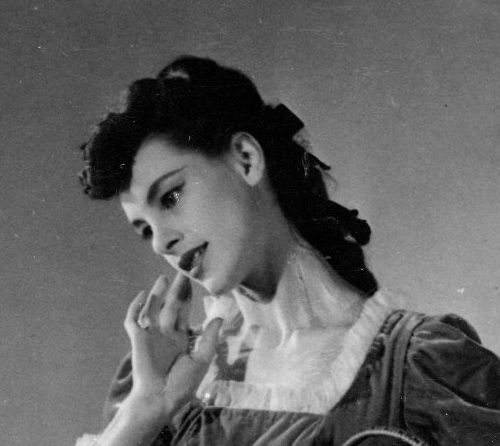
Rowena Jackson and Philip Chatfield
This gorgeous couple, infectiously happy and loving and warm, not surprisingly became special “voices” for British ballet. They were stars of The Royal Ballet at a remarkable point of that company’s history and contributed hugely to its success. This conversation between the couple and Patricia Linton, founder and director of Voices of British Ballet, was recorded in 2006. The episode is introduced by Monica Mason.
First published: March 10, 2026
Biography
Rowena Jackson b. 1926 d. 2024; Dancer, teacher and director
Rowena Jackson was born in Invercargill, New Zealand, in 1926. She originally studied ballet with Rosetta Powell and Stan Lawson and for her academic studies attended the Epsom Girls’ Grammar School in Auckland. In 1941, Rowena won the very first Royal Academy of Dancing Scholarship to be awarded in New Zealand. She travelled to London and joined the Sadler’s Wells Ballet School in 1946 and won the Adeline Genée Gold Medal in 1947, the same year she joined the Sadler’s Wells (later Royal) Ballet at Covent Garden.
By 1954 Rowena had been promoted to the rank of principal dancer and performed most of the ballerina roles in the repertoire at that time. She was especially noted for her interpretation of Swanhilda in Coppélia and was also famous for her ability to pirouette, both alone and supported. There is proof in film of her ability to perform fast and brilliant turns with a repetition of single and double fouettés for the whole of Odile’s 32 fouettés in the third act of Swan Lake, something that was seldom attempted in those days. Before she left New Zealand for England, Rowena had set a World Record of 121 consecutive fouettés without a break.
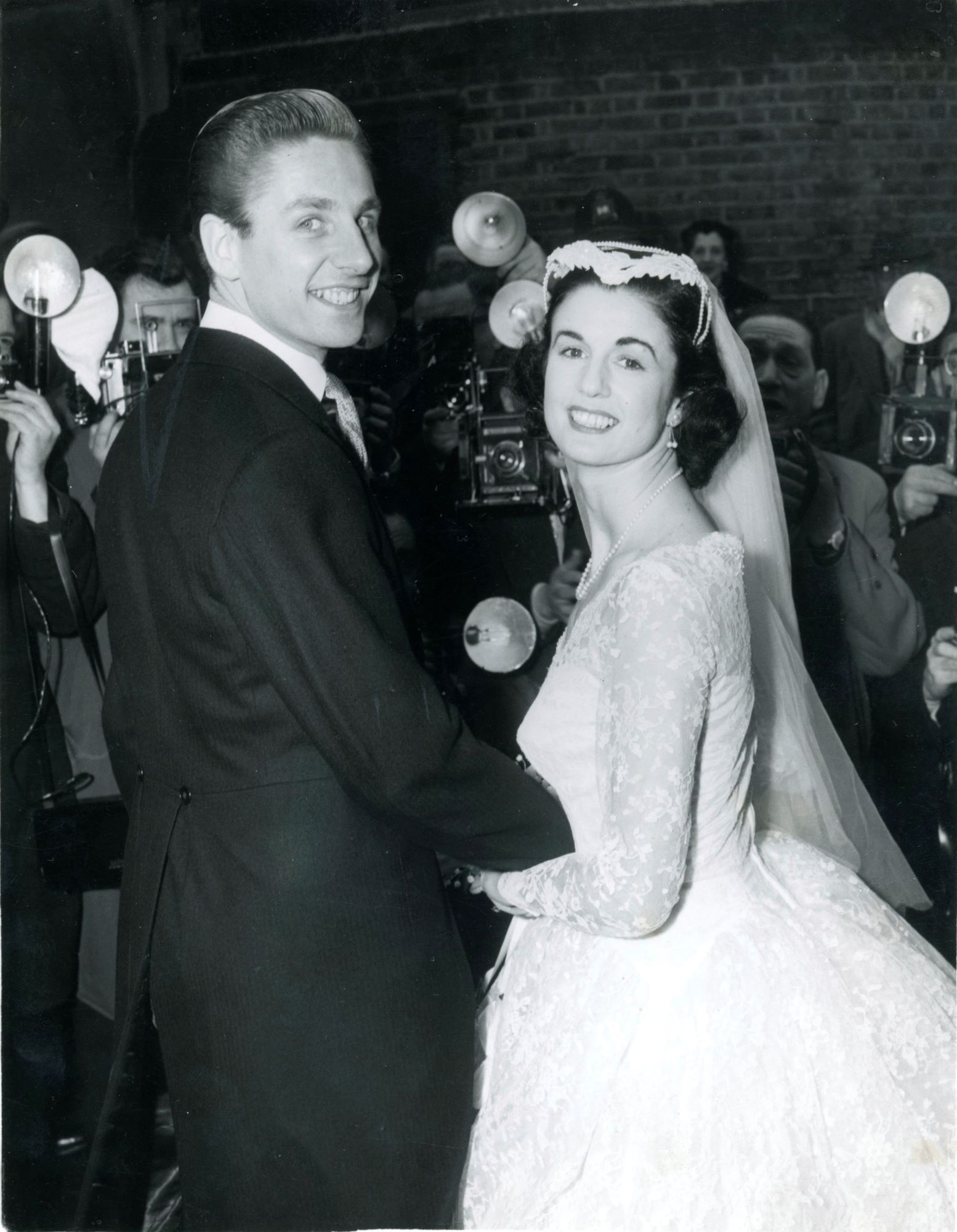
Early in 1958 Rowena married fellow Royal Ballet principal, Philip Chatfield. That same year they danced together in The Royal Ballet’s Giselle. They both retired in 1959 and moved to New Zealand. In 1961 Rowena was awarded an MBE. In 1972, she and Philip became directors of the National School of Ballet in Wellington. They eventually moved to Australia but continued to teach until well into their eighties. The couple had two children. Rowena died in 2024.
Philip Chatfield b. 1927 d. 2021; Dancer, teacher and director
Philip Chatfield was born in Eastleigh, Hampshire, in 1927. He first studied at the Elfin School of Dancing before getting a scholarship to the Sadler’s Wells Ballet School. He joined the Sadler’s Wells Ballet in 1943 and danced in a wide range of ballets. In 1944 he joined the Armed Forces and returned from service to re-join the Sadler’s Wells (now Royal) Ballet at Covent Garden in 1946. He travelled extensively with the company and was on the famous tour to the United States of America in 1949. He became a principal in 1953, married Rowena Jackson, a ballerina with the company in 1958, and retired in 1959 to New Zealand. In 1972 he and Rowena became joint directors of the National School of Ballet in Wellington, and they later went on to direct the Royal New Zealand Ballet. They retired again, this time to Australia where they made their home. Both Philip and Rowena continued to teach and coach for many years. Philip died in 2021
Transcript
in conversation with Patricia Linton
PHILIP CHATFIELD: Well, I was born in Eastleigh, Hampshire. My father worked on the railway. All my schoolmates were destined to work on the railway, and my father, who hated the railway, said, “He can do anything he likes except work on the railway.” So, that gave me carte blanche, and when I wanted to be a ballet dancer, my father didn’t object one little bit. [Laughter]
ROWENA JACKSON: I was born in Invercargill [in New Zealand] in 1926 and as a young thing, around about the age of five, I had quite bad bronchitis and the doctor said, “Send her somewhere where she will get plenty of exercise”. And, of course, like a little girl, I loved flitting about and everything, and my mother sent me to dancing school.
PHILIP CHATFIELD: My parents bought me an His Master’s Voice wind-up gramophone when I was four, and I was [so] captivated with the music, I started to wear out the carpet in the front room by twirling around to the music, so my mother thought it would be safer for me to go to a ballet school. So, I went to the local one, which had the incredible name of The Elfin School of Dancing, and I was the only boy there.
ROWENA JACKSON: My father, he was in the post and telegraph office. He was moved to Dunedin, so the whole family moved to Dunedin when I was only six. I went to a ballet school there run by someone called Rosetta Powell and Stan Lawson – they were in partnership, and they used to produce the old shows like Rosemarie and New Moon and all those old shows in Dunedin. There was no television, of course, in those days, and I became the principal dancer, even as a little girl…
PHILIP CHATFIELD: Then my mother wrote to Ninette de Valois when she saw in the paper that she was looking for young boys to give scholarships to, so I went up to London, was awarded a scholarship for five years, at the age of 11 and I was the only boy in the school for about a year, under the tutorship of Ninette de Valois, Ursula Moreton and, of course, Nikolai [Nicholas] Sergeyev.
ROWENA JACKSON: The Russian Ballet came out to New Zealand. The Ballet Russe. Yes. That Colonel de Basil, and the Monte Carlo. And who was with them, of course, but Irina Baronova and Anton Dolin and David Lichine and Riabouchinska, Tania Riabouchinska, and this was the first real ballet I had ever seen, and of course then I wanted to do ballet as a profession and become a ballerina.
PHILIP CHATFIELD: I’d come up on the milk train at six o’ clock in the morning, catch the 67 bus from Waterloo to Sadler’s Wells theatre, run up 94 stairs, get into my tights, go down to class, and I was absolutely trembling, and Sergeyev would say to me, “Allez, allez Philip, jelly, jelly, jelly”, because my legs were shaking. He was really very nice. He used to stroke my face, and he was a very gentle man, but what a hard teacher. Oh dear! And, I really wasn’t ready for Russian training at that point, but I was very grateful to have it. And he had a big stick, a bamboo stick, and he used to whack you.
ROWENA JACKSON: I had to do my exams, of course. I was doing the Royal Academy of Dancing examinations, and I sat my Solo Seal from Auckland, and I think I was only about 15 then, and I went for the Royal Academy scholarship, and won that. I was the first New Zealander to win the scholarship, but, of course, I couldn’t take it up because the war was on. It was 1942. However, the war did finally finish, and I went off to England, and went to the Sadler’s Wells [Ballet] School. And, of course, I was then 19. I wasn’t a youngster, and when I went to the school, you know, they were all 15, 16, and here was I, 19, in my little garb panties and things. [Laughter] The tunic, you know.
PHILIP CHATFIELD: And then after a year, I think, Ray Powell came to class, and he’d never danced in his life, and within three months he was in the company. Which I thought… I was very upset about. And he was already doing the Gravedigger in Hamlet, and he stayed with the company from then on. So, eventually, other boys did come to the school. Douglas Stewart, Eric Hyrst, people like that.
PATRICIA LINTON: Were you aware of the company at this time? Because Sergeyev must have been… in 1939, he must have been putting on The Sleeping Princess?
PHILIP CHATFIELD: Yes, he was. I went down and watched a rehearsal of Sleeping Princess with Margot Fonteyn, and I thought she was absolutely wonderful, but I was in it myself. On my 14th birthday, I left school and I was the little boy with the drum in Nutcracker on my 14th birthday and then I was in The Wanderer. It would be nothing for me to be just leaving the school, and the stage doorman would say, “You have to go to the New Theatre because they want you to dance tonight,” and I had to go in, and they wanted me as the little boy in The Wanderer as Robert Helpmann when he was a youngster, chasing Margaret Dale. So, I had to learn that in about ten minutes.
PATRICIA LINTON: And this is an Ashton ballet?
PHILIP CHATFIELD: Yes.
PATRICIA LINTON: And you’re still not in the company at this stage?
PHILIP CHATFIELD: No, I wasn’t in the company.
PATRICIA LINTON: But were you aware of Frederick Ashton?
PHILIP CHATFIELD: He used to come back dressed in [his] Air Force uniform and do things like The Quest and things like that.
PATRICIA LINTON: Because he had already been called up at the time?
PHILIP CHATFIELD: Yes. Everybody had been called up. There was virtually… hardly anybody in the company.
PATRICIA LINTON: How did the school and the company keep going, do you think?
PHILIP CHATFIELD: Well, there were plenty of girls, and three or four boys in the end, and then they put on The Bartered Bride for the opera company, and I appeared as the Horse Clown in that with Anita Phillips and Brian Shaw, and they took me out of that and took me straight into the company for Miracle in the Gorbals. Now, I’d had a knee injury which was getting worse, and before the first night of Miracle in the Gorbals, I was sent home for two months. I actually stayed [at] home [for] two years, and Brian Shaw took my place in Miracle in the Gorbals. Now, the extraordinary thing is that after the war, when my knee injury was well enough to go back to dancing, Brian Shaw went into the Army, and I took his place in Symphonic Variations. Having been off two years, they put me in Symphonic Variations.
ROWENA JACKSON: It’s funny, I was a turner. We always used to do fouettés at the end of class. Now, my teachers, they always said to me, “See how many circles of turns you can do. It doesn’t matter what you do. See how many”.
PHILIP CHATFIELD: I might say that the first day I saw Rowena do the fouettés in the Chalk Farm school, she did at least 72!
ROWENA JACKSON: Well, I’ll tell the story about that one, because, you know, they always do fouettés at the end of class. And so, they said, “All right, fouettés everyone”. Some got to 16, and then they stopped, and some tried a bit further, and I did my 32 and I was still going strong, you know.
PATRICIA LINTON: You’d only started.
ROWENA JACKSON: Then I got to 64, and everybody was sort of going, “Ahem”, you know, and I’m 64, and then I’m 70, and by this time I’m beginning to feel a little bit uncomfortable, because, you know, it seemed ages and nobody was doing anything, and I sort of… you know, and I can always remember… I think I did probably about 80 and stopped. I didn’t… you know, I suddenly felt it wasn’t… it wasn’t quite right, because, I mean, I had done 121. That was my [Guiness] Book of [World] Records one that I had done…
PATRICIA LINTON: That must be the record of all time, surely?
ROWENA JACKSON: No, it’s been surpassed, because I’m not in the Book of Records for fouettés now, somebody else is. They’ve gone over the 121. So that’s good.
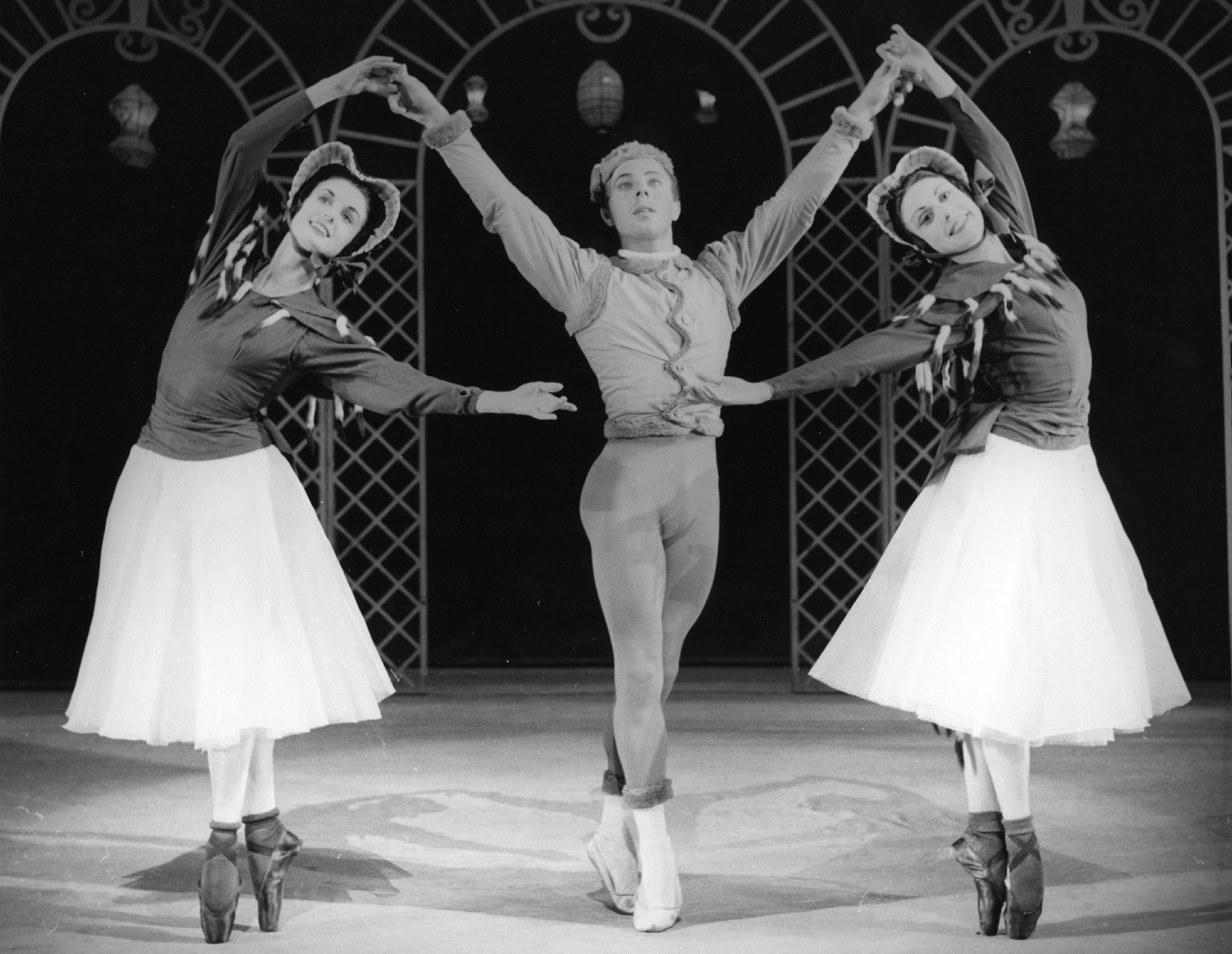
And then the next week [Ninette] de Valois had to come in, didn’t she. Word had got around, but de Valois clapped on her chair, you know, “Very good, darling,” she said, you know. And then it eventually got to Fred, of course, for Les Patineurs, and so I was cast…
PATRICIA LINTON: Quickly made a Blue Girl [in Les Patineurs]. Any secrets you can tell us about the fouetté?
ROWENA JACKSON: Whether it’s the old school, or however? I was taught fouettés, I feel, really [it] is the only way that you should do fouettés, but I know the Russians have a… you know, where they relevé in the second before they turn. They relevé up onto pointe, and then turn and I never ever, ever did that. The fouetté movement was from the fourth crossed en l’air sweeping to the side on a full fondu and then a complete whip up onto relevé, into the retiré and around.
PATRICIA LINTON: And into the turn?
ROWENA JACKSON: All at the same time. That’s the way I did my fouettés, and I still maintain that that is the way to do good fouettés, and fouettés have to have a whip in them. But if you’re en pointe in the second position, in the open second position, en l’air, how can you get a whip from your pointe shoe which is up en pointe? You’ve got to get it from the flat foot up onto the relevé as you go around.
PATRICIA LINTON: We ought to talk about your partners, Philip.
PHILIP CHATFIELD: Yes. Now, I had Beryl Grey, who was my pride and joy. I adored doing Swan Lake with her. I did her last Swan Lake with her… And then, of course, I inherited the beautiful [Svetlana] Beriosova, as well. But I also did Anya Linden’s first… partner her in Giselle, her first Giselle. I partnered [Alicia] Markova in Sleeping Beauty. I think I was the last person in the world to partner her in a tutu. Yes. And, of course, Violetta Elvin and also my own lovely wife. I partnered her lots and lots of times. And she was the easiest of the lot, because you only stood behind her and she did six or seven pirouettes and you just put your hand out and stopped her. You never had to put her on to balance or anything like. She was very light to lift. Very light to lift.
ROWENA JACKSON: Not very good now. [Laughter]
PHILIP CHATFIELD: And we did the whole Australian tour for five months. Australia and New Zealand in 1958, ’59, and we did all the Swan Lakes, Coppélias, Sleeping Beauty… not Sleeping Beauty, [Les] Sylphides, all the big ballets. We loved it. We were on our honeymoon. [Laughter] Because we got married in February and we were on tour in September, which was good. But in London we did Sleeping Beauty together, and the audience loved it, because we were husband and wife. And we were the only principal dancers that were married in the company.
PATRICIA LINTON: Did you learn [to partner] by, sort of, accident?
PHILIP CHATFIELD: My first partner, funnily enough, to laugh, was Robert Helpmann, because I had to run on to the stage in The Wanderer, do a chassé coupé jeté turn, and he lifted me up in the air, so I could say Robert Helpmann was my first partner. [Laughter] It was a lovely feeling, going up. [Laughter] I never had it again, unfortunately. I always had to lift, instead of be lifted. So, I learned pas de deux, really, from when I joined the company.
PATRICIA LINTON: And how do you adjust for different women?
PHILIP CHATFIELD: It’s quite difficult, because Beryl was very tall, so her waist was very high, and then I’d suddenly have Margaret Dale or Violetta Elvin and they’re way down low. One of them shoots off to the left on a pirouette and the other one sits like a duck waiting to be pushed, you know. You have to know them all and you have to please them all. They all want something different.
PATRICIA LINTON: You were both in the main [Royal Ballet] company, weren’t you, but it sounds like you did quite a bit of touring in this time?
PHILIP CHATFIELD: Oh yes, we toured in England and we toured abroad. The abroad tours were wonderful, of course. We weren’t so fond of Huddersfield and Hanley.
ROWENA JACKSON: Glasgow.
PHILIP CHATFIELD: And Ashton-under-Lyne, which rather got a laugh from the company. [Laughter] We should say Ashton under Somes!
ROWENA JACKSON: I didn’t see that. [Laughter]
PATRICIA LINTON: Why?
PHILIP CHATFIELD: I often wondered that. [Laughter]
ROWENA JACKSON: The tours were wonderful, actually. We had our own train in the [United] States, you know, with all the orchestra and the stage crew and everybody, and the scenery, it all went on the train. Well, that was really five months.
PHILIP CHATFIELD: We’d dance in cinemas that hadn’t had shows for years, and the showers were all rusty water, and…
ROWENA JACKSON: We used to do long journeys.
PHILIP CHATFIELD: Oh yes, we did. Right across the Rockies from one side of Canada to the other.
ROWENA JACKSON: And the train used to get what was called a “hot box”, where it used to have to stop and cool off, you know, and we all got out, I can remember.
PATRICIA LINTON: So, you were both in the company for the 1949 Sleeping Beauty [at the Metropolitan Opera House in New York]?
ROWENA JACKSON: 1949 Sleeping Beauty? We must have been, yes. It was…
PHILIP CHATFIELD: The one we took to America? Yes. It was very enjoyable to do. It made Margot Fonteyn a world star, to begin with.
ROWENA JACKSON: It was so exciting.
PHILIP CHATFIELD: And we witnessed that.
ROWENA JACKSON: Yes.
PHILIP CHATFIELD: And the whole glamour of everything was wonderful. The performance went beautifully. The audience went mad, even the man wearing a tiara, and, I mean, we’d never seen anything like it. And, of course, afterwards we had this motorbike thing… Cavalcade to the Mayor of New York’s mansion, and we had this incredible party, you know.
ROWENA JACKSON: Yes. It was very exciting.
PHILIP CHATFIELD: It was all so wonderful.
ROWENA JACKSON: You know, all these sirens going, and it was The Royal Ballet going off to this party. [Laughter]
The transcript of this podcast may have been lightly edited for ease of reading.
You may also like...
Dudley Simpson
Federico Bonelli