David Bintley
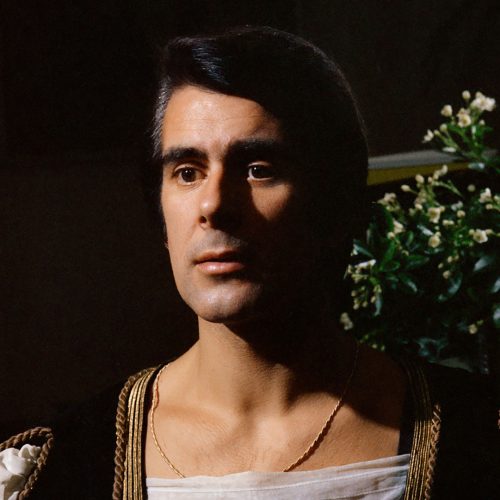
David Bintley tells dancer and director Bruce Sansom, in this interview recorded at the Birmingham Hippodrome in 2005, how he was hooked on ballet from the age of 12, and how what particularly attracted him were roles which made a powerful dramatic impact. After studying in his native Yorkshire, he went to The Royal Ballet School, where he won a choreographic competition that was judged by Kenneth MacMillan. This led to his joining Sadler’s Wells [now Birmingham] Royal Ballet, and he tells us about some of his male Yorkshire contemporaries who also made it into the world of professional ballet, as well as his grandfather’s pride in what he was doing. The interview is introduced by former Birmingham Royal Ballet principal and assistant director, Marion Tait.
First published: November 10, 2026
Biography
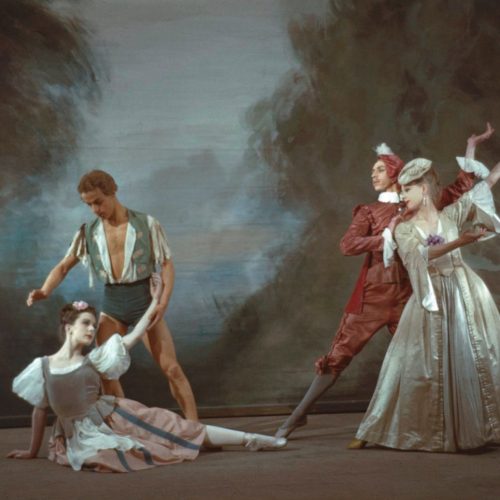
David Bintley was born in Huddersfield in 1976. Fascinated by ballet and its dramatic power from the age of 12, he studied with local teachers before going to the Upper School of The Royal Ballet School. While there he won a choreographic competition that was judged by Kenneth MacMillan, as a result of which he was offered a job with Sadler’s Wells Royal Ballet (SWRB) in 1976. Bintley was praised for his performances in such roles as Petrushka, Carabosse in The Sleeping Beauty, the Red King in Checkmate, Alain and Widow Simone in La Fille mal gardée and a Step Sister in Cinderella. His first major choreographic work, The Outsider, was performed by SWRB in 1978.
From 1986 until 1993, Bintley was resident choreographer for The Royal Ballet at Covent Garden, where an early success was ‘Still Life’ at the Penguin Café in 1988. This was followed by Hobson’s Choice, for SWRB, in 1989. In 1995 he was appointed artistic director of Birmingham Royal Ballet (as Sadler’s Wells Royal Ballet had become). He held this position until his retirement in 2019, by which time he had created ten full-length and 12 one-act ballets for the company. From 2010 until 2014 he was also artistic director of the National Ballet of Japan, dividing his time between the two companies.
During his choreographic career Bintley worked with a number of companies, including Stuttgart Ballet, San Francisco Ballet and Sarasota Ballet. He was particularly noted for his full-length works, such as Edward II, Cinderella, Cyrano, Beauty and the Beast and The Tempest. He was appointed CBE in 2001 and was knighted for services to dance in 2020.
Transcript
in conversation with Bruce Sansom
DAVID BINTLEY: First thing I used to do [was] the dance festivals. So, I used to have all these numbers and solos that I used to go around doing.
BRUCE SANSOM: So, these are competitions?
DAVID BINTLEY: Competitions. Yeah.
BRUCE SANSOM: But at what age at this point?
DAVID BINTLEY: I guess I must have been 12. Twelve, yeah. I got to a point, from that point, where I actually got hooked on ballet and there were two things that did it. It was that… I think it was that Petrushka performance which sort of sparked off so much interest for me in the ballet – in the history of the ballet; in [Serge] Diaghilev, in the formation of British ballet. One of the solos that I did… I’d done a character solo, dreadful character solo, called the “Great Misto” and I wanted a different one. And I said I want to do The Rake’s Progress because I’d just seen pictures of The Rake’s Progress in a book. And I think I ended up playing cards with the devil or something. I don’t know who’s the idea the devil was, but I ended up playing cards with the devil, I think, and losing everything and going mad. In two minutes! That’s how long it was!
But that’s, you know, that was my idea and this is what I think is indicative of how much I was interested in, in that period of ballet, and in these great characters from ballet. I didn’t want to, kind of, leap around in it in a blouson sleeved thing just doing steps. I was interested in Petrushka, in the Rake.
And the other thing was, is that in getting interested in it. Loads and loads of people were saying, because this wasn’t a very good ballet school, “You can’t do that, you’ve got to…”, you know, “You can’t do that”, you know, “good enough and,” you know, “you’ve got to be really”, you know, “you’ve got to be really brilliant, to be Rudolf Nureyev and everything” you know?
I don’t think they realised that there was a level, somewhere, between me at that time and Rudolf, you know, that there was a bit of work to be done. You know you didn’t that kind of… So, that was another thing really that people kept saying, “Oh, you don’t want to do that,” you know, “you want to be Tommy Steele!”
And I kind of flew against that. And the more that people said I couldn’t do that the more determined I was to do it. So, then I just looked round to find proper ballet teachers and the first one that came up was a teacher in Manchester, Muriel Tweedy. And I used to go there on a Saturday and do two full classes and a private lesson. So, I was working hard trying to catch up and loved it.
BRUCE SANSOM: What, you’re 12 or 13 now that you’re looking around?
DAVID BINTLEY: Yes. Yes, I really… at that point I just thought I want to be part of this. I want to go to The Royal Ballet School.
BRUCE SANSOM: How did you find out about The Royal Ballet School?
DAVID BINTLEY: I had been to Muriel Tweedie’s. I then found a class closer, which was Dorothy Stephens, who’s a good teacher. And there were a couple of boys there. Boys who both went to The Royal Ballet School eventually and eventually worked professionally. And really, it was really nice there because Dorothy was really mad about dance, you know? She was one of these dance widows, never married, you know, married to the job. And it was a purely ballet school and she sent people to Royal Ballet [School] auditions.
BRUCE SANSOM: But had you heard of the school?
DAVID BINTLEY: I mean, [I] had heard of The Royal Ballet because, you know, I used to go. I used to go to the Hippodrome – No, the [Bradford] Alhambra, and to Leeds Grand [Theatre] all that time. And then I started watching the [Royal Ballet] New Group, or whatever it was called, and watching, you know, what I called, kind of, quality and interesting repertoire because, you know, [London] Festival Ballet wasn’t. It was the usual stuff.
But then I first had my first taste of Hans Van Manen, and things like that. Things that they were doing. I saw Rake [’s Progress] in at Leeds Grand. So, all these pieces that I, kind of, read of and the New Group, and there were better dancers, you know? They were better dancers – Kerrison Cooke, Stephen Jefferies and Paul Clarke. Nicky Johnson, Patti Ruanne and, you know, really, really good dancers.
And so, that’s what I wanted to do, and Dorothy had – they had the Dancing Times [magazine]. So, at that point I’d said to my mum, “I want to get the Dancing Times”. So, we got the Dancing Times and, of course, it had all the auditions and things like that. And that was it, really. And I don’t remember a point when that was actually said, you know, it was just, you know, that that’s why we were there. That’s why I was there. John Carney was there and Eric Gibson was older than us. I think it was about 21, or something, when he went to school. I was from Leeds and he was a welder’s mate, and he just absolutely fell in love with ballet. Straight as a die. Absolute. Leeds Yorkshire bloke. And poor lad, he got into when he got into The Royal Ballet School and there was a picture in the Yorkshire Post of him standing doing an attitude with welding gear and a welder’s helmet on, tipped up in woolly tights. And a good thing about our year was we all got jobs. A lot of us got into the [Royal Ballet] company.
At the end of the first year, we did this kind of end-of-term party performance which somebody’d got together – I think was Michael Pink. I think Michael Pink, who was the year above me, wanted… Well, apart from being a superstar, you know, Michael could do everything. I think he wanted to sing “My Way”, can you believe it? I think he wanted to sing “My Way” and he did at the end! Completely straight, with a bow tie on. Unbelievable! Anyway, he got this performance together of kids in the school to do this performance. I did “Emcee” from Cabaret with all the stuff. And, you know, I was good at it. I mean, I was really good at it. Good as acting it. Good vocally. A good performer. I’d spent my whole life doing this. I haven’t had one single solitary opportunity all the time I had been there to show any of that. I really hadn’t. So, you know, there was a… suddenly there was a… there was a different person. Not just this kind of odd bod with a bust-up knee who could be a pain in the ass at times. There was somebody that could do something.
So, the next thing that I did was I entered the Ursula Moreton [choreographic competition], and I did a piece for 12 boys or something. It was called Dulce et Decorum est Pro Patria in Mori, which is from a Wilfred Owen poem. And it was about war, of course. I was 19. That’s what you make ballets about: war! And that had me featuring in it, and James Smith featuring in it, largely because it was very difficult to get to 12 boys together to make a piece like that. Kenneth [MacMillan] judged it, gave it to me.
And then that’s really when the word got around to somebody that they can do something here. Nobody [had] heard of me. I mean, none of the companies or anything had really heard of me at all. And it was really… Probably, a matter of a day or two at the most before I got summoned to Barbara Fewster’s office and she said to me that the companies are interested because of the choreography. That was it. From that point onwards my life completely and utterly changed.
BRUCE SANSOM: So, this is sort of 1975-1976?
DAVID BINTLEY: It would have been Christmas ’75 yes. It literally was just that, from that performance and within a couple of days, you know, I was choreographing for The Royal Ballet Choreographic Group. I was appearing at the Royal Opera House not only doing numbers I’d done before but doing, you know, being entrusted with, you know, the stage and I was being kept for one of the companies. And also, very quickly after that, they [The Royal Ballet School] said we’re doing Coppélia for the [annual school] matinee.
BRUCE SANSOM: So, this was this annual school performance. This was in your second year or your third year?
DAVID BINTLEY: Second.
BRUCE SANSOM: And it was just a two-year course? Then you go into the company?
DAVID BINTLEY: No. They had three years, but it was very much the norm that most people left after the second.
BRUCE SANSOM: When did you start at the Wells [with Sadler’s Wells Royal Ballet]? What can you remember from day one, week one?
DAVID BINTLEY: Day one was at The Royal Ballet School, actually. We were rehearsing down [there] because, you know, at that time the company was fairly homeless. The Wells… There might have been in the company in that time, we had a five-week rehearsal period, five or six-week rehearsal period before performances. So, we were down, did my first class in the company studio down at Barons Court, and that’s where we started doing the first rehearsals. I can remember going in there and wondering where on earth I should stand. Strange.
BRUCE SANSOM: Was it a very territorial company?
DAVID BINTLEY: Do you know when I joined the company, I’m not – or at least I am – I don’t make friends easily. I’m not an open kind of person in that respect, although I’m a very different person now. But then, you know, there was a mixture in me, I suppose, of some determination. Ambition. And I was not confident, and I think that when I see people join my company, and I see the people who instantly become part of the company, I was not one of those people. And I can see it in some of the people that join the company. And it’s… and I see how easily it can be misinterpreted. And I definitely think that there were some people that misinterpreted that in the first year or so.
BRUCE SANSOM: What else can you remember for those first couple of years? The roles that you did?
DAVID BINTLEY: It was really nice because I did have some meaty things very early. I mean I joined in ’76. So, I did… I know it’s going a little bit on, but I did things. I did my first Widow [Simone in La Fille mal gardée] in 1980. So, I mean, I was, you know, I’m still very young. I don’t think anybody had done it that young. Fille was actually the very first thing that I did. That was the first ballet that we did. And I was doing – get this! – I was doing “Big Boys” because of an injury, and I was thrown on in “Big Boys”. So, that was the very first performance that I did at Sadlers Wells, was “Big Boys” in Fille mal gardée.
My grandfather had been ill for quite some time. When I used to go [and] do the dance competitions and things, my grandfather was pretty ill from about 40 onwards. I think he had a heart attack, and he was very young and so he’d been, kind of, semi-invalid, didn’t leave the house much. As we used to drive through the village to go off to competitions, and things like that, my granddad would come to the door and just wave and do that every time and it became like a talisman he had to do and that, you know, I had to drive past doing that and my granddad. And I remember him. He always said that he was going to see me dance one last time because he got quite ill, and everything, and he died at 7.30 that night.
BRUCE SANSOM: Curtain up.
DAVID BINTLEY: Yeah, and just as the doors opened and the “Big Boys” walked through the doors. And so, we always like to think that that he’d popped down to the Wells and hovered there for a while before. So, yeah. So, that was a bittersweet moment.
You may also like...
Marcia Haydée
Donald MacLeary