Christopher Bruce
Christopher Bruce is one of the great names in British dance. Here, in a conversation with the dance critic Mark Monahan in 2017, he describes his early days in Ballet Rambert, and his relationship with Marie Rambert herself. He talks about the transition of the Rambert company from classical to a contemporary dance ensemble and locates his own work within that framework. He also speaks warmly of Norman Morrice, and of Morrice’s important, but sometimes overlooked, role in the development of Ballet Rambert. The interview is introduced by Mark Monahan.
First published: June 16, 2026
Biography
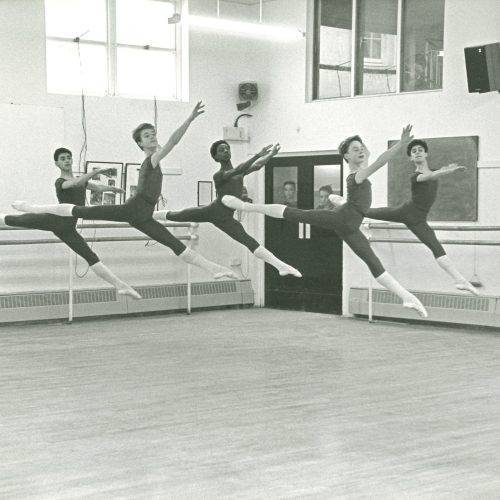
Christopher Bruce was born in Leicester in 1945. He began studying dance at the Ballet Rambert School in 1956, and joined Ballet Rambert in 1963, appearing in such works as Don Quixote and Coppélia. In 1975, by which time Rambert had become a contemporary rather than a classical dance company, he became associate director of the company and, from 1979 until 1987, associate choreographer. Increasingly in demand internationally as a choreographer, he then left Rambert. He returned at the company’s re-launch in 1994 as artistic director, a post he held until 2002.
Bruce choreographed the Andrew Lloyd-Webber/Alan Ayckbourn musical Jeeves at Her Majesty’s Theatre in London in 1975. As well as choreographing for Rambert, he has created works for English National Ballet (with whom he has a long association), Nederlands Dans Theater, Houston Ballet, the Cullberg Ballet and The Royal Ballet, among others. His works include Cruel Garden, Ghost Dances, Sergeant Early’s Dream, Swansong, Moonshine and Rooster. His choreography can be seen as a fusion of classical ballet and modern dance, sometimes with autobiographical references, and there is often a political meaning as well.
As one of the leading British choreographers of his era, in 2009 Bruce was appointed a CBE for his services to dance. Since 2009 he has been an honorary visiting professor at the University of Exeter.
Transcript
in conversation with Mark Monahan
CHRISTOPHER BRUCE: I started off in Wally Gore’s company, Walter Gore’s London Ballet, in ’63. [I] did the end of a five-week tour, replacing the dancer that was leaving. Wally wrote a letter to Rambert recommending me; what he saw in me at that time – again, really sort of quite weak, very sort of gauche, teenager – I will never quite know, but he saw something. Rambert interviewed me, took me into the company. And then in September I joined the Rambert company. Learned about, sort of, five or six works in a two-week rehearsal period. I could not see where I was going in the character dancers in Coppélia because these were taught to me in the dressing room, up and down the aisles, in the Espinosa Studios, and while they were doing something else in the main studio, so when I came into the studio I didn’t know what [laughs] what was front or back.
But I learned also two Norman Morrice pieces, dances from Don Q [Don Quixote] and many other pieces. I remember being just sort of guided by the older, more mature members of the company. They were an extraordinary company at that time; wonderful dancers, real artists who could bring a world to life on stage, whether it was in a [Antony] Tudor work or a Norman Morrice piece. Gillian Martlew, June Sandbrook, as well as John Chesworth, Ken Bannerman and Norman Morrice in the more contemporary works. I loved the works of Walter Gore. I loved particularly the Tudor works; was influenced by these works, taken in by them. They created a world on stage, which drew me in, which I totally believed in, and I think this was the germ that started my own choreographic development. A very strong atmosphere, a world created on the stage; they took you somewhere. So, later, when I began to choreograph, I think I tried to create my own worlds.
MARK MONAHAN: Obviously I want to talk to you about your memories of Marie Rambert as well. How well did you know each other, did you know how?
CHRISTOPHER BRUCE: I think we knew each other very well. You know, I was so arrogant and so fortunate because I fought with Rambert, and why I didn’t get thrown out of the company I’ll never know. She didn’t speak to me at all for weeks and weeks, because I stormed out of a rehearsal ‘cause she was so savagely cruel.
MARK MONAHAN: To you particularly?
CHRISTOPHER BRUCE: No, not to me, she was never cruel to me; to one of the girls in the company, and if you stood up to Rambert you were strong. She used to… She would push you, but she would respect that.
MARK MONAHAN: Right.
CHRISTOPHER BRUCE: But if she saw a weakness [MM laughs], she would devour you; she could be so cruel. She liked me; she respected me, she thought I had some talent and she pushed that talent. She gave me opportunities which other people didn’t. But anyway, I stormed out of the rehearsal, so she wouldn’t speak to me; she expected me to give in and… I had the most peaceful few weeks of my life at Rambert, in those early days, because she wouldn’t correct me. Then she started to send corrections via a third person.
MARK MONAHAN: Oh, really?
CHRISTOPHER BRUCE: She wouldn’t mention my name. “Tell the boy, with the boy in the blue tights, to straighten his leg” …and …said, “Rambert said, ‘blah, blah, blah, blah’, Jonathan [Taylor] would say. And then I used to say, “Tell her to get knotted.” [MM laughs] Anyway, so, in the end Rambert called me into her office and said, “I’ve told, I’ve decided to speak to you because you’re too talented for me not to be giving notes to, to be developing.” And so, from that time my peace was interrupted, but I didn’t mind. I learnt so much from her; I loved being pushed by her.
MARK MONAHAN: Because you were at the company when it changed from being, essentially this ballet company into essentially a contemporary company, how did that do down with the dancers? I mean, what was the mood? Do you remember a day when it was announced that there was going to be this absolutely seismic shift in Britain’s oldest dance company?
CHRISTOPHER BRUCE: I think it went down very badly with a lot of the dancers… I should just go back and say, yes, Rambert was basically a classical company, but it was not completely. Rambert had always from 1926 made contemporary work, work of its time and it had a repertoire of what I call chamber work, and I feel my work is based very much on that, the nature of that chamber work of the ‘20s, ‘30s, ‘40s, and that’s where I evolved from. So, although I ploughed my own furrow, my work evolves out of that tradition, which in itself evolved out of the work of, umm, the Ballets Russes, the early part of the 20th century.
So, Rambert was never purely a classical company, but the majority of its dancers were there to perform the classics. Although many of them were involved with Norman’s work, with the Tudor repertoire, Andrée Howard, Walter Gore’s works, they were filling the ranks of the corps de ballet, the soloists. So, it didn’t go down particularly well.
MARK MONAHAN: I mean as I understand, and obviously correct me if I’m wrong, essentially Marie Rambert sent Norman Morrice to America for a year or so, around ‘65, to learn, very largely to learn Martha Graham technique and to research that, then you came back and the company reopened, restarted in ‘66.
CHRISTOPHER BRUCE: Norman had seen that. His argument was that there was no place for another classical company. It [Rambert] couldn’t compete with The Royal [Ballet], and London Festival Ballet had stronger classical principals and soloists. Rambert’s strength was actually its chamber works, its contemporary works, works that were unique to the company. Umm… and there were financial difficulties and he persuaded Rambert that this was a renewal of that early 1926 revolution when she created her own company under the school, in ‘26.
The roots were still there, but so, err… to answer your question, yes, I think a lot of dancers were very unhappy and couldn’t see why it had to change. Some dancers went to the other classical companies, others retired. Norman became director, and a new company evolved.
MARK MONAHAN: We touched on your memories of Norman Morrice, and a lot of people seem to suggest that he was, sort of almost, he was a lovely fellow and almost self effacing to a fault in the sense that, actually, he was a very big part of British ballet, but again, obviously not forgotten, but one name that people don’t talk about enough these days. Would you agree with that?
CHRISTOPHER BRUCE: Absolutely. He had a remarkable effect on the development of British talents, from the ‘60s onwards. I think not so much with his work as a choreographer, more in the revolution he created at Rambert. Because it just didn’t affect Rambert, it affected the world of dance in the country, but also in him bringing Glen Tetley’s work into the repertoire.
Where did it go next? The Royal Ballet, all the major classical companies, all over Europe. So, he gave birth to a movement in the development of dance, of new dance, all over the world, which I don’t think he is given credit for. Yes, Glen had worked, and done wonderful work, I think some of his best work in Holland before, with NDT [Nederlands Dans Theater], and carried that on at Rambert, but it was a development of his repertoire at Rambert that seemed to give him a profile, which then was taken on by classical companies. Norman created, I believe… I’m not saying it would not have happened, but he pushed that, that development.
The transcript of this podcast may have been lightly edited for ease of reading.
You may also like...
Ernest Tomlinson
Reflections: Anna Pavlova