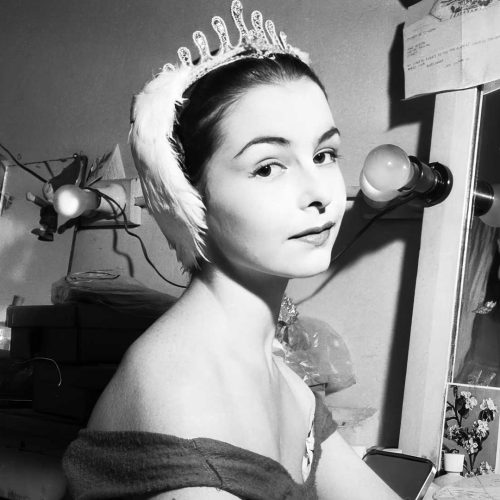
Patricia Clover
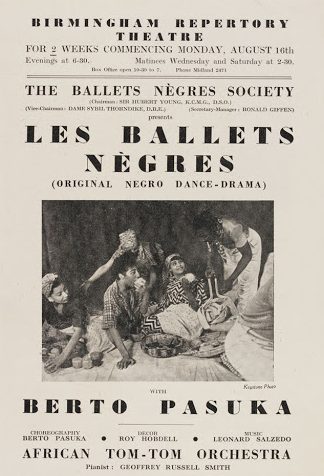
Patricia Clover gives the merest hint of the thinking behind Les Ballets Nègres, the company that lasted from 1946 until 1952. Her excellent memory and matter of fact style almost make you forget what a feat was achieved by its founder and director, Berto Pasuka. A Black company of dancers with cutting-edge material existing full time for six years touring the length and breadth of the country and abroad without any sort of government grant. Clover tells Patricia Linton, founder and director of Voices of British Ballet, of her early involvement with dance and about dancing with Les Ballets Nègres in its early days, as well as reflecting on the extent of racial prejudice at the time. She also talks about the musician Leonard Salzedo, whom she married, about the choreographer Andrée Howard, and about Pasuka’s determination in setting up, running and choreographing for his company. The interview, which was recorded in 2010, is introduced by the historian Stephen Bourne.
First published: July 21, 2026
Biography
Patricia Clover was born in Hammersmith, west London, in 1924. She started dancing at a local ballet school and at 16 went to study at Morley Theatre School in Lambeth. After working for a short time in a library, she joined the Gateway Theatre in Notting Hill Gate as assistant stage manager where she also played character parts. It was here that Clover met her future husband, the composer Leonard Salzedo, who was later to become musical director for Ballet Rambert and Scottish Ballet; the couple married in May 1945. Clover was involved with Berto Pasuka’s Les Ballets Nègres from the start, and the first performance was held at the 20th Century Theatre in Westbourne Park. Salzedo wrote the music for all four of the opening ballets and Clover danced with the company for several months before leaving in 1946. She later worked at the Ida Foster Theatrical Agency and then became general secretary of the Society of Cosmetic Scientists. After her retirement, Clover decided to study for her A Levels, followed by an English Literature degree. Salzedo died in 2000 and Clover in 2012.
Transcript
in conversation with Patricia Linton
PATRICIA CLOVER: I had an ordinary sort of childhood in an ordinary sort of home and went to school, and I got a job in a library. And [I] went to the Morley College Theatre School because I fancied being a dancer.
PATRICIA LINTON: Were you aware of Sadler’s Wells [Ballet]?
PATRICIA CLOVER: Oh, yes! We used to go regularly to Sadler’s Wells because they were performing at the New Theatre throughout the war with [Robert] Helpmann and [Margot] Fonteyn. Alexis Rassine, Gordon Hamilton, June Brae, Pamela May, Julia Farron.
PATRICIA LINTON: Does any ballet stand out particularly to you?
PATRICIA CLOVER: I very much liked Nocturne, Dante Sonata. Of course, the [Ballet] Rambert were also in London during the war, so I got to know them fairly well. Then, of course, Len [Leonard Salzedo, her husband] joined the company. Walter Gore and Sally Gilmour and Joan McLellan. Yes, it was quite a time when ballet was beginning to become very important in British theatre. It all started during the war.
PATRICIA LINTON: And did it cost a lot to go to performances?
PATRICIA CLOVER: Nine pence in the gallery at Sadler’s… old money. No, no, prices don’t compare now.
PATRICIA LINTON: You did how many years’ training at Morley College?
PATRICIA CLOVER: Not very much. Only about 18 months actually. Then I left and went to the Gateway Theatre. I got a job there as assistant stage manager…
PATRICIA LINTON: How long did you say you stayed there?
PATRICIA CLOVER: Oh, at The Gateway?
PATRICIA LINTON: Mmm.
PATRICIA CLOVER: Let’s see. About 18 months, two years, not very long.
PATRICIA LINTON: So, we’re almost to the end of the war, are we now, or about the middle of the war?
PATRICIA CLOVER: At the end because I married at the end and met Leonard at the Gateway Theatre at the end of the war. Well, he came to play, to lead a string quartet. We did a rather posh production, Easter by [August] Strindberg, and played the Haydn quartet, The Seven Last Words, and he was violinist. That was his principal instrument, and he led the quartets, and I turned the pages for them when they needed it. Then he went on – he played in another production. Next time he played the piano and I turned the pages for that, and that’s when we really got to know each other.
PATRICIA LINTON: So, was The Fugitive – when was The Fugitive done?
PATRICIA CLOVER: Oh, it was done… well, the Rambert tour, so it was done at the King’s Theatre, Hammersmith.
PATRICIA LINTON: What date was it though? Did he do that before you were married?
PATRICIA CLOVER: 1944.
PATRICIA LINTON: Yes, so it was just before you were married.
PATRICIA CLOVER: Yes, yes.
PATRICIA LINTON: So, did you ever meet Andrée Howard, the choreographer?
PATRICIA CLOVER: Oh yes, I got to know her quite well.
PATRICIA LINTON: Could you talk about her?
PATRICIA CLOVER: Well, she was very nervous, as you know. She felt the world was against her a bit, and to some extent it was. She was very ignored by the sort of ballet hierarchy, because she was a very gifted choreographer. She did make one ballet for Sadler’s Wells and Leonard did the music. That was Mardi Gras, which was quite strange, very psychological.
PATRICIA LINTON: Was that typical of her?
PATRICIA CLOVER: I think so, yes. I think she had mental health problems. She had several breakdowns… quite a sad character, really.
PATRICIA LINTON: Did she and Leonard get on well?
PATRICIA CLOVER: They seemed to get on very well, yes.
PATRICIA LINTON: Did they discuss Mardi Gras?
PATRICIA CLOVER: Oh yes, definitely. They used to have meetings. She used to come along to the 20th Century Theatre while the Ballets Nègres season was on and have discussions with him.
PATRICIA LINTON: Was she interested in [Les] Ballets Nègres?
PATRICIA CLOVER: I don’t think she was very… not really. It wasn’t her scene.
PATRICIA LINTON: Do you remember going to see Mardi Gras?
PATRICIA CLOVER: Oh, yes! I went to the first night at Sadler’s Wells Theatre. That was in November ’46. I was very nervous. I can remember that, so I think a lot of it passed over me.
PATRICIA LINTON: Now we’re going to find out how you got involved with Les Ballets Nègres.
PATRICIA CLOVER: Principally, it was because I married Leonard and he, by that time, was involved and I became involved. It was very much a show in which all the family helped. I had a small part in one of the productions, Market Day it was called, I played an old English tourist. Very hammy…
PATRICIA LINTON: Do you know how Leonard got involved?
PATRICIA CLOVER: Yes, Michael Tippett was asked to do the music for Berto originally.
PATRICIA LINTON: We’re now talking about Berto Pasuka, who was the leading light…
PATRICIA CLOVER: Berto had got in touch with him, yes, Michael Tippet, because of his cantata featuring Negro Spirituals [A child of our time], but he didn’t want to do it. So, he and Leonard were friends and he put Leonard forward.
PATRICIA LINTON: And where would Leonard have met Berto? Were there rehearsal rooms?
PATRICIA CLOVER: Oh yes, that’s right. They went to Mack’s Rehearsal Rooms, which was near the Wyndham Theatre… Windmill Theatre, I should say, in Windmill Street.
PATRICIA LINTON: This was the very beginning of the whole enterprise?
PATRICIA CLOVER: Yes. Yes, Berto had done a film, Men of Two Worlds, from which he made a lot of money.
PATRICIA LINTON: So, he’d been in a film, but what he really wanted to do was to build a dance company.
PATRICIA CLOVER: That’s right, yes. That was Berto’s aim. He’d been quite a popular cabaret artist in Jamaica, and also in London, and I think Paris. He had connections…
PATRICIA LINTON: So, what was his aim? What did he want to do?
PATRICIA CLOVER: He wanted to form a Black ballet company with Black ballet movements, particularly. No pointes.
PATRICIA LINTON: Would you say his work was radical in any way?
PATRICIA CLOVER: Oh, I think it was very radical because it was quite political.
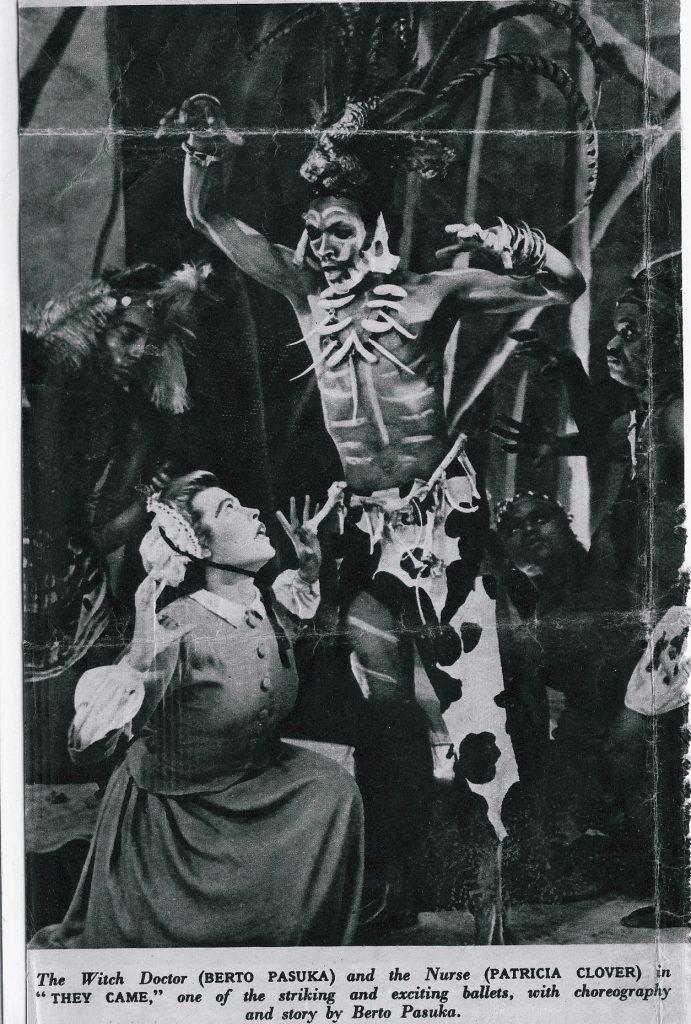
PATRICIA LINTON: One of the first ballets I think you did was called They Came. It was a comment…
PATRICIA CLOVER: …on the influence of the white man which was a bad influence on the whole, on African life, on business and religion and, yes, there was a character who was a priest and another one who was a businessman. I was a nurse, and white people took their medicine and ignored the witch doctor who was also a principal character in They Came. Yes, that’s right, the witch doctor was Berto, and he had a most amazing dance, and he leapt onto the stage and it was really very exciting.
PATRICIA LINTON: So, the four ballets – I think there were four ballets that they opened with?
PATRICIA CLOVER: That’s right.
PATRICIA LINTON: So, you must have been there when it opened in the 20th Century Theatre?
PATRICIA CLOVER: Oh yes, definitely, yes.
PATRICIA LINTON: Was it They Came, De Prophet –
PATRICIA CLOVER: They Came. Yes, Market Day and Aggrey.
PATRICIA LINTON: And Berto had… Do you know how long he’d worked for, putting those together before the first night?
PATRICIA CLOVER: Difficult to say because I think he did… he’d done a lot of preparation beforehand.
PATRICIA LINTON: Was he there all the time with you? Because he obviously was the lead dancer as well.
PATRICIA CLOVER: Oh yes, definitely, and Ritchie [Riley] was the second leading dancer. There was a certain amount of jealousy, envy, on Ritchie’s side. He thought he should be where Berto was.
PATRICIA LINTON: Because?
PATRICIA CLOVER: He just thought he was as good, if not better, as you do.
PATRICIA LINTON: But he didn’t choreograph, did he, Ritchie?
PATRICIA CLOVER: Not to my knowledge. I don’t think he ever choreographed. Berto was the main spring, undoubtedly. It would never have happened without him.
PATRICIA LINTON: But how did he feel about living in London?
PATRICIA CLOVER: Well, London probably had the largest Black community at that time. There were quite a lot of Black people in London, and the war, of course, had brought many other Black soldiers settled in London and married. There was a certain amount of prejudice, but it was general then. All of the company felt it. Even we felt it at the theatre. There were cafés round that didn’t like us to go in there, and that type of prejudice.
PATRICIA LINTON: I mean you’re absolutely white.
PATRICIA CLOVER: Oh yes, yes.
PATRICIA LINTON: First of all, how did they accept you?
PATRICIA CLOVER: Well, they accepted me very well. I shared a girls’ dressing room with them, and, yes, made some very good friends.
PATRICIA LINTON: What sort of audiences did you get? Were they some Black and some white, or all Black?
PATRICIA CLOVER: Never all Black. No, there’d be some Black people but mostly white… predominately white.
PATRICIA LINTON: Well, the film that I watched recently, that you had helped to put together in the ’80s, I mean, they listed all the places you’d been in Great Britain. I mean, it was a huge number, and all your tours as well…
PATRICIA CLOVER: That’s right, yes, oh, yes. We went to France, toured France, toured Scandinavia… Sweden.
PATRICIA LINTON: So, would you say you were working at least three quarters of the year, performing?
PATRICIA CLOVER: Oh yes, definitely. Definitely.
PATRICIA LINTON: And who did all the arranging of the tours?
PATRICIA CLOVER: They had an agent.
PATRICIA LINTON: Did you stay with the company throughout their six years?
PATRICIA CLOVER: No, I left in the summer of ’46.
PATRICIA LINTON: So, you just stayed quite a short time?
PATRICIA CLOVER: Very short time, yes. I went back to do the French tour because the girl who took my place, Berto sacked her for some reason.
PATRICIA LINTON: When you think about it, it was a fantastic feat to tour for six years, allowing people to have enough money obviously to live on and eat, with absolutely no financial support.
PATRICIA CLOVER: That’s right, yes.
PATRICIA LINTON: I mean, just box office receipts.
PATRICIA CLOVER: That’s right, yes. We applied to the Arts Council, but everyone was applying to them then, so nothing was forthcoming.
PATRICIA LINTON: Was this probably the reason why it had to finish in 1952? Just lack of funds?
PATRICIA CLOVER: Yes, principally it was. And I think Berto got ill and it was difficult for him to carry on, and he wasn’t going to let anyone else do it. So, yes, that was why.
PATRICIA LINTON: He wasn’t going to let Ritchie take over?
PATRICIA CLOVER: Oh, definitely not. No!
The transcript of this podcast may have been lightly edited for ease of reading.
You may also like...
Joan Seaman
Dudley Simpson