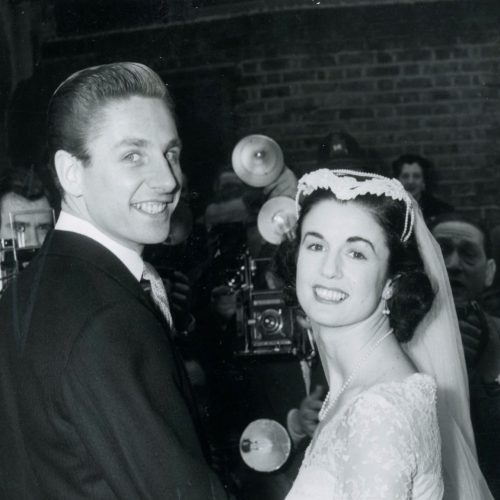
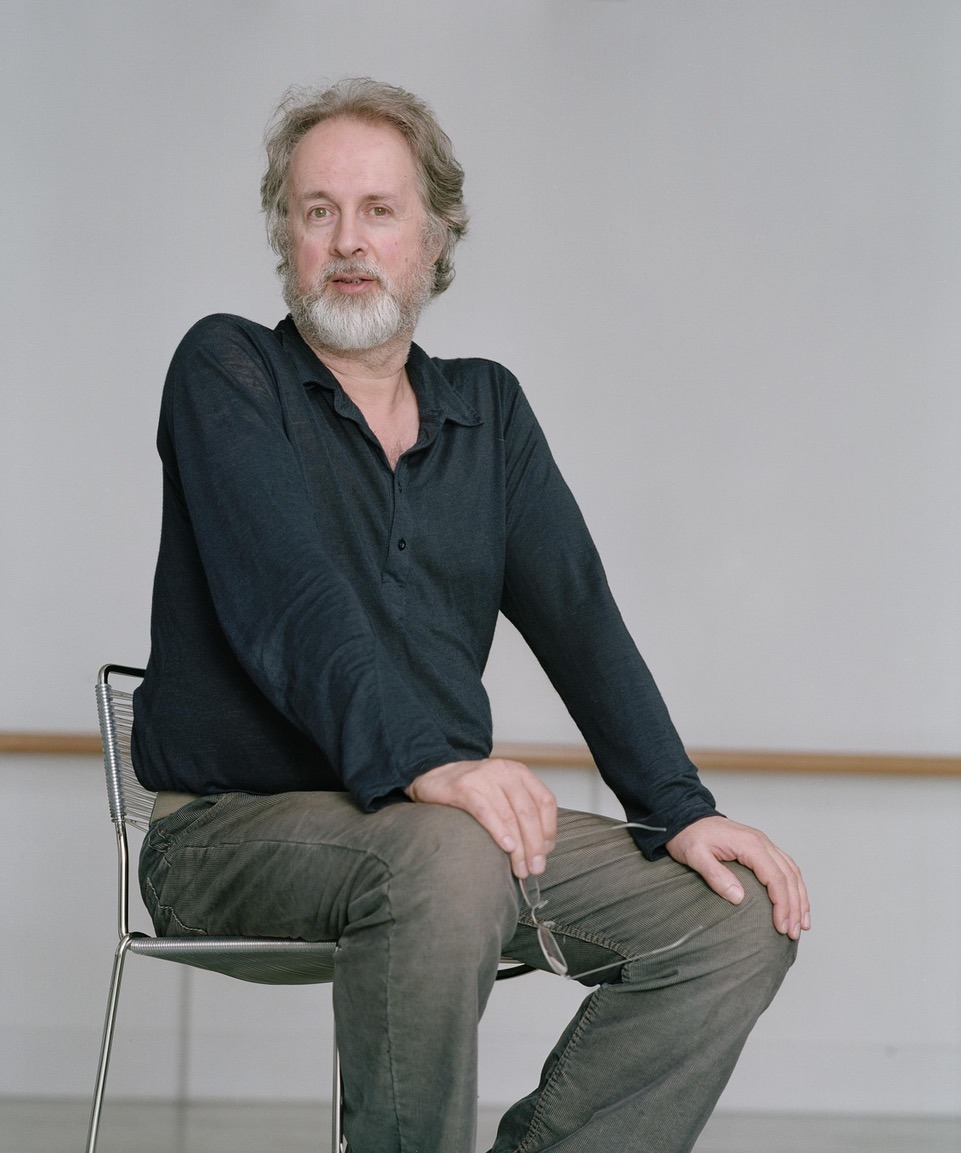
Richard Alston
The distinguished choreographer and director Richard Alston explains how, as a teenager, he was entranced by watching ballet. After studying fine art, he began working on the Martha Graham technique with what became the London Contemporary Dance Theatre. He eventually found this too restricting and embraced the freer, less floor fixated approach of contemporary dance associated with Merce Cunningham. Alston goes on to discuss how his own choreography began, and how it developed in line with this expansion of his aesthetic. He speaks about his dealings with Cunningham and with the composer John Cage and also about his long and immensely fruitful creative partnership with Sue (Siobhan) Davies. The interview is introduced by Alastair Macaulay.
First published: January 20, 2026
Biography
Richard Alston was born in October 1948 in Sussex. He was a British choreographer as well as having been artistic director for several dance companies. His education began at Eton College, followed by two years at Croydon School of Art. His passion for ballet was first sparked after attending performances by the Bolshoi Ballet and The Royal Ballet Touring Company, and also by Merce Cunningham and the Martha Graham Dance Company, which excited an interest in modern dance. As a result, he started attending classes with the Rambert School of Ballet, and in 1968 he became one of the London Contemporary Dance Theatre’s original students. After only three months there, he created his first work, Transit. In his third year at the School he organised a group of students to tour schools, colleges and universities demonstrating the Graham technique. After choreographing for London Contemporary Dance Theatre, he created an independent dance company, Strider, in 1972.
In 1975, Alston travelled to New York to study primarily with Merce Cunningham at the Merce Cunningham Dance Studio. He returned to Europe two years later, working as an independent choreographer and teacher. In 1980, he was appointed resident choreographer for Ballet Rambert. He founded Second Stride with Siobhan Davies and Ian Spink in 1982, and in 1986 was appointed artistic director of Ballet Rambert, a post he held until 1992. To reflect the changing nature of the company and its work, in 1987 Ballet Rambert changed its name to become Rambert Dance Company. During his years with Rambert, Alston created 25 works for the company, as well as pieces for the Royal Danish Ballet and The Royal Ballet.
After working in France and at the Aldeburgh Festival, in 1994 Alston became artistic director of The Place and he also formed Richard Alston Dance Company. A steady stream of over 50 dance works created by Alston over the next decades was interspersed with collaborations with the London Sinfonietta and Harrison Birtwistle in 1996, and several television productions, including The Rite of Spring, commissioned by the BBC for their Masterworks series in 2002. The Richard Alston Dance Company celebrated its tenth year with its first appearance in New York in 2004. In 2006 the company made its first full tour of North America, followed by further tours in 2009 and 2010. Alston created a new ballet, En Pointe, A Rugged Flourish, for New York Theatre Ballet in 2011. In March 2020, the Richard Alston Dance Company was wound up after a quarter of a century of critical acclaim., giving its last performance at Sadler’s Wells.
Richard Alston received the De Valois Award for Outstanding Achievement in Dance at the Critics’ Circle National Dance Awards in 2009. He was appointed a CBE for services to dance in 2001, and was knighted in 2019.
Transcript
Richard Alston: My brother – my older brother – he got me tickets to, to go to the Festival Hall in the summer and see the Bolshoi [Ballet].
Alastair Macaulay: How old were you?
Richard Alston: Sixteen. And it was a programme of Divertissements. And… He must have got me a lot of tickets because I went countless times. I was bowled over by part of it and not at all bowled over by others. And this, I think, it really tells you something about the oddness of my taste, or whatever. They did Flames of Paris. They did everything you could think of that was huge and spectacular, and then every night, at the beginning, there would be an announcement saying, “Ladies and Gentlemen, because…” let’s say “Yuri Vladimirov is injured, he is unable to dance Flames of Paris tonight and Flames of Paris will be replaced by the Chopiniana [Les Sylphides] pas de deux, danced by Ekaterina Maximova and Vladimir Vasiliev.” And all the audience would moan and I would go, “Oh, goody!” So, I saw it night after night and I just loved the Les Sylphides pas de deux.
Alastair Macaulay:How interesting!
Richard Alston: And so, I saw that the touring Royal Ballet were going to Hippodrome Golders Green, and they were doing Les Sylphides. And I lived up then on the edge of the Heath – on the Highgate side – and I just walked across on a very beautiful, sunny evening and joined a queue and went in to see this. And then when I was there, I saw that this was Monday and that on Tuesday and Thursday, interestingly, Margot [Fonteyn] and Rudolf [Nureyev] were doing Giselle as guests with the company. And I didn’t go until the Thursday. And it’s, I think it’s the first time that I left the theatre in what I call a trance, you know, after the second act of Giselle. When Margot was “on” and when she was really on form in the second act of Giselle, she was absolutely mesmerising, and I was just gobsmacked. And so, I thought I can see the rest of the week. And so, on Friday and Saturday, there was a triple bill, which was Les Sylphides, Helpmann’s Hamlet and Lady and the Fool. But at the end of the week, Friday, Saturday matinée, Saturday evening, they did Fille – they did Fille mal gardée. That, that’s when I thought, “I want to do something like this. I’m supposed to start at art college on Monday. How can I tell my mother? I really, I don’t… I want to put my pencil down. I want to be a choreographer!”
Alastair Macaulay: [Laughs] Now, then you did become an art student. How did art and dance connect for you?
Richard Alston: In the mid 60s, which is when I went to art college, it was an extraordinary time for London because a lot of very, very marvellous American [dance] companies came over here. So, in 66, we all went – a whole group of us from, from the Foundation Course – we all went to see John Cage give a lecture and we stayed, and in the evening, we saw a performance by Merce [Cunningham]. Then the next year, 67, because of [the artist and designer Isamu] Noguchi, I went to see Martha Graham. So, you see, I was fascinated by visual artists working in the theatre. When I saw the Graham company, I was fascinated – it was the old Graham company, it was the good old senior Graham company. It was Bob Cohan – Robert Cohan – Bertram Ross, Helen McGehee, Ethel Winter. The younger dancer was the extraordinary Noemie Lapzeson – she caught my eye immediately. And the Noguchi really held my interest. The first ballet I saw – the first dance I saw – was Embattled Garden, which has a wonderful set. Seraphic Dialogue had a beautiful, beautiful set.
So, those were the things I was looking at, and then I began to find the movement. I’ve always had some strange predilection – whatever you would call it – for movement that flows from movement that isn’t sort of static. And so, I became fascinated when Mary Hinkson did, did a movement which the Graham technique, in the Graham technique, is called “knee vibrations”, where you do a kind of figure of eight with your knee in front and then behind the knee and then in front and behind the knee. I thought, “Look at that! I wonder where I could learn how to do that?” And in the programme, there was a little slip of paper saying when the company has finished here, some of the dancers are going to teach at the London School of Contemporary Dance, off Oxford Street. And so, I went there and I went to these Graham classes, which were not easy for me to do. I could never really do Graham technique, but it’s an amazing language. Once… It gives you extraordinary strong sensations, which are still in my body. I can remember the things that I could do, I can still feel in my body, but I’m sort of one of those dancers who… you sit on the floor in second position, I kind of sat behind second position, looking at my legs in despair. But I noticed that they were going to start a full-time course in September and in the full-time course, they were going to have, obviously, Graham classes, and ballet. And so I thought, actually, I’m going to come here because I would really like the combination of those two.
There were no [Merce] Cunningham teachers in London then, and so a great, a great, but a great, great moment for me was when Viola Farber came as a guest [teacher]. And, of course, you know, there’s nobody more resistant to new influences than someone who’s an absolute recent convert, so that all the other dancers wanted to do Graham technique. They wanted to be on the floor. They wanted to do their floor work. They wanted to do those “spirals round the back”. The floor work hurt me so much that, when this woman came in and said, “Get up, we’re going to start standing”, I thought, “Oh, fantastic!”
Alastair Macaulay: [Laughs] Now, was she teaching technique?
Richard Alston: Yes.
Alastair Macaulay: And was it Cunningham technique?
Richard Alston: Yes, absolutely.
Alastair Macaulay: Any particular accentuation and Cunningham technique that she taught you? As you know, it has various ways.
Richard Alston: I would say that the – Viola was – she was the wild side of Merce. And, just recently, there was this wonderful film – short film made by Daniel Madoff for the Cunningham Trust – a collage of almost his [Cunningham’s] solos, and you could see how fast he moved and how really extraordinarily clear he was, and yet untidy. Not nearly as tidy as his dancers at the end of, the end of his choreographic career. And they were so exact. Most didn’t bother to be exact, except it was incredibly clear. And Viola was that side of him. Viola was wild. She was wonderful.
So, she had a huge influence on me because she really showed me there was another way of moving and she saw, both Sue [Siobhan Davies] and I, really took to it, and she therefore became very, very fond of us.
Alastair Macaulay: Wow. We’re talking about 1969, 1970 here. Am I getting the dates right?
Richard Alston: I think Viola would have come over in ‘68. We were still at Berners Place. We were still in that funny little studio off Oxford Street.
Alastair Macaulay: I know I started, I think I first met you in 1979 and by the mid 80s I was doing a big dictionary entry on you, which is when I started to understand a lot about your earlier choreography that I had missed. And one of the things that emerged – and it’s something that you and I shared, and we perhaps learnt from our great friend David Vaughan – was that the ABC of contemporary classicism was [Frederick] Ashton, [George] Balanchine, Cunningham. When did Balanchine enter your life?
Richard Alston: Ah! Ah! Later, later. I’m a devout late convert. I would just like to add quickly, I always thought that, that, David’s Alphabet was Ashton and [Fred] Astaire, Balanchine and Bournonville, and only Merce was the single C.
Alastair Macaulay: Quite right! And I first met you at the Bournonville Festival in 1979…
Richard Alston: Absolutely.
Alastair Macaulay: You’d begun choreographing in 1969, 68…
Richard Alston: 68, 68. Yes.
Alastair Macaulay: Am I right that all your first work for almost ten years was either in silence or independent of music?
Richard Alston: Not independent, although, but… the weird way I put it to myself is that I didn’t think I’d invented a language where I could deal with the kind of music that I loved. And so, I kind of kept my distance from it, except in a piece called Combines in 1972, which I made with Sally Potter, who made wonderful film. And it was indeed named after the Rauschenberg Combines, which were these wonderful paintings, sculptures – whatever you like to call them – a kind of wonderful goat and a rubber tire and goodness knows what. You put everything together. So, for Combines I used – I think it was mostly Schubert and Chopin. Yes, I did use music then, but up until then, you’re absolutely right. But when I say independent music… never independent of music in the way that Merce was. So, in the sense that I would make a piece, and when the music arrived, I would be very happy if I and any other dancer who was performing – we were listening to the music and it might be different every night, but we were listening to it. And, and our timing was not in any way anything to do with a stopwatch. It was clearly defined, seconds and minutes, so that there was this very wonderful pianist, and also composer, Michael Finnessey. He was involved with the Contemporary Dance Trust when it first started, and he used to find pieces for me and play them for me – his own work, or Stockhausen, or Cage – and I made a whole series of dances when I very first started, and Sue Davies danced in all of them when Michael would play… And… There’s no question about it, I was listening to the music and saying, “Well, listen, when that happens, that’s, oh, we could do that”. But it was kind of free.
Alastair Macaulay: But using cues in the music?
Richard Alston: Yes, yes, exactly.
Alastair Macaulay: At least responding to atmosphere…
Richard Alston: Yes.
Alastair Macaulay: Can you describe the young Sue Davies? What she was like as a dancer and, indeed, as a friend and colleague? Because you two, within London Contemporary Dance Theatre, began to, shall we say, expand what London Contemporary was capable of. I don’t know if you were rebels, but you were different.
Richard Alston: Yes. Sue. Sue was a wonderful dancer. Really wonderful dancer. She was like a very elegant colt. Not quite sort of coordinated yet, but with these amazing long legs and long arms and, and this… Always this extraordinary eagerness. So, we were soulmates in that way and we did, we had the same sort of excitement. And she, also, had come from our art college. And, err, she was in my very first piece – four women, four incredibly patient women. I didn’t know what the hell I was doing, and, er, it was a way of getting started. There was an opportunity and I thought, “OK, I’m going to do it”. It was a very “student of Graham” piece in long ground floor-length dresses. Very Grahamist movement. It was very much the way that a student choreographer might start.
And then I began to make more pieces. Winter Music was a piece I made for three women. It was a Cage piece and, and various pieces which eventually came together for my first 20-minute piece, which is what would, in those days, would be called, not a full-length, but it was a third of an evening. And that was Nowhere Slowly, when it finally, finally arrived, came from a, from a, from a lecture by, Lecture or Nothing, I think it’s called, by John Cage.
That brings me also to something very odd, but hugely important to me. In the book, In Silence, which is, which is John Cage’s first book, there is an article called Grace and Clarity, which he wrote quite early on when they [Cage and Cunningham] were doing their first solos. This… this was a revelation to me, this piece of writing, because there was John Cage, who I knew as Merce’s collaborator, writing about how in Giselle the movement and the music breathed together, and that this is why the audience could watch countless performances of Giselle, even if they weren’t really interested in Wilis’, or whatever. And I thought, “Oh! My goodness. This is why I used to…”
Graham class was always very exciting musically, but everything was always on the and beat: And a one. And two, and, and, and the movement, even in company class, the movement was short and repeated. Merce and ballet, both of them connected because they had phrases, complicated phrases. Ballet, doing chassé, pas de bourrée in the corner, a pirouette da, da, da, da, flowing with a waltz was just to me heaven. It was just heaven compared to, “And a one, and a two”. I found that very, very… I just wasn’t… it didn’t fit for me. That article was like a revelation to me, it really was.
Young students often saying to me, “Richard, what do we do? What do we do when we’re stuck? What do you do when you’re stuck?” And, and, I have to say to them, “I don’t get stuck”. I don’t get stuck because I have such a love of making movement and also, most importantly, I work with music. I work with music! I always try to make dance very fast. I love making dance very fast.
Another little bon mot of mine is that I read that the master of cocktails at the Savoy in the 20s, an American called Harry Craddock, he was asked by someone, “Mr Craddock, what’s the best way to drink a cocktail?” And he said, “Drink it fast whilst it’s still laughing at you.” [Laughter] And that’s what I feel about movement. For me, it’s the flow of movement. It’s the phrase of movement. It’s, it’s like spoken language. You have the important words and the words which don’t matter so much because they’re just leading you to the next important word.
The transcript of this podcast may have been lightly edited for ease of reading.
You may also like...
Anita Landa
Cassa Pancho