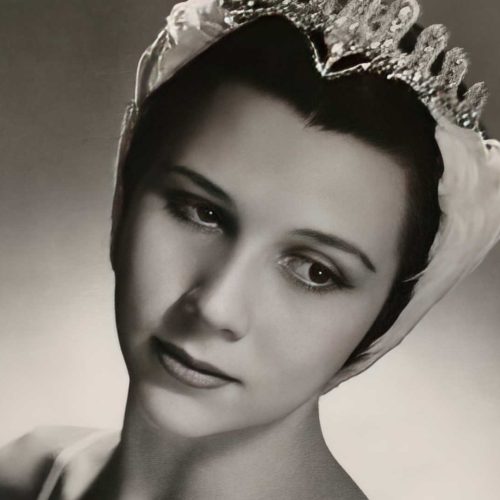
Patricia Thorburn
Here, Patricia Thorburn throws a little light on finding jobs after completing her training at Sadler’s Wells Ballet School. She is in conversation with Patricia Linton, founder and director of Voices of British Ballet and the interview, which was recorded in 2003, is introduced by dance historian Jane Pritchard.
First published: March 24, 2026
Biography
Patricia Thorburn was born in Peebles, Scotland, and was a student of Mrs Bell Hardy in Edinburgh. In 1937, she auditioned and then studied at the Sadler’s Wells Ballet School and made her debut with the Carl Rosa Opera in 1938. In 1939 and 1940 she served with the Auxiliary Territorial Service (ATS) but joined the Anglo Polish Ballet in 1940 and remained with the company until 1942. Following this, she appeared in a number of London shows, and married John Arnold in 1945 before joining the Sadler’s Wells Ballet at the Royal Opera House, Covent Garden, in 1946 to boost the numbers in their extraordinary production of The Sleeping Beauty.
Thorburn then danced as a member of the Agnes de Mille Ballet in the stage musical London Town. She retired from the company in 1947. Using her ballet training as a basis, she went to study with Sigurd Leeder at his School of Dance at Dartington Hall, Devon, to expand her horizons. She pioneered a Pure Movement course to help actors move more naturally on stage and screen and, working under her married name of Patricia Arnold, started to teach movement and historical dance at the London Academy of Music and Dramatic Art (LAMDA) in 1955, where she became head of Movement from 1963 until 1972. She also taught at the Guildhall School of Music and Drama. Thorburn taught well beyond the age of 75, and even after retirement was often asked back to teach masterclasses.
Transcript
in conversation with Patricia Linton
PATRICIA THORBURN: We moved to Edinburgh, I went to all these dancing schools, and then in 1938 I got into… or ’37, I think… I got into Sadler’s Wells [Ballet School]. My mum took me down there.
PATRICIA LINTON: Can you tell me anything about the school? Who was teaching there?
PATRICIA THORBURN: Yes, Ailne Phillips. She was the daughter of the man who ran the Carl Rosa [Opera].
PATRICIA LINTON: Ailne. Right. She had been a ballerina with the Carl Rosa, hadn’t she?
PATRICIA THORBURN: That’s right.
PATRICIA LINTON: Yes.
PATRICIA THORBURN: Ursula Moreton, she did all the character dancing… and then, of course, [Nicholas] Sergeyev. I think most of our ballet classes were with him.
PATRICIA LINTON: Do you remember anything about his classes?
PATRICIA THORBURN: All I can remember is him saying, “You can get your leg higher.” (laughter) “Try”. And sort of going with his little cane – he had a little cane – he didn’t hurt me, you know. And then also I remember he used to say [in Russian], “Eras dva tri, tri, tri [One, two, three, three, three]” is what he used to call out.
PATRICIA LINTON: Right.
PATRICIA THORBURN: And that’s… he was very much respected and then, of course, he put on the Russian version, the old Russian version of Casse Noisette [The Nutcracker].
PATRICIA LINTON: As a student, were you involved in that at all?
PATRICIA THORBURN: Yes, we were snowflakes in Casse Noisette, some of us. And that, I think, was the first time I’d been on the stage, and the most awful thing happened. I was still quite green and had a new pair of shoes… and how, I don’t know, it slipped off. So, I had a nightmare bourréeing with this thing dangling around my ankle. However, they didn’t take me out of it, but they just showed me that, after that, they used to glue them on. I don’t think I had elastic up the back at that time. I didn’t know and nobody told me this, you see, but it was dreadful.
PATRICIA LINTON: Can you remember any of your classmates of the time?
PATRICIA THORBURN: Well, these ones, like Maggie [Margaret] Dale, Beryl Grey, who was quite a little girl, very slim and did fouettés quite easily. Jean Bedells, Moira Fraser, Angela Bailey.
PATRICIA LINTON: And how long were you in the school?
PATRICIA THORBURN: I suppose about a year. But it might have been just… going in the autumn. I got a job in a pantomime over Christmas… in Exeter. That was the first job I ever had. It was Cinderella… And then I must’ve gone back and done spring term. What I can’t remember is when I auditioned for the Carl Rosa [Opera]. Ailne Phillips auditioned people from the school.
PATRICIA LINTON: Because of her connection?
PATRICIA THORBURN: Yes. My feeling is that we probably auditioned in the summer and went on tour in the autumn of 1938, it was, I think. That’s right, because they break up for the summer because I went home to Edinburgh. We were to reform in the autumn of 1939, and then the war came and they cancelled. That’s right, so…
PATRICIA LINTON: So, can you tell me anything about your time with the Carl Rosa Opera?
PATRICIA THORBURN: Well, what we had… she did all the choreography. We had to…
PATRICIA LINTON: Who was it that did the choreography?
PATRICIA THORBURN: Ailne Phillips did.
PATRICIA LINTON: Right.
PATRICIA THORBURN: I thought, I think we called her “Babs” Phillips.
PATRICIA LINTON: Yes.
PATRICIA THORBURN: We did.
PATRICIA LINTON: Yes.
PATRICIA THORBURN: She did all the choreography. We did, you know “The Inferno” music in first (sings a tune from the opera Faust) we did a ballet to that. We liked Die Fledermaus best because we danced to The Blue Danube in that, and we all loved that. And then we had to do [a] Spanish dance in Carmen, in the tavern scene when the toreador sings his famous toreador song. And we had to go and learn Spanish dancing, with castanets from an amazing woman who had a studio, a Spanish woman, in Westbourne Terrace. She was very scornful about it. She would say, “Oh no, the English can’t really do it”, and she used to disappear into her office and just say, “Just practice that” and come back.
PATRICIA LINTON: So, did you work every week?
PATRICIA THORBURN: Yes.
PATRICIA LINTON: Every day every week?
PATRICIA THORBURN: Yeah, yes.
PATRICIA LINTON: And you toured?
PATRICIA THORBURN: We travelled on Sunday.
PATRICIA LINTON: Right.
PATRICIA THORBURN: Travelled on Sunday, get to your digs – some of which were awful –and then you had a class on Monday morning.
PATRICIA LINTON: Then you rehearsed?
PATRICIA THORBURN: Yes, I don’t remember whether we rehearsed every day, but I know we had a class everyday.
PATRICIA LINTON: And performed every evening?
PATRICIA THORBURN: Yes. I wouldn’t say it was too exacting because you only had the one ballet.
PATRICIA LINTON: Right. So you were in the Carl Rosa Opera for about two years?
PATRICIA THORBURN: No, it was only one year. Because you went in ’38 and it didn’t start again in ’39. And that’s when I joined the ATS.
PATRICIA LINTON: The ATS being?
PATRICIA THORBURN: The Auxiliary Transport Service of the Army. Well, I lived at home and I used to go and drive the ambulances up at the hospital.
PATRICIA LINTON: Were you dancing yourself at that time? Keeping in practice or…
PATRICIA THORBURN: No, not very much, no. There wasn’t a chance to, but then when the Anglo-Polish [Ballet] came along…
PATRICIA LINTON: What made you start with the Anglo-Polish? Had you kept up with friends?
PATRICIA THORBURN: Oh no, they came to Edinburgh and they were short of a corps de ballet girl. And a friend of mine who I’d trained with and also who I’d kept up with, who’d been in this pantomime with me, Eileen, said, “Do you want to audition?” So, I went and auditioned and I did get in and I got to do the Mazurka and the Polonaise. The Mazurka, some people didn’t get to do the Mazurka, perhaps people who were a little bit better, or better height or something, and that’s when Alexander Hamilton, who was Alexander Valeski, was my partner and I loved that dance.
PATRICIA LINTON: And the Anglo-Polish, they travelled all over?
PATRICIA THORBURN: All over England, yes.
PATRICIA LINTON: They did?
PATRICIA THORBURN: Yes, we did a lot of travelling and, of course, it was ran by these Polish émigrés who I think were slightly, not exactly criminals, they were a very dodgy lot. There was one occasion when they didn’t… they were so long getting ballet shoes for us, they were always economical… we [had] done everything, we shellacked them, and darned them and shellacked them again, and they were so soft, you know, they weren’t giving you any support, you know?
PATRICIA LINTON: Absolutely.
PATRICIA THORBURN: And we were so angry after a while, the whole of the corps de ballet decided they were going to do it on half-pointe, which they did. And we got our shoes, but they must’ve been ghastly looking.
PATRICIA LINTON: How long did a pair of pointe shoes last? Or how long did you have to make them last?
PATRICIA THORBURN: The soloists got one pair, I think, a week, so perhaps we got… we were supposed to get a pair perhaps every other week, you know, because…
PATRICIA LINTON: Right.
PATRICIA THORBURN: We only had to do [Les] Sylphides on pointe.
PATRICIA LINTON: Right. And the other ballets?
PATRICIA THORBURN: The other ballet was… no, yes, the other ballet was Cracow Wedding, and then a Divertissement, so unless you were doing [the] Divertissement, which was really the soloists. I mean, Konarski and Halama were the stars, and they were really a cabaret act from Poland, and they really did quite sensational lifts which I’ve never seen before. She was very tiny and he was very strong. They did Cracow Wedding and then they had their big duo in the Divertissement, which is very, very, very striking. It was… I can’t remember what the music was, it wasn’t a Polish dance… it was a sort of cabaret dance.
PATRICIA LINTON: And this was choreographed by them?
PATRICIA THORBURN: Yes. I think Cracow Wedding was too.
PATRICIA LINTON: And music? Was it an orchestra?
PATRICIA THORBURN: It was an orchestra, I think… Yes, because they took around a violinist… and a conductor.
PATRICIA LINTON: So, it was quite a big concern? Quite a lot of people travelling?
PATRICIA THORBURN: Yes. So, this lead violinist, and I suppose another one. Maybe they had three or four musicians and then they recruited… they had an orchestra of local musicians, I suppose.
PATRICIA LINTON: Right.
PATRICIA THORBURN: What the quality was like? I’ve no idea?
PATRICIA LINTON: You can’t remember?
PATRICIA THORBURN: No, I wouldn’t have known really.
PATRICIA LINTON: Do you remember the conductor?
PATRICIA THORBURN: No, I don’t remember who he was now, I’m afraid. He didn’t impinge on our life much.
PATRICIA LINTON: And who organised the tour and the getting of digs and…
PATRICIA THORBURN: Oh, that would be the office of the people who ran it and I can’t remember his name – the businessman. It was basically a businessman running it and we didn’t like much.
PATRICIA LINTON: But do you have good memories of being in this company?
PATRICIA THORBURN: I have good memories because it was the first sort of ballet company, really, I was in and I loved doing the Cracow Wedding. I loved that Mazurka. I was taught them by this Polish star…
PATRICIA LINTON: So, you were getting the right feel, the right emotion?
PATRICIA THORBURN: It’s quite a strong dance, you know? And they were quite strict with us to get it exactly right.
The transcript of this podcast may have been lightly edited for ease of reading.
You may also like...
Darcey Bussell
Anne Heaton