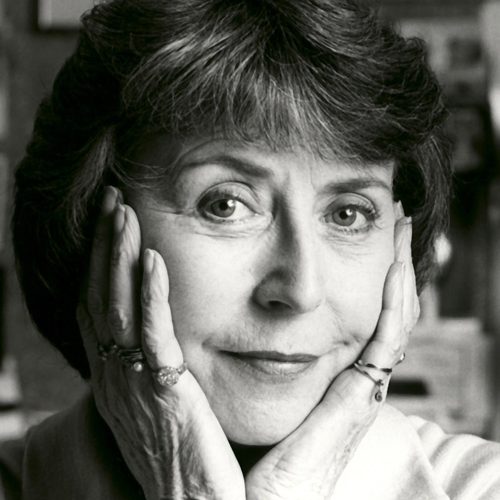
Jean Bedells
Jean Bedells talks about the 1930s as if it was yesterday. Full of detail and feats of memory, we are given an idea of the sense of foreboding that descended when their artistic home, Sadler’s Wells, was taken over as a refugee centre at the start of World War Two. In this interview, which was recorded in 2005, Jean Bedells talks to former Royal Ballet principal dancer Bruce Sansom. The interview is introduced by Alastair Macaulay.
First published: February 3, 2026
Biography
Jean Bedells was born in Bristol in 1924 as Jean McBain. She was the daughter of Phyllis Bedells, the great British ballerina, teacher and, later, a founding member and examiner for the Royal Academy of Dance. Jean Bedells first studied ballet with her mother and then trained at the Vic-Wells Ballet School for a year in 1936 before joining the Vic-Wells Ballet in 1937, making her debut as Clara in The Nutcracker. She had leave of absence from the company to dance as the Herald of Spring in Hiawatha at the Royal Albert Hall in 1937, 1938 and 1939. When she rejoined the Vic-Wells Ballet in 1938 she danced in Les Patineurs and The Haunted Ballroom, as Rose and Silver Fairies in The Sleeping Princess [The Sleeping Beauty], as Bathilde in Giselle, and in The Quest and, later, as one of the Three Fates in Adam Zero. She also appeared in a number of early films made of the company, notably as the Fairy Silver in The Sleeping Princess (1939), a Red Pawn in Checkmate (1939) and, later, a character role in a film of The Nutcracker (1958).
In 1946, Jean Bedells became ballet mistress for Sadler’s Wells Ballet when the company moved into the Royal Opera House at Covent Garden. (The Vic-Wells Ballet was re-named Sadler’s Wells Ballet in the early 1940s.) She became a teacher after her retirement from the company, often teaching at The Royal Ballet School, especially during the 1960s and 1970s. Her granddaughter, Anne Bedells, was a member of London Festival Ballet. Jean Bedells died in 2014.
Transcript
in conversation with Bruce Sansom
JEAN BEDELLS: I’m professionally known as Jean Bedells – I was persuaded to take the name Jean by Ninette de Valois in 1937 – and my mother was Phyllis Bedells, and she was recognised as the first English Ballerina. My grandmother was really quite ambitious, and she got mother an audition with the musical director at the Empire Theatre, and the long and short of it is that they offered her a contract in 1907 and that lasted through to December 1915.
BRUCE SANSOM: And what roles was she dancing?
JEAN BEDELLS: Oh, there weren’t any of the ballets we know today, apart from Coppélia. There was one called The Debutante. She did speciality solos and the one solo that she did which she was renowned for was with a skipping rope – I think that was in a ballet called A Day in Paris.
BRUCE SANSOM: And these were created for her?
JEAN BEDELLS: These were created for her. There was a wonderful gentleman called Fred Farren, and he did most of the choreography. He was, I suppose, a sort of character dancer and, for instance, in Coppélia he did old Dr Coppélius.
When I was three, we went to baby dancing classes at the Cone School. I then started having one or two lessons a week with my mother. I was five, I think, when I did Grade One; six when I did Grade Two; and just seven when I did Grade Four. At this time, my mother was appearing with Anton Dolin, and they had a small company of dancers, and they would tour and appear in London. In 1932, I took my elementary examination of the Association of Operatic Dancing [now the Royal Academy of Dance]. And in those days the exam lasted all day. It started about 10 o’clock in the morning and went on for about two and half hours. We then had a lunchbreak, and we all came back afterwards, so the whole exam lasted five hours and we were 48 candidates in at the same time. I was number one, and the examiners were the entire panel of examiners. So, there was Adeline Genée, my mother, Judith Espinosa, a lovely Scottish gentleman called D G McLennan. The following year, in 1933, I did my intermediate examination.
And then I stayed working with my mother all the time. She had trained me until, it was, I think, the spring of 1936 when a pupil of my mother’s, who by this time was a member of the Vic-Wells Ballet, choreographed a sort of Scandinavian theme ballet for a charity performance and I was a sort of slightly demon spirit in it. And the rehearsals were done in my mother’s studio in London, north London, and I can remember Dame Ninette de Valois came to watch. I had no idea why she was there, but I think she was, in her mind, she was auditioning me. And in September 1936 I went up to Sadler’s Wells, to the school.
I had two hours lessons in a morning, from nine to 11, with a governess with three other students. I would then catch the bus and get a “two penny half” up to New Oxford Street, change onto the Number 19 bus, and get a “penny half” and go up to Sadlers Wells theatre, change in the Dress Circle ladies cloakroom into our tunics, our black tights and shoes, and have class in what then was called the Wells Room. And the class, I suppose, lasted about an hour and a half about, and then, if I was lucky enough, I would creep back in there and watch the company rehearse.
BRUCE SANSOM: Who taught that class?
JEAN BEDELLS: Well, we would have had perhaps Ninette de Valois – not every day – Ursula Moreton, Ailne Phillips, sometimes Sheila McCarthy. Anyway, in January 1937 Casse Noisette [The Nutcracker] was presented and I was going to be Clara, and that was when my name was changed, at Ms De Valois’ behest, from Jean McBain to Jean Bedells. She said, “You must carry on the name.” The performances started at half past eight at night, and I went through the party scene and went through the snowflakes and was brought on – can you believe it – by Robert Helpmann, who was the Nutcracker Prince, brought onto the Kingdom of Sweets, and they all made their révérence to me. And, I mean, I was a child of 12! People like Pamela May and June Brae. It was an experience never to be forgotten, and then I would be taken to the side and sat down and they all danced for me. And there was one performance, I remember, I was sitting on my little stool, because it was not a throne, it was not chair, and Ursula Moreton was in the wings saying, “Jean, Jean”, beckoning me to come off the stage. So, I crept out and they put a coat around me and stood me outside the Stage Door because the inspector was there and I was still on the stage at 10 o’clock at night, so I had to be got out. So, providing I was out of the theatre at 10 o’clock, he was quite happy. But it was jolly cold in my nightie with a coat around my shoulders!
And then, in September 1938, Madam [Ninette de Valois] appointed me, I suppose, what they called a “paid student”, so I became a member of the company, but, and doing everything that the corps de ballet dancers did, but couldn’t have a proper contract, so I was paid £1 a week.
My first involvement as a full member of the company was in 1939, and we went up to Manchester for the week, and then we went to Liverpool for a week, and then we were on the train between Liverpool and going up to Newcastle, and we stopped in Manchester and we were told war had broken out, and nobody knew what was going to happen. Then, and we all forgathered in the coach, and Ms de Valois said nobody, but nobody, was to go to London because everyone was expecting the bombing to happen.
We had to let Ms de Valois know where we were, and so I wrote to her at Sadler’s Wells. I told her where I was, gave her my address. That was the 4 September, if I’ve got my dates right. Sunday, 17 September, we all gathered at Paddington Station and got on the train to Cardiff. From Cardiff, half-way through [the week], we were told we were going to Newcastle. So, on the Sunday, we went up to Newcastle. Half-way through, we were going to Leicester, so we were always told in the middle of the week where we were going. So, Cardiff, Newcastle, Leicester, Leeds, Birmingham, Southsea, Brighton, Cambridge, Nottingham, Glasgow, Bradford and Hull – the first 12 weeks of the war.
So, ballets that we would [have] had on the first 12-week tour were all one-act ballets, so the programmes would have been triple bills. We probably would have had [Les] Sylphides, Checkmate, Horoscope, Façade, Les Patineurs, probably the Second Act of Lac [Swan Lake]. And it was always called Le Lac des Cygnes. But during that tour, we were down in Southsea and up on the notice board went the casting for Fred’s [Frederick Ashton’s] new ballet, and this was Dante Sonata, and I was ecstatic to see that my name was there as the Child of Light. We rehearsed it throughout the next six weeks, and by the time we got to Hull the ballet was complete. It was an extraordinary time, really, because, apart from being in Job – de Valois’ Job – I don’t think any of us have done any barefoot work. It [Dante Sonata] was an amazing ballet to be in. And it was, and these wonderful costumes, which were so simple. The Children of Light were [in] very slim night dresses, that’s what they were like, and the men, white men were in white shirt, white tights. And the black girls were almost as if they were naked tops, with a snake around their arms and a black skirt with one leg sticking out, and the black men were in crotch-type knickers with a snake around their bodies, so they had to look as if they were naked.
BRUCE SANSOM: Was that just a decoration over the top of a tunic?
JEAN BEDELLS: No, no! They had to look as if they were naked! Starkers! Then Fred produced a new ballet, the Wise and Foolish Virgins – again a barefoot ballet. Didn’t last very long, but it had a wonderful set by Rex Whistler, but you couldn’t take it on tour because it was far too cumbersome. We must have had a tour. In fact, I know we had a tour and came back to Sadler’s Wells in the summer of 1940, and Madam was rehearsing The Prospect Before Us with Pamela May as Madame Théodore, Bobby Helpmann as Mr O’Reilly. Well now, during that season up at the Wells, the bombings started and the season ended, I think, round about the 7 September and we all dispersed to have a break, and the bombing really did start then, and Sadler’s Wells was taken over as a refugee centre. So, we didn’t go back to Sadlers Wells for a very, very long time.
![Bedells J, Checkmate [Remix]](https://voicesofbritishballet.com/wp-content/uploads/2026/01/Bedells-J-Checkmate-Remix.jpg)
![Bedells,J Countess Act 1 Giselle [Remix]](https://voicesofbritishballet.com/wp-content/uploads/2027/01/BedellsJ-Countess-Act-1-Giselle-Remix.jpg)
You may also like...
Beryl Grey
Edward Watson