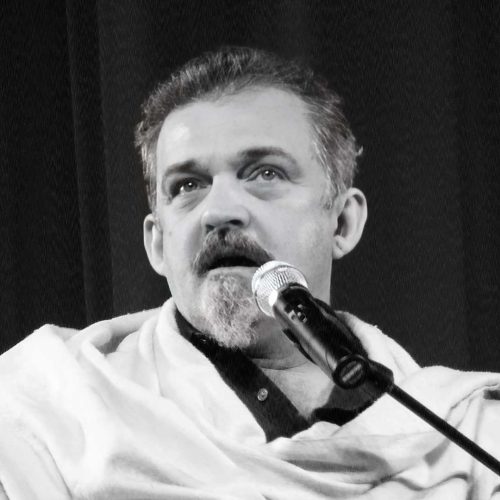
Henry Danton
In this extract, poor Henry Danton always seems to be running behind his talent – that is until he met the wonderful ballet teacher, Vera Volkova. However, before this and often against the odds, he managed to do quite a few things. From his early training with Judith Espinosa, he went on to work with Allied Ballet, International Ballet and, finally, Sadler’s Wells Ballet, and all this in the space of a few years. Candid and clear, something eventually went right as Henry continued to teach ballet into his 100th year. In this interview, recorded in 2004, Henry Danton talks to Patricia Linton, founder and director of Voices of British Ballet. The interview is introduced by Alastair Macaulay.
First published: February 10, 2026
Biography
Handsome and dashing, clever and full of life and good humour, Henry Danton was born into an army family in Bedford in 1919. He was educated as a King’s cadet at Wellington College. At first, Danton joined the army, but when on sick leave, following a back injury, he was introduced by a friend to the ballet teaching of Judith Espinosa. Almost overnight a new life unfolded for him. Although an avid ice skater, ballet had not been contemplated, but was “in his bones”, so to speak. After only 18 months of training, Danton joined the short-lived Allied Ballet, and then Mona Inglesby’s International Ballet. He joined the Sadler’s Wells Ballet in 1944. Here he began studying with Vera Volkova in her West Street Studio, and his lifelong passion and interest in Russian ballet training began. Volkova helped him to understand and fill in the gaps in his training. He was one of the original six dancers in Frederick Ashton’s Symphonic Variations at Covent Garden in 1946. From here he danced with various companies, including Les Ballets des Champs-Elysées, and toured the United States of America with Roland Petit’s Ballets de Paris. The USA became his home. He taught and choreographed extensively, both there and internationally, and was teaching at The Dance Studio with the Ballet Theatre of Scranton, Pennsylvania, until shortly before his death in 2022.
Transcript
in conversation with Patricia Linton
HENRY DANTON: The whole thing was crazy because it was during the war and we lived about ten miles outside of Bedford, and I had to ride a bicycle to get to the station and I had to take the train to come to London. And I would come once a week to see Judith Espinosa and take a lesson there. As I say, my mother and sister didn’t know this, I had an army gas mask – like a khaki thing? – so, I took my gas mask out and my dance clothes went in. [Laughter] The whole thing seems terrible!
PATRICIA LINTON: Let’s talk about her classes, now we’ve got to her. How did you fit in? You must have been 19 or 20 by this time?
HENRY DANTON: Yes.
PATRICIA LINTON: And do you remember who your contemporaries were at that time?
HENRY DANTON: Well, Jack [John] Hart was there. He used to come there. Leo Kersley says that he knew me from there, but I don’t remember him… Mona Inglesby! She took classes from Judith. There was a crazy dancer called Rovi Pavinoff – he was a monster! But he used to take classes, he would come and do hundreds of pirouettes and nothing else! She [Espinosa] was not a very good teacher, or the system was not very good, and it’s a French system. And she gave me a huge sway back but… she was marvellous because she had so much enthusiasm. I mean, she was very good to me. And I’d passed the three RAD [Royal Academy of Dance] exams in 18 months with honours in all of them. I’m not saying it, but apparently that was unheard of at that time.
PATRICIA LINTON: So, these are the big majors – elementary, intermediate and advanced?
HENRY DANTON: Elementary, intermediate and advanced. Then I also did the Solo Seal…
PATRICIA LINTON: Gosh!
HENRY DANTON: …and the Adeline Genée Gold Medal, which I didn’t get the gold because Ninette [de Valois] [Laughter]… she was going on about my swayback all the time. Anyway, I got the silver medal…
PATRICIA LINTON: So, you were still with Judith, and you’d done all these exams and, add 18 months…
HENRY DANTON: Then there was… I don’t know whether she was English or American, or English married to an American. Her name was Pamela Carter. Apparently, she was with the de Basil [Ballet Russe] company with her husband and then, of course, when he did the final season [before World War 2], they were stranded, I think, in England. Well, she went to the class at Judith’s. They formed a company, which was called the Allied Ballet. So, they said did I want to be in it, so I said: “Of course I want to be in it.” Because I was getting short of money at that time – I was short of money.
But, out of the dance studio, I went into doing the… in the first performance, I did three ballets. One was [Les] Sylphides, which I danced with Pamela Carter. I had no idea what I was doing! Another one was called Silver Birch – it was very contemporary, very vague. I had no idea what I was doing, I mean, absolutely no idea! That was 18 months training. Then they had another ballet, which was called La Plus Belle, which was like a… like a whorehouse! And I was supposed to be the young man who ventured into this place and I was to be enchanted by three different girls!
Sonia Arova was in that company, that was her first job also. Anyway, the only thing I remember is the trauma of being thrown into three ballets as a principal dancer with 18 months training behind me! [Laughter] Which was ridiculous!
PATRICIA LINTON: But you enjoyed it?
HENRY DANTON: No, I didn’t! I thought it was horrifying!
PATRICIA LINTON: And then what did you do?
HENRY DANTON: Well, that company folded, but then… that was when Mona picked me up. So, Mona was in the class, and she had her company by then, but it was not very old. And her partner at that time was Harold Turner. So, I got into the company, into the International Ballet. The first thing I had to do was [Le] Carnaval. I was in the “Valse Noble”, and I had to do balancé – I couldn’t do balancé. I mean, I didn’t know how to do them, I’d never had to do them. And so, [Stanislas] Idzikowski, who was the ballet master, and Madame [Vanda] Evina, they got so angry with me because I couldn’t do balancé side-to-side, and they said: “What’s the matter with you?”, and I remember crying because I couldn’t do it! Anyway, then I was in another ballet which was made by Harold Turner called Fête Bohème, with its Slavonic dances. And that was all a mystery to me because there were character steps which I had never done.
PATRICIA LINTON: So, Harold Turner choreographed as well?
HENRY DANTON: He did that for Mona, yeah. So then, Harold was… he was having a lot of trouble with Mona ‘cause she was kind of a heavy – heavily-built – and she was kind of difficult to lift. And he couldn’t get on with Mrs Inglesby – you know the story about the Inglesbys?
Well, they both had lots of money. Mona had been in the De Basil company, in the corps de ballet, and when the war started and De Basil left, she stayed here in England. They [her parents] made the company for her – they bought everything for her. She was a “bought ballerina”. But it was done very well, no expense was spared – their costumes were absolutely fabulous.
They got [Nicholas] Sergeyev. Sergeyev was getting to be a little senile at that point and he had all these Stepanov notes and he couldn’t decipher them. He had a French wife, who was very smart, and she would always be behind him. When she thought that he was in trouble, she would cover up… invent steps that poor [Marius] Petipa had never even thought of! [Laughter]
PATRICIA LINTON: So, she couldn’t read the Stepanov [notations]?
HENRY DANTON: She didn’t have the access to it… Sadler’s Wells [Ballet] wanted… they retired him [Sergeyev], they gave him a benefit, there was a benefit performance given for him and they gave him a large sum of money. He went off the next day and signed with Mona Inglesby… so, I mean, fortunately for me, because, while I was in that company he was setting Giselle and… Giselle is not strictly a Russian ballet, but he had worked in the Paris Opéra so he had a pretty authentic record of the choreography.
Then we got on to, off, of Harold Turner… he couldn’t get on with Mrs Inglesby. Mrs Inglesby was kind of difficult. So, I was picked up as her partner, as Mona’s partner. I had partnering classes from Idzikowski with Mona… which was marvellous. I didn’t know how lucky I was but, to me, I was being crammed with things I couldn’t do. So, I got to dance Sylphides with Mona and the Second Act of Swan Lake… inside of six months of joining the company! This is with two years of training behind me! It’s nonsense!
So, after about eight months in that company, I realised that I was not getting anywhere and was being asked to do things which I could not do, so I went and saw Ninette and I thought: “It’s a better company and if I could be with anybody, I’d like to be in that company.” But the same thing happened there. I mean, I was shoved into things which I could not do. I mean, the first thing I had to do was fine. I was a pallbearer [laughter] for Robert Helpmann [in Hamlet] and, I thought: “This is not true!” Then I was… and he was saying rude things to us, stinking of Chanel No. 5. [Laughter]
Well, then the next thing that happened, it happened very fast. Alexis Rassine was in the company then and he… when Bobby started, Robert Helpmann, started leaving the classical roles, Alexis Rassine started taking over his roles, so I was pushed into Alexis Rassine – he was a very good dancer.
PATRICIA LINTON: Mmm.
HENRY DANTON: I mean, he was world trained. He was Russian-trained in South Africa, and so I was immediately shoved into the Pas de Trois in Swan Lake, which I could not do. I mean, I remember at that time they used the big waltz as an overture for the Third Act, and every time I hear that damn waltz now it makes me sick because I was… because the Pas de Trois was in the Third Act at that time, and it was the first number in the Third Act. I mean, they had… Siegfried and the mother come out and then the Pas de Trois came immediately after that. Every time I hear that damn music, I get sick in the stomach because I was being asked to do something I couldn’t do – tours en l’air… you know, I could do them, but I fell over every time. It turned out to be the same thing again. I was stuck with doing things which I really was not technically able to do. So, the next interesting step, I suppose, was [Vera] Volkova. I was one of her first pupils when she was upstairs…
PATRICIA LINTON: In West Street?
HENRY DANTON: …in West Street. Yes. So, I became a regular student there and we had, whenever we were in London, we had company classes in the morning. We had to do a report at 9.30 [am] to see who was still alive… [Laughter] No, really, it was!
PATRICIA LINTON: Gosh, ‘cause of the…
HENRY DANTON: ‘Cause of the war, you know, and the bombing. “Who’s going to be missing today? How are we going to fill that hole?” It was awful. Anyway, I cut the classes to go to West Street, and they had… Mary Skeaping was one of the teachers at that time, and Harijis Plucis.
PATRICIA LINTON: Did you find with Volkova, at last you were beginning to understand?
HENRY DANTON: Yes, oh yes. She was the one who showed me. Well, she was the first Russian we’d seen. I mean, any of us had seen. The dancers in The Royal Ballet at Sadler’s Wells, they were awful! They were so bad! You wouldn’t believe how bad they were, and I look back and I think: “How could they possibly have managed?” They were such bad dancers. The corps de ballet dancers were awful!
Anyway, after a little while, I was called to Ninette’s office and she said: “Boy…” She called me “Boy” For the first two years I was in the company she called me “Boy”. She would never call me by my name. “Boy, why are you not going to the classes?” And this is not printable, but it actually happened. So, I said: “Well, I’m going to a teacher on West Street.” She said: “Who are you going to?” So I said: “Volkova.” So, I mean, that was… there was a tremendous amount of animosity between Volkova and Ninette.
PATRICIA LINTON: But you continued?
HENRY DANTON: I continued to go. It was a struggle because I don’t know what we were paid like, I think it was £12.50 a week and you had to pay for the classes. They were, I forget how much they were, but we had to pay for them. But I continued to go, so she was very angry with me, Ninette. She didn’t like it that I went because… well I was headstrong, you know. I wanted… I saw that that was what I wanted and what she was providing was not what I wanted to do.
PATRICIA LINTON: But, at last, you were getting to grips with your technique and feeling you could cope with the work that you were being given?
HENRY DANTON: No, not really…
PATRICIA LINTON: Not quite? Not yet!
HENRY DANTON: You know it takes a long time to make a dancer! [Laughter] And I was 21 when I started!
You may also like...
Richard Alston
Noel Bronley