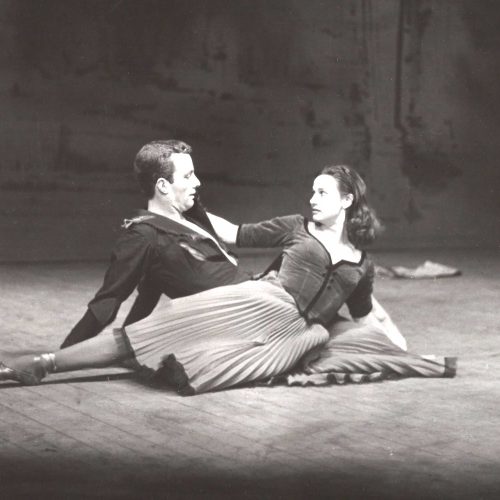
Anne Heaton
Anne Heaton’s career coincided with an upsurge in creative talent at the Sadler’s Wells Ballet. Observant and wide ranging she reflects on many things, not least the enigmatic choreographer, Andrée Howard. In this extract, which was recorded in 2003, she is interviewed by Patricia Linton, founder and director of Voices of British Ballet. The interview is introduced by Monica Mason.
First published: February 24, 2026
Biography
Anne Heaton was born in Rawalpindi, India, in 1930. She studied with Janet Cranmore in Birmingham from 1937 until 1943, and then with the Sadler’s Wells Ballet School. Her debut was with the Sadler’s Wells Opera in 1945 in a production of The Bartered Bride, and she became a soloist with Sadler’s Wells Theatre Ballet (SWTB) in 1946. That year, Heaton created roles in two ballets by Andrée Howard, Assembly Ball and Mardi Gras, and also in Celia Franca’s Khadra. In 1947, she created a role in Frederick Ashton’s Valses Nobles et sentimentales. She transferred to Sadler’s Wells Ballet at Covent Garden in 1948, where she specialised in romantic roles, for example, in Les Sylphides and Giselle. She performed again with SWTB when it was renamed The Royal Ballet Touring Company, creating the roles of the Woman in Kenneth MacMillan’s The Burrow in 1958 and the Wife in The Invitation in 1960. A foot injury caused her to resign from The Royal Ballet in 1959, but she continued to dance intermittently until 1962. Following her retirement from the stage, Heaton taught at the Arts Educational School and, from time to time, she staged ballets, including Giselle in Tehran in 1971. Having married Royal Ballet principal dancer John Field, who later became director of The Royal Ballet Touring Company, she co-directed the British Ballet Organization with him from 1984 until 1991. Field died in 1991 and Heaton in 2020.
Transcript
in conversation with Patricia Linton
ANNE HEATON: Aged 11, my mother took me to, not for an audition at all, but just to see if I was going to be taught to dance, whether I would be taught correctly. That was the idea. A very nervous 11-year-old performed a version of the Sugar Plum Fairy if you please [LAUGHTER] for Joy Newton, who was the ballet mistress [of the Sadler’s Wells Ballet School] at that time. I was allowed to sit in the wings and watch the evening performance.
PATRICIA LINTON: Can you remember who was dancing?
ANNE HEATON: Yes, I do. It was Coppélia and it was Margot [Fonteyn] and [Alexis] Rassine. Anyway, Joy Newton obviously went back and told [Ninette] de Valois that she thought she’d seen something worth looking at again, so I went for another audition up at the New Theatre where they [Sadler’s Wells Ballet] were and immediately got offered a scholarship to the school.
The two teachers who were just so wonderful were Vera Volkova and Ailne Phillips. Now, two more different human beings you couldn’t find. Volkova was full of “carry on” and panache and theatre and encouraging you to give, give, give. Babs, as we called her – Babs Phillips – we didn’t but she was called Babs Phillips! – she’d come in in a very nice pair of black high heeled satin shoes, sometimes with a stick, and sit down. And most of it was done by her hands in her lap telling you what to do. Now, this is a strange thing because she was responsible for the wonderful footwork that we had in those days – and we did have it. And, I mean, she would correct you verbally whereas Volkova would get up and do a lovely port de bras in front of you or something like this.
PATRICIA LINTON: When you were both at the school and young in the company did you feel part of the pioneering spirit?
ANNE HEATON: Pioneering, certainly, when news of the [Sadler’s Wells] Theatre Ballet came in and the others were moving to Covent Garden. That was the idea: we were at Sadler’s Wells and the big company moved to Covent Garden. That’s the reason for our being formed really.
PATRICIA LINTON: Well, I notice that you had your debut performance when you were only 15 in The Bartered Bride.
ANNE HEATON: Yes, That’s right.
PATRICIA LINTON: And that seemed to be the sort of unofficial birth of the Sadler’s Wells Opera Ballet, which almost immediately became Sadler’s Wells Theatre Ballet.
ANNE HEATON: And yes, we opened with The Bartered Bride and then progressed to our first actual night with Assembly Ball… that’s right, Assembly Ball which Andrée Howard had done.
PATRICIA LINTON: [Danced to] Bizet’s Symphony in C.
ANNE HEATON: That’s it. I would just like to talk for a moment about Andrée.
PATRICIA LINTON: I would love to hear about it because I know you created several ballets for her later.
ANNE HEATON: Yes, she created for me in the Theatre Ballet, the Mardi Gras, which was [about] the sort of semi-conscious dreams of a young girl – things like witches and different scenes and moods.
She was strange to work with, and she could drive you mad. I mean, later, when she did Mirror for Witches for me at Covent Garden, I think we finished it on the morning of the first performance or something! She could drive you mad.
Mirror for Witches. Huge sets, so, unfortunately, we could never tour it because the sets were absolutely wonderful. Music – Denis Apivor, I remember. But it was very strange, with these sorts of moods of madness, like throwing the dolls and all this snap mood changes.
PATRICIA LINTON: Was it uncomfortable to do?
ANNE HEATON: No, I loved it, but, I mean, it was one of those [ballets] where you were shattered by the end. It’s rather nice – I like to be shattered by the end. You know if you have put everything into it.
PATRICIA LINTON: Totally involved in it.
ANNE HEATON: Yes. No, it was great to do. Lovely. But really, I don’t think she has been given her full due for movement and contact with partners and people, and things like this, and I wish that a little bit more had been said about her.
PATRICIA LINTON: Was there a common theme in her work?
ANNE HEATON: No. I think all the ballets were quite different. They varied greatly.
PATRICIA LINTON: So, she managed to get these very strong emotions. Did she teach you how she wanted you to move to create an emotion or did she create the emotion in you and then you moved?
ANNE HEATON: She moved a lot herself. She was a “get up and go” choreographer. I think it was fairly formed in her mind. I mean, you get someone like Fred [Frederick Ashton] that comes up and says, “Do something pretty” and he starts from that. You know he has just done it out of the blue and taken a lot from that person. De Valois used to come in with it all written down and that was your lot!
PATRICIA LINTON: So, you had to be there to really catch this. Is this why you think it hasn’t handed down through the generations?
ANNE HEATON: Yes.
PATRICIA LINTON: Do you think it would be worthwhile trying to revive something of Andrée Howard’s now?
ANNE HEATON: No, I think that it’s gone. I think it’s gone completely. I mean, there is nobody, anyway, that would remember those things now. She died. She killed herself actually. It was sad about her. Maude Lloyd is the only person who… she was a great friend of Andrée’s, and she is the only person who knew what she did. She [Howard] killed herself in her flat. Everything was orderly, all the papers were seen to, the place was tidy. But we never knew – and I’m sure you’ve never heard – how she did it, how she was found.
PATRICIA LINTON: Was she a fairly lonely figure? Quite separate?
ANNE HEATON: Yes. Oh, yes, quite definitely.
PATRICIA LINTON: Did she used to socialise with you?
ANNE HEATON: John [Field, Heaton’s husband] and I had a house overlooking Clapham Common and she used to come and garden with me, and things like that. She knew a lot about flowers and she loved gardening. She was nice to be with.
PATRICIA LINTON: Well, I think we ought to talk about Giselle because in 1954 you danced Giselle to rave reviews with John Field.
ANNE HEATON: Oh, but the first time I did it was in Vancouver. We were on tour there. Margot was worked to bits and Beryl [Grey] was something and Violetta [Elvin]. I remember we did Homage to the Queen or something the night before and she snapped a tendon or something. Anyway, I remember Fred coming into my dressing room and saying, “Right, can you do Giselle tomorrow?” “Yes,” I said yes! De Valois had always hung it like a carrot in front of my nose, “You’ll do that one day Heaton, not yet.” [LAUGHTER] Do you think that is a good impersonation?
PATRICIA LINTON: Excellent!
ANNE HEATON: But the Company was so wonderful – there was no feeling of, “Why is she doing it and not me?” And Margot came and watched and it was such a lovely time.
PATRICIA LINTON: So, you just did the one?
ANNE HEATON: I did one there, yes.
PATRICIA LINTON: But in 1954 you danced it at the [Royal] Opera House with John Field.
ANNE HEATON: I adored doing it in London. Yes, the Second Act, particularly, I absolutely adored doing. And I think technically it suited me. I didn’t worry or anything in the Second Act. But I could never portray Giselle as an ordinary village girl. She wasn’t an ordinary country girl that he [Albrecht] fancied or anything like that. There was something different about her.
PATRICIA LINTON: Which already puts the whole ballet into a different perspective.
ANNE HEATON: Yes, yes. And I remember, again – it’s going to be a de Valois story – we were doing rehearsal one day and I couldn’t come on going, “yum, de dum, de dum”. It was different. And there was the lovely mime scene and everything there. But she stopped the rehearsal. “Heaton,” she said, “Giselle is not a dramatic ballet, now will you go back to the beginning and cheer up!” She said that to me! I couldn’t believe it. So, I cheered up like mad in the rehearsal room and did it when it got to the performance how I felt it.
PATRICIA LINTON: How you truly felt it?
ANNE HEATON: Yes
PATRICIA LINTON: In 1955 I believe Peggy [van] Praagh left the Sadler’s Wells Theatre Ballet, which was shortly to become a part of The Royal Ballet and John Field transferred to be the director of that company.
ANNE HEATON: That’s right.
PATRICIA LINTON: I believe also there was a big change in approach at this time, that they almost doubled the amount of people in the company?
ANNE HEATON: He built that company to equal proportions to Covent Garden. I didn’t go immediately with him – just a few weeks after. Talking personally about that, it was a very difficult move because I was being put as prima ballerina to that company over and above the Sara Neils, Doreen Temples, on people that were there. Plus, my relationship with John. So, you can imagine that it was a difficult situation. We worked very hard and he built that company up, really, and my gosh did we tour!
PATRICIA LINTON: From that company came really the most wonderful dancers for the next generation.
ANNE HEATON: That’s right, and I think John was responsible for that. All the David Walls and Christopher Gables…
PATRICIA LINTON: Michael Coleman
ANNE HEATON: Yes.
PATRICIA LINTON: Lynn… [Seymour]
ANNE HEATON: Lynn, yes. All of those people. They decided to break up the Touring Company – I’m sure you have heard about that? Dissolve it.
PATRICIA LINTON: I was there when they changed it into… it was when Ashton retired. I think that’s 1970, and they decided to bring both the companies together as one company and then just send out a splinter group which was to do experimental work.
ANNE HEATON: Well, I’ll tell you the nitty gritty about that. John was told that they were going to disband that [The Royal Ballet Touring Company], and that he and Kenneth [MacMillan] would be co-directors at Covent Garden. I remember Donald Albery at this time ringing me up and saying, “Anna, will you pop in and see me?”, and he was chairman of Festival Ballet then. And he said, “I want John to take over the directorship of Festival Ballet.” I said, “Oh, Donald, he’s going to Covent Garden, and you know how he loves The Royal Ballet and he’s got this new place with Kenneth”. And I remember Donald Albery saying to me, “It’s not going to be what he thinks”.
What happened, he found when he went to take over this new post, was that Kenneth obviously would be doing his ballets but, in fact, would be principal director and John was given an office, but somewhere upstairs at Covent Garden, and told not to go near the dancers – that was Kenneth’s bit.
PATRICIA LINTON: So, it was turning into an administrative post?
ANNE HEATON: Yes. But can you imagine? If they had told him that Kenneth was doing it and that that was that it would have been better. But to go through this sort of pantomime of co-directorship! What is so silly is that John would have been the best back-up that Kenneth could ever have had. He would have taken all the worries from Kenneth. Kenneth wasn’t a director – not really.
But no, he was told that he wasn’t giving classes and that he wasn’t to do anything. So, he stuck [at] this for a bit and started to look really poorly. We went for a walk one day near our flat in Kensington and he said to me, “Darling, I’ve got to leave, haven’t I?” And I said, “Yes you have, because you can’t go on like that”. And he said, “No, I can’t”. So, he gave in his notice and eventually moved on to various things like the Royal Academy of Dancing, and all these things. He and I went a few times to produce abroad, but I just think it was such an awful thing to do. Perhaps they were glad when he left, but it would have been better to have been honest.
The transcript of this podcast may have been lightly edited for ease of reading.
You may also like...
Patricia Thorburn

Clement Crisp