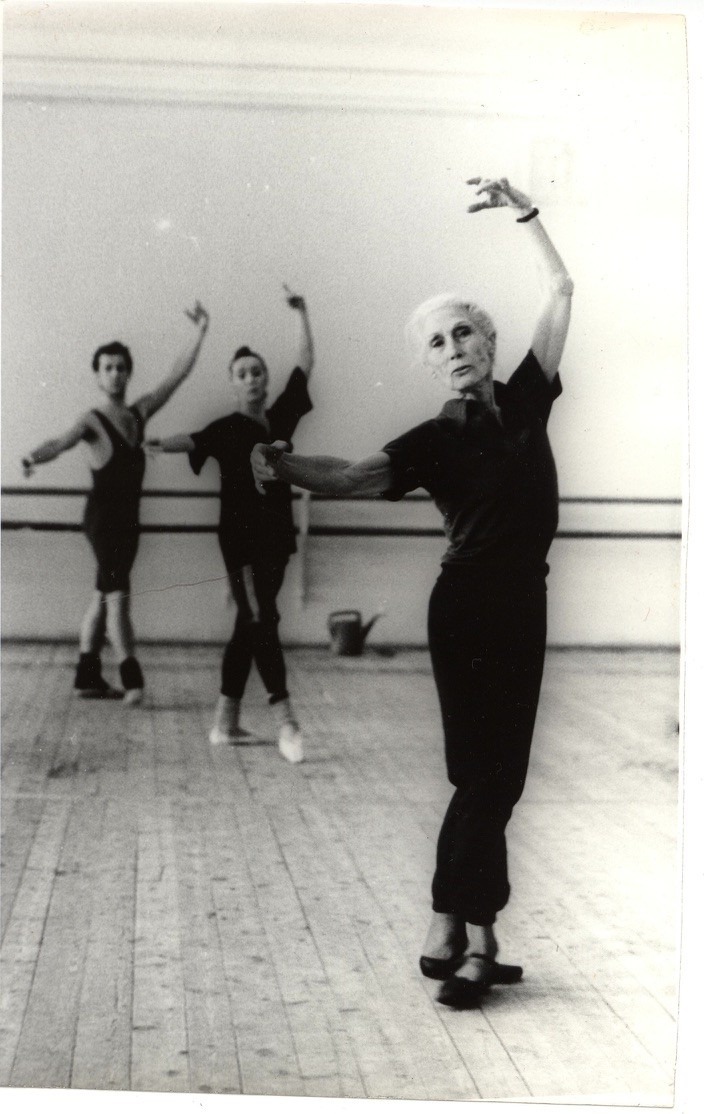
Barbara Vernon
In this interview with Patricia Linton, founder and director of Voices of British Ballet, Barbara Vernon illustrates that it is not all plain sailing out of the mainstream of the ballet world and gives a glimpse of a different sort of struggle, where dedication and belief are not quite enough – especially without funds. The interview, which was recorded in 2003, is introduced by the dance historian Jane Pritchard.
First published: May 12, 2026
Biography
Born in 1918, Barbara Vernon’s mother was aware that she was an artistic child and supported her in her endeavours. Her first ballet classes were in Birmingham, where she trained in the syllabus as set by the Royal Academy of Dance (RAD). From the age of 16, she danced with various small groups, but it was whilst performing in pantomime at the Gaiety Theatre in Dublin that her future life was set. There, she heard about the teaching of a Russian émigré ballet master, Nicholas Legat. When back in London in 1936, she joined his classes at 46, Colet Gardens. Legat died the following year, and Vernon then found her way to Léonide Massine’s studio in Monte Carlo, where she learnt a wonderful variety of repertoire.
These two momentous happenings – the teaching of Legat and the repertoire of Massine – were to shape and inform the whole of Vernon’s future life. During World War Two, she danced with various companies, including Mona Inglesby’s International Ballet, and the Anglo-Polish Ballet. It was whilst she was in the latter company that she met John Gregory, the multi-talented actor, artist, dancer and writer, John Gregory. The couple married in 1945 and later had two children together. In 1949 the pair created the School of Russian Classical Ballet in Chelsea, which developed into the Harlequin Ballet ten years later. This little group took ballet to the people for the following decade. From that time onwards they taught, lectured and wrote, and in 1995 the couple inaugurated the Legat Foundation. John Gregory died in 1996, and Barbara Vernon in 2007.
Transcript
in conversation with Patricia Linton
PATRICIA LINTON: Barbara, would you mind going back a little bit and talking about [Nicholas] Legat? You and your husband, John Gregory, were lifelong disciples of the Legat teaching method and great exponents of it. I know you were a wonderful teacher, but I’m fascinated that you danced with him for such a short time, really, but somehow you managed to capture enough for a lifetime.
BARBARA VERNON: That’s true! He didn’t make a labour of anything. His piano playing was light and humorous. He played for his own class. Music that suited him, that felt it inside him, he did the steps as it were from his soul. He always had this lovely studio, so we could always do a big diagonal from top corner to the bottom corner. It was just this complete abandonment, freedom, and yet there was a tremendous discipline. I mean, he was though, he wouldn’t let anyone just flop about. Really his class – they called it the class of perfection, it’s when a dancer doesn’t need immediate correction all the time. It’s just a movement class. Essentially class, his class, was a movement and this is what struck me so strongly because I had studied RAD [the Royal Academy of Dance syllabus].
What I had learnt was a step close, for a glissade – but his was never was just step close, his was step push and assemblé and push. It was an impetus for the next step – a glissade is a preparatory step. You never just separately analysed step close assemblé, step close assemblé. It was step close assemblé, sissonne, and away you go.
PATRICIA LINTON: Do you think these things were special to him, or do you think he caught it himself from his training? In Russia?
BARBARA VERNON: Definitely from his training in Russia.
PATRICIA LINTON: Do you think we have absorbed in any sense the Russian influence of Legat’s time from his teaching in London?
BARBARA VERNON: Not really. Because already the Royal Academy of Dancing was firmly established in this country, with their examinations, their syllabus, and also the ISTD [Imperial Society for the Teachers of Dancing]. These two organisations were firmly established, and they gave the syllabus and the certificates.
PATRICIA LINTON: Could it be taught now in the way that you caught it?
You’d established your school. Through the fifties you had a lot of pupils, and you did a lot of performances, I think, at the French Lycée you quite often put performances on. When did you decide to make a company, the Harlequin Ballet?
BARBARA VERNON: After ten years, we had the nucleus of nice material, and we were ready to make a small group. But one of the chief things about it was that we had live musicians and we travelled with a quartet of musicians.
PATRICIA LINTON: Did it last for ten years, the Harlequin Ballet?
BARBARA VERNON: Yes, very nearly. All but all, but at the end of ‘69 we had our grants cut. There’s a lot of diplomatic intrigue in ballet, and I think we were too successful. Everywhere we went they loved us. On tour we had a great success everywhere and they used to say, “How is it you can stand up on our stages and other companies can’t?”, and John just laughed and he said, “well I wash the floor before we start with Coca Cola!”, so it has a grip, so that we could grip it.
Critics, when we came to London, they used to absolutely… I don’t understand why, they used to absolutely flatten us, whereas on tour everywhere people were delighted with our performance. But in London we couldn’t please London critics.
PATRICIA LINTON: And you don’t know why that was?
BARBARA VERNON: They were primed not to praise us.
PATRICIA LINTON: Was that to do with your dedication to the Russian system or what?
BARBARA VERNON: No, it was just that we were too successful. I’m sorry, but [Ninette] de Valois said, we can do what they’re doing, that’s why Ballet For All was made… there’s no need for this company. She wanted to get rid of us. I mean De Valois really plotted against us. I mean, she didn’t want us. She said, “But The Royal Ballet can do that, Ballet For All can do it, there’s no need for Harlequin”. There was, oh, such intrigue.
PATRICIA LINTON: Can we talk a little about the repertoire of Harlequin Ballet, which was actually very, very big and with a huge range of music and ideas?
BARBARA VERNON: Our aim was to entertain not to educate. I mean, De Valois said we were educating people wrongly because we did a version of Chopiniana or Les Sylphides which was taught to us by Cleo Nordi, who had been – I don’t know – ten years, I think, with [the Anna] Pavlova [company] and, of course, it was Pavlova’s version of Chopiniana. I thought it was charming, but de Valois said, “No, this is not Chopiniana, and you call it Fokine’s original and it is not Fokine’s original”. And I said, “Well, that may be. I still find it charming choreographically”. I said, “We also dance Dying Swan, [it] is danced by Yvonne Meyer who learnt it from Cleo Nordi, and Cleo Nordi again studied it from Pavlova’s company, so I don’t think there’s anything very wrong in that choreography.
PATRICIA LINTON: These sound like wonderful ties to Pavlova and the Russian ballet.
BARBARA VERNON: Yes, yes, yes. Look how Pavlova danced all over the world and danced on rickety stages! She was an amazing artist and trouper. I can only say that our company was a happy company. We enjoyed travelling around in our coach. We had a coach that came to our studio door, and the girls all gave a hand, and loaded, and then when they unloaded, they were all prepared to sort out their dressing rooms and to set up the ironing board and iron!
PATRICIA LINTON: So, a real camaraderie!
BARBARA VERNON: Yes, absolutely! I must say John always saw that they had a good meal served to them in the evening when they had finished, and decent digs, somewhere to stay. Sometimes it was hospitality, and sometimes it was a hotel. It varied. They all wanted to dance; they were doing what they wanted to do, and so they didn’t complain. We had one boy who tried to tell them, “Well, John is underpaying you. You don’t have equity rates”, and all the rest of it, and they just laughed and said, “Well, we’re perfectly happy. We know that John pays us what he can and we’re happy to work. We enjoy the work, so don’t interfere with us”.
PATRICIA LINTON: Did John do all the administration?
BARBARA VERNON: Absolutely, yes. He was incredible. He was disappointed in the end that he couldn’t get into the studio to choreograph. He had so much office work to do – to book hotels or to book tours, organise the coach to come at the right time etc. So, it was big work for him. He was disappointed that he could not create or choreograph anymore. I mean, I was always backstage ironing or sorting out costumes, or stitching.
PATRICIA LINTON: You were teaching and dancing as well!
BARBARA VERNON: Yes. On all the bus journeys I was either gathering tarlatans or changing, fitting bodices, and goodness knows what! On every journey there was something that had to be done.
PATRICIA LINTON: And did your musicians travel with you?
BARBARA VERNON: Mostly, yes. Sometimes they had a car – they had their own way of getting there, but yes, mostly they travelled with us.
PATRICIA LINTON: Did you have a company pianist?
BARBARA VERNON: Company pianist? Yes. We had some calamities somewhere. One pianist came and said, “I don’t need to look at the music, it’s alright, I can read quickly. I’m a quick manuscript reader”. And when it came to it, you couldn’t get a sound out of her! She didn’t play a thing, so we had to sing – literally, we were singing from the stage! Oh, God! We had some times!
The transcript of this podcast may have been lightly edited for ease of reading.
You may also like...
Lynn Seymour
Patrick Harding-Irmer