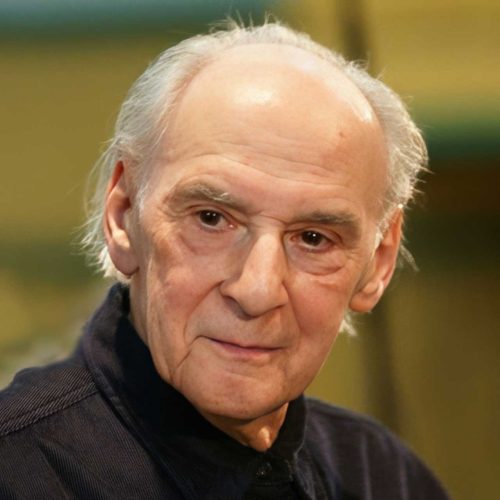
Violetta Elvin
Violetta Elvin was one of Frederick Ashton’s favourite ballerinas. She was born Violetta Prokhorova in Russia. Here, in this interview with Patricia Linton, founder and director of Voices of British Ballet, Violetta traces her evacuation to Tashkent at the start of World War II and how she returned, via Kuibyshev, to Moscow to join the Bolshoi Ballet. Despite being warned by the authorities not to talk to foreigners, she married the British diplomat Harold Elvin and managed to come to London in 1946. Only weeks after her arrival she joined the Sadler’s Wells Ballet at Covent Garden and danced the “Blue Bird” pas de deux on the second night of their opening production of The Sleeping Beauty. The interview is introduced by Monica Mason.
First published: January 6, 2026
Biography
A dancer of rare beauty, Violetta Prokhorova was born in Russia in 1923. She trained at the Bolshoi Ballet School in Moscow and joined the Bolshoi Ballet in 1942, following her graduation performance, for which she was coached by Galina Ulanova. When Moscow was evacuated and the Bolshoi was scattered, she danced as a ballerina with the State Theatre of Tashkent. In 1944 she rejoined the Bolshoi in Kuibyshev, on the Volga, where she fell in love with a young Englishman, Harold Elvin. The Bolshoi returned to Moscow in early 1945. She danced with the Stanislavsky Ballet for a year, then married Elvin and obtained permission from Joseph Stalin to leave Russia.
Once in London Violetta started training with Vera Volkova, where she was seen by Ninette de Valois and immediately offered a place in the Sadler’s Wells Ballet. She adored and was true to her Russian training, but with her intelligence and sensitivity she was able to fit in beautifully with the British repertoire. From the Black Queen in de Valois’ Checkmate, through all the classical ballerina roles to Roland Petit’s Ballabile in 1950, Violetta Elvin as she was now known, danced with exquisite vivacity, a hint of exoticism and always impeccable port de bras. Frederick Ashton created several roles for her, notably the Summer Fairy in Cinderella (1948), Lykanion in Daphnis and Chlöe (1951), and one of the seven ballerinas in Birthday Offering (1956). For a decade Violetta Elvin was a unique and irreplaceable member of the developing Sadler’s Wells Ballet. She went to live in Italy in 1956, and although she guested with several companies, including La Scala, Milan (where she performed alongside soprano Maria Callas) in 1952 and 1953, and briefly directed the Ballet of the Teatro San Carlo in Naples in 1985, she retired from ballet when her heart called her elsewhere.
Transcript
in conversation with Patricia Linton
Violetta Elvin: And the next thing, shall we say, the period of the Bolshoi. So, again, I was very lucky when I stepped in and was starting having lessons with Elizaveta Pavlovna Gerdt. In that class there were [Galina] Ulanova, [Olga] Lepeshinskaya, all the soloists and prima ballerinas and some young dancers, like myself, who just stepped in. And that was a splendid beginning of the year to be there.
I was called to the director’s office, and he wanted to talk to me to say of the future, what he would like me to do, and he said kind words. He said, “Well, God give you a lot of talent and it depends on you how you will use it. I would like you to start to learn Raymonda to prepare as your first leading role. But you must stop seeing foreigners, because you don’t realise we’re in such a difficult moment for us as a country. It’s always very dangerous to meet casually with foreigners because your sentences can be completely misinterpreted and used for ill use. So you must stop.”
So, I said, “Alright, I will give a lot of consideration to that, and we’ll see.”
And then, of course, I did continue seeing friends that I met that were from [the] British Embassy. And then I was called and said, “It’s better that I leave the Bolshoi”.
Patricia Linton: Were you frightened at this moment?
Violetta Elvin: Well, it was difficult. Yes, it was, but I thought if they were listening to my conversation, I knew what I was saying. I never would say a word against my country, because I was a patriot. Of course, that didn’t mean anything because things were… strange things were happening. People were patriots but they were sent to [prison camps in] Siberia. I was careful how I was meeting Harold Elvin, and so on.
But anyhow, I had a very good year in [the] Stanislavsky Theatre. And that was a very good experience because there was a very good ballet master whose name was [Vladimir] Bourmeister. He did quite a number of ballets and he did very nice ballet for me, Lola, and then there was a ballet, it was Straussiana, and I did the leading role, and it went very well. So, it was very good experience because they were very much working on preparation of roles on Stanislavsky technique of preparation. As much as possible in a natural way, acting, not in a traditional way of miming and so on. That all helps to be more natural on the stage in expressing oneself. It was fascinating. And then I got a visa.
Patricia Linton: And you left legally?
Violetta Elvin: And I left legally, you see. But not that I was particularly keen, but I mean in my case I met Harold Elvin. He was architect by profession but when war broke out he was a pacifist and then he had the chance to go to Moscow. And the chance to be in Moscow he could be a night-watchman in the embassy in Moscow. He thought, being a night-watchman, he would be able to write and in fact he wrote his first book, The Cockney in Moscow it was called.
When we came and arrived in London, to start with we were living with his parents in Stanmore it was. He continued writing and I started already working, and, of course, he wasn’t gaining any money, and he said, “Is it alright?” I said, “It’s perfectly alright”.
Of course, I was generous with him and, as I say, we were never saw money as a sort of important thing but was a great believer that everything should be alright. And, in fact, it was alright. In fact, Dame Ninette de Valois, after she has retired and I have retired, we met, I remember, once in London and she took me for lunch she said to me, “You know, Violetta, you were the only ballerina who never went to my office to ask for more money” and I thought, “Well, because really I was lucky”. First, because whatever was given to me for me it was great money because, you know, being in another country and I was doing splendid things. I started with the “Blue Bird” [pas de deux] at Covent Garden for the second night of The Sleeping Beauty after the company started to be working in the big opera house, and I was lucky also in that. Coming from the Bolshoi Theatre it was lucky that I was stepping into another big theatre.
Patricia Linton: How did that come about?
Violetta Elvin: Well, that is also by chance! Somehow, it happened that maybe because I was Russian and [Arnold] Haskell had a wife, she was Russian, and they invited me once for lunch with my husband. And I was asking them, where could I go to practice and they told me about [the] West Street [Studio]. Vera Volkova was teaching there. So I thought, “Good. I will start immediately, practising”. And then I think he said, “The best thing would be if maybe the director of the Opera House goes to see your classes when you have a class, so she will decide if she would like you as a dancer.”
And that’s how it happened. De Valois came, she saw me and after class she said to me, “We are opening with The Sleeping Beauty, and I would like you to do the ‘Blue Bird’ pas de deux.” So, I said, “Well, very nice, thank you very much”. That was finished then when, nearer to the time, maybe already when I started, entered the company, she said to me and I think this just shows a what a charming person she was, because one hears bad things from ballerinas. “Oh, she was difficult!” Well, I was lucky because she came to this little Russian girl, in the end, I’d just come out of the school at the Bolshoi. She came to me, who was in a very weak position, she was saying to me, “You know, I must say I have promised the ‘Blue Bird’ to a dancer that has been with us for a long time and I promise her to do ‘Blue Bird’ on the first night at Covent Garden of our opening, her name is Pamela May” . Well, I said, “That’s perfectly alright. I couldn’t care less if I’m on the first night or second night! That’s perfectly alright” And that’s how it happened. So, Pamela was doing “Blue Bird” on the first night and I did it my second.
Patricia Linton: And you did it with?
Violetta Elvin: I did it with Alexis Rassine, yes.
The transcript of this podcast may have been lightly edited for ease of reading.
You may also like...
Pamela May
Henry Danton