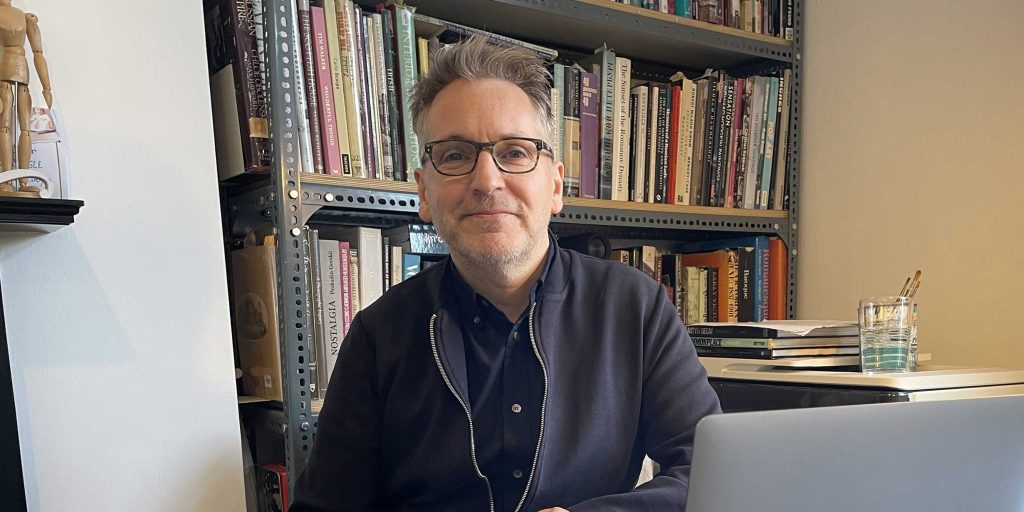
Tom Pye
In this 2023 interview British theatre designer Tom Pye talks about his career in dance with Jonathan Gray, dance writer and former editor of Dancing Times magazine, who was also a fellow student with him at Wimbledon School of Art during the late 1980s. Pye talks about his work on The Royal Ballet’s new production of Frederick Ashton’s Cinderella in 2023, and how a thorough understanding of the construction of ballet costume has helped him find some surprising solutions to designing authentic period costumes for television.
First published: October 13, 2026
Biography
Born in Lincoln in 1968, Tom Pye studied for a BA Hons in Theatre Design at Wimbledon School of Art from 1986 until 1989. His best-known work as a designer includes the BBC television series Gentleman Jack, and the award-winning stage productions of My Friend Totoro and Paddington The Musical, as well as West End productions of Medea, Brokeback Mountain and Who’s Afraid of Virginia Woolf? In opera, he has worked with the director Deborah Warner on productions of The Turn of the Screw, Death in Venice and Eugene Onegin, as well as English National Opera’s acclaimed production of Akhnaten directed by Phelim McDermott. For ballet, Pye has worked closely with the choreographer Yuri Possokhov on a production of The Seagull for the Bolshoi Ballet, as well as Anna Karenina, Eugene Onegin and The Nutcracker in the USA. For The Royal Ballet, he designed the sets for the new production of Frederick Ashton’s Cinderella in 2023.
Transcript
in conversation with Jonathan Gray
JONATHAN GRAY: Hello. This is Jonathan Gray. I’m talking to Tom Pye, the theatre and costume designer, and this is a recording for Voices of British Ballet. So, Tom, we’ve known each other for a very, very long time. [Laughs]
TOM PYE: We have, yes.
JONATHAN GRAY: But I think I’d like to know… get a bit of background information about you and the family, first of all. So, you were born in Lincoln, is that right?
TOM PYE: Umm, I was actually born in Norwich…
JONATHAN GRAY: Norwich.
TOM PYE: … but I grew up in Lincoln from the age of four.
JONATHAN GRAY: And did you come from a kind of artistic family?
TOM PYE: No, not really. My mum was a health visitor, my dad was an engineer, [he] worked for the Council. My grandmother was an amateur painter.
JONATHAN GRAY: Right.
TOM PYE: Her paintings were very beautiful, but it was only amateur, sadly.
JONATHAN GRAY: Did she want to go on and do something like that…
TOM PYE: I think she did, but I don’t think she had the means or… You know, in those days, and the War was on, and all those things.
JONATHAN GRAY: So, how did art kind of emerge in your life then? Was it something that you came across at school or feel…?
TOM PYE: Yeah, I felt it sort of rescued me at school, to be honest. I didn’t have an easy time at school.
JONATHAN GRAY: Right.
TOM PYE: I went to a comprehensive, which was fine, but I wasn’t very academic. I was… I am dyslexic and they didn’t really work that out until I was 14, which was a bit too late really.
JONATHAN GRAY: It took a long time [to recognise dyslexia] in those days.
TOM PYE: It did take a long time, yeah. So, I was really messed around in school: I was in “A Groups” and then in remedial groups, in the shed at the back, [both laugh] and they really didn’t know what was going on. I think in the end that’s given me some very good tools, because I can get hold of anyone and everyone, because I have to, but it left my schoolwork a bit of a mess. It was chaos really, and the art class was the only sort of consistent thing that I was constantly good at, and excelled and enjoyed, and so did art after school.
JONATHAN GRAY: OK. So, you had a good teacher there as well?
TOM PYE: Yeah, I had a great teacher there. Yeah, that was really, really essential, I think. And then so I left school when I was 15.
JONATHAN GRAY: Right. Before your GCSEs [General Certificate of Education] or…?
TOM PYE: I did, yes. Not officially.
JONATHAN GRAY: What were they called in those days? CSEs (Certificate of Secondary Education]?
TOM PYE: They were called CSEs and O’ [Ordinary] Levels, yes. Umm, yeah, not officially, I just never turned up, but I’m also the youngest in the year, so I would have been 15 when I graduated anyway.
JONATHAN GRAY: Yes, I forgot you were the baby of our year!
TOM PYE: I was the baby, yeah! [Laughs] I was particularly baby because I didn’t do A’ [Advanced] Levels, you know? I went and left school at 15, went straight to art college, did [a] two-year foundation.
JONATHAN GRAY: And they were… you were allowed to do that, were you?
TOM PYE: Yeah, they managed to… I had some great support at Lincoln Art College, and they made me do an extra A’ Level… well, one A’ Level.
JONATHAN GRAY: Art, was it?
TOM PYE: No, it was Ceramics.
JONATHAN GRAY: Ceramics. OK.
TOM PYE: Yeah, so I did that on the side very quickly during my foundation, and that gave me just enough to get into Wimbledon [School of Art].
JONATHAN GRAY: Right. So, whilst you were doing your foundation course, were you already thinking about doing theatre as…?
TOM PYE: I was, yeah. I’d seen some amazing pieces of theatre whilst at school. The RSC [Royal Shakespeare Company]in those days toured schools and did things in gymnasiums, and they did an amazing production of The Crucible in Lincoln nave at night, which was extraordinary, with Alun Armstrong, and that really blew me away.
Umm, and I understood the sort of power of staging and what staging was, and they used the entire space, and it was promenade and… partly promenade and that really got me going. And then I, of course, went to go and see Cats [both laugh] – all those productions that were of that time. Amazing.
JONATHAN GRAY: So, were these school trips to see things in London…
TOM PYE: Umm, no
JONATHAN GRAY: …or was it you went on your own, or…?
TOM PYE: No. I’m trying to think. I think I went on my own to the things that were in Lincoln; but it must have been a school trip. I know that we went to see Turn of the Screw in Nottingham, the opera, and that’s…
JONATHAN GRAY: Mmm. And that was with Opera North, was it?
TOM PYE: Must have been, yeah. That’s kind of amazing seeing that. So, yeah, I think maybe it was the school or partly my family. I can’t remember who I went to see Cats with. I think friends.
JONATHAN GRAY: So how did your family feel about you going on to art school then? Were they…? Was it a kind of surprise to them, or…?
TOM PYE: I think it was a relief!
JONATHAN GRAY: Yeah? [Both laugh]
TOM PYE: I think it was, because I had two elder brothers who both did chemistry and a science. They did physics degrees, and so that was the sort of the way the family was going – the physics and engineering, and things like that. So, when I said, “I’m going to art college”, I think they went, “Oh, thank God, [JG laughs] he’s doing something”.
JONATHAN GRAY: So, you went on your foundation course – and for people who don’t know, foundation courses are where students learn all kinds of disciplines within art, so they learn painting, printmaking, photography, err, fashion, ceramics, lots of things – so, how quickly did you kind of think, “Oh, I’m gonna go down the theatre route”. There, or…?
TOM PYE: Quite quickly. I mean, I remember… I think in the second year I… you had to choose in the second year…
JONATHAN GRAY: To specialise?
TOM PYE: Specialise, yeah. And there was a group run by an amazing teacher called Diane Peacock who did what she called Combined Arts, and it was the crazy lot. It was the sculptors and painters and people that worked in performance art and theatre as well. And she gave a speech on the first day of that and said, you know, “The one thing that I would, you know, warn you about doing is theatre, because it’s the most competitive thing.” And I sort of sheepishly [JG laughs] put my hand up and said, “Yeah, that’s what I want to do.” But I found the two-year foundation was just fantastic. The first year was so sort of solid. I don’t remember it being, you know, a bit of everything. What I really remember from it was a really solid foundation in colour theory and all those kinds of things. Just really solid, you know? Perspective and colour theory, and tone and light and shadow, and composition, the things I use every single day; you know I still…
JONATHAN GRAY: Did they give the colour-blind test while you [laughs] were there as well?
TOM PYE: No, I don’t [JG laughs heartily] think I did. I’d hate to do that.
JONATHAN GRAY: Yeah. They did for us [at Leicester Polytechnic Art and Design Foundation Course].
TOM PYE: Did they?
JONATHAN GRAY: Yeah, so we had…
TOM PYE: That’s very funny.
JONATHAN GRAY: … like these very colourful pictures that you had to work out where the line of dots were, and that kind of in a different… yeah.
TOM PYE: Yeah?
JONATHAN GRAY: So that was quite interesting!
TOM PYE: That would be… They did amazing, umm, things. After teaching us all this colour theory, they sent us out on the streets with pieces of cardboard, so big, and you had to mix paint and hide them.
JONATHAN GRAY: Ah, OK.
TOM PYE: So, you placed them on tarmac or on a big stone or on grass, and you had to mix the exact colour, so it was as invisible as possible.
JONATHAN GRAY: Yeah, oh that’s…
TOM PYE: I really remember that.
JONATHAN GRAY: That’s very good.
TOM PYE: It’s a really good exercise; it really makes you look.
JONATHAN GRAY: So, you’ve finished your foundation course, and you then had various options to go and do theatre design courses, all mainly in London, but all… So, what was it that made you decide to go to Wimbledon [School of Art]?
TOM PYE: Oh, I don’t know! I remember…
JONATHAN GRAY: Did you like just…? Did you go visit and think you liked it?
TOM PYE: I think… There was that. I do remember I went… I got into Worthing and Trent as well, applied to three different courses, but Wimbledon… There were two things: Wimbledon was just so much more theatrical, and it had its own theatre. I liked the fact that, you know, they’d put on plays. They did everything. There was an extraordinary atmosphere to the place at the time, but I also had a friend, Annabel Lee, who was…
JONATHAN GRAY: Oh, yes!
TOM PYE: …two years above me at school. I caught up with, through doing … [indistinct] by not doing A’ Levels, umm, and so she was already in… What year was she in?
JONATHAN GRAY: She… Well, just for people to know, Tom and I were on the same course in the same year. We joined in 1986?
TOM PYE: Yes.
JONATHAN GRAY: So, Annabel, I think, was a year above us, wasn’t she?
TOM PYE: She was in Damian…
JONATHAN GRAY: Damian’s year.
TOM PYE: Yeah…
JONATHAN GRAY: Damian Dibbens… Dobbin, Dibbin?
TOM PYE: Dibben.
JONATHAN GRAY: Dibben, yeah. Umm, so, err, yeah…
TOM PYE: So, one year above.
JONATHAN GRAY: Yeah. So, did she show you round when you came or not?
TOM PYE: I lived with her, so I moved in with her in a shared house, and then we left that shared house because it was chaos and moved into… So, for the first year, I lived with Annabel in shared accommodation, so that was really helpful and [a] good leg-up in… Lots of inside information about the lecturers and who to avoid!
JONATHAN GRAY: [Laughs] So, what did you feel you gained at Wimbledon, ‘cause there are very… there is a range of teachers, and some were better than others – let’s put it politely!
TOM PYE: [Laughs] Let’s put it politely, yeah!
JONATHAN GRAY: But there… obviously there were some quite inspirational people working there as well. I think we talked before about Richard Negri?
TOM PYE: Yes.
JONATHAN GRAY: Who…
TOM PYE: Richard Negri was extraordinary. He was really… Yeah, I think he was a massive influence on me. I still think… I still hear his voice in my head, and when I’m talking about design, I find myself quoting him and thinking about him.
JONATHAN GRAY: So, what do you think you learned from him, in particular, that inspired you later on as a designer?
TOM PYE: I think his sort of methodology on design. I think we talked… I mean I remember his… you’d have an hour with him, looking at… and he would see extraordinary things that I hadn’t seen in my own work. And I remember picking up a piece of fabric and putting it onto a figure on… in one thing, and he suddenly went… it was extraordinary, amazing. I found it on the floor, but… [JG laughs] He was… he was incredibly smart and quite obtuse in the way he spoke to you. It was all… it was very abstract, wasn’t it, in the way he…?
JONATHAN GRAY: Yeah, and the way he came from… to things that had a slightly different angle as well. Was he your personal tutor?
TOM PYE: I don’t know, to be honest. I do remember I really connected with him in the first year. He might have been, I’m not sure.
JONATHAN GRAY: Because I think I had Malcolm Pride as my personal tutor [laughs] and, umm… Yeah, I think with Richard, ‘cause I was involved in the drama thing that he put on, and he was really looking at ways of approaching music and speech in a kind of off kilter way, which… but then would somehow all join together in this performance that we did, and at the end of the first year, I think.
TOM PYE: I vaguely remember that, yeah. Yeah, it was very out there, wasn’t it?
JONATHAN GRAY: Yeah.
TOM PYE: But he would just… He was just very challenging in a great way. He’d just make you think about things in a really extraordinary way. But he… also simple things, just… Err, I remember him talking about research and about the mountain and, err, that you… that… And I still think of that, but I think it more as a sort of spiral that when I’m on a project, I am just collecting, collecting, collecting, collecting, collecting as much research as I possibly can, until there is a mountain there, and he says, then you have to throw it all away and find the diamond in the middle of the mountain, and use that one thing, and it’s a great piece of advice, and I think it’s really relevant.
JONATHAN GRAY: So, at Wimbledon, we learnt about technical drawing and costume making, and costume designing, and the history of costume, architecture, and the history of theatre and dance, and opera, and we also learned about making models, and that side of it. And we also had a dissertation to do as well, so being dyslexic that [TP laughs] that was…
TOM PYE: That was really a challenge, yeah. [Laughs] It was not my finest hour; I didn’t enjoy that one bit.
JONATHAN GRAY: So, did you feel that you got a very well-rounded education in theatre from being there?
TOM PYE: Yeah, I think it was good. I think the practical level I learnt a lot, I think, working on other people’s shows. If you remember, Mark Tildesley was in the year above us, and working for people like him was really inspirational; you know, he then went on to design the Olympics and… But I remember… it’s not so much the coursework, it’s the atmosphere of the place [that] really changed me, I think. And do you remember the fact that every party we had was a fancy-dress party?
JONATHAN GRAY: [Laughs] Yeah! Yes, I had forgotten that!
TOM PYE: Just everything was very over-theatrical, and Mark Tildesley, I think, arrived at one party in a spaceship that he’d flew in from the…
JONATHAN GRAY: Oh, that’s right.
TOM PYE: Yeah. I mean it was that kind of a place. It was all was extraordinary, it was, umm… There was this kind of feeling that you could do anything, you could try anything. And I did a lot of work outside at the time, so it just gave me the confidence to go and start working in the business in a way. I mean, I was immediately designing shows down the road at the Wimbledon Attic while I was in the third year but also working for Annabel’s… a lot of people in Annabel’s year, so… you know, and those gave me jobs. The minute I left college, I was working on Robin Hood, Prince of Thieves, because Jimmy was working, you know… was from the course, and, umm, Ann, one of our lecturers was…
JONATHAN GRAY: Umm, oh, what was her second name? She was married to John…
TOM PYE: Bloomfield.
JONATHAN GRAY: Bloomfield.
TOM PYE: Yes.
JONATHAN GRAY: And she was a costume designer as well.
TOM PYE: Yes.
JONATHAN GRAY: Umm, Ann Beverley.
TOM PYE: Ann Beverley.
JONATHAN GRAY: Yes.
TOM PYE: Yes, so I ended up working for them, which was a great, great piece of err… extraordinary hard work, but…
JONATHAN GRAY: So, John… John designed, umm, The Last Emperor, and…
TOM PYE: No, I don’t think he did.
JONATHAN GRAY: He did the costumes for it?
TOM PYE: Oh, no that was… that was…
JONATHAN GRAY: He did, umm, James Acheson!
TOM PYE: Yeah, that was J… who also came to our college, yeah.
JONATHAN GRAY: Yes, that’s right, that’s… I’m mixing them up.
TOM PYE: Yeah, John designed… well, Robin Hood, Prince of Thieves, but he did… err, was it Westworld? He did another Kevin Costner film. And he had a big career; he did a lot of Hollywood sort of blockbusters.
JONATHAN GRAY: So, you feel that they… you were prepared on the course to get… kind of enter the professional world, or…?
TOM PYE: Yeah. I think what worried me later on was when they took our course and turned it into about 17 different courses. Because what I felt was when I left college, of course I didn’t really have the skills or confidence to go out and design in massive stages, but I did know how to scene paint and did know how to build a flat, and I did know all those kinds of skills. And so, I immediately started working as a painter and prop maker, and so I could support myself and, you know, I think that’s really essential.
JONATHAN GRAY: That was the problem, wasn’t it, for being able to just live in London and try and work at the same time, and that was what I found very difficult afterwards, which is why my career went off in a completely different direction in a way.
TOM PYE: Yeah.
JONATHAN GRAY: So, you graduated and you’re doing jobs for other people. So, when did it start that you were asked to do your own designs for plays and things?
TOM PYE: Umm, umm… I mean quite early on I managed to sort of juggle, so while I was doing… I mean it was a good balance between… you know, I could do a pop as a painter and earn quite a lot of money, and then that would help fund me do a little play in a pub theatre, so I was always doing both. And those fringe theatre jobs grew quite quickly into bigger jobs, and I got a show at the Lyric Hammersmith, quite early on, in the early 1990s. Umm, and I was also working in the States…
JONATHAN GRAY: Oh, were you?
TOM PYE: Yeah. I used to do theatre camp.
JONATHAN GRAY: [Laughs] What is theatre camp?
TOM PYE: Oh, well, it was… err… It was a place called Stage Door Manor, and every summer I would go over there, and kind of be dropped in the middle of Upstate New York, and I designed the main house [production] there. They had about five or six different theatres, and all these kids would descend, and we would put on, just in my theatre, three shows every three weeks…
JONATHAN GRAY: Wow…
TOM PYE: …and those three shows were back-to-back, with an hour in between them. And they weren’t little shows, they were like 42nd Street, followed by A Midsummer Night’s Dream and then… you know, it was huge and it was really challenging.
JONATHAN GRAY: So, these kids were acting in them, performing in them, and helping you make the things, were they?
TOM PYE: Yes, a little bit, yes.
JONATHAN GRAY: Yeah?
TOM PYE: Yes, err, though I used to work nights often to be able to be in there, but, yes, I used to do the odd teaching class as well.
JONATHAN GRAY: Yeah?
TOM PYE: But it was very good, you know? In at the deep end: right, you’ve really got to turn out nine shows every summer; and it’s just me and a carpenter. [JG laughs] It’s… and we did some extraordinary things. And it’s very funny looking back at those actors [who] were in those… you know, there were people like Natalie Portman…
JONATHAN GRAY: Oh, really?
TOM PYE: Yes, opposite somebody other… who was incredibly famous in the Midsummer Night’s Dream I did and, yeah, a lot of them have turned out to be quite famous. Lee… shower [phonetic] I think, lots of people, yeah.
JONATHAN GRAY: So, you were working in America and in the UK, so when did you feel that you’d kind of started properly, as your own theatre designer person?
TOM PYE: Pretty much around that time, yeah. I think going to the States and working there, I did that [for] four years in a row. I got poached by another place, and so pretty… Yeah, that gave me the confidence to think, OK, I am a designer. I remember somebody saying that, you know, there’s something about when you say you’re a designer. Something shifts, and you stop describing yourself as… And I remember doing that at work and getting a sort of side glance from my boss, [JG laughs]. “I’m not actually a painter, I’m a designer”, but, you know, this is how I support myself. But it’s… mentality is really important, actually. It suddenly shifts… you know, your focus.
JONATHAN GRAY: So, did you ever work as an assistant to a designer? It’s like Richard Hudson, who worked for [Nicholas] Georgiadis and Yolanda Sonnabend, and… did you have that kind of experience as well?
TOM PYE: Weirdly, I didn’t. No. That was something… I’m not very good at those kinds of skills [both laugh] to be perfectly honest. You know, I’m not a great technical drawer; I don’t have those computer skills. I’m an OK model maker, but it’s not my best thing.
JONATHAN GRAY: No, but when we were doing technical drawing, it was…
TOM PYE: Hand drawn…
JONATHAN GRAY: … hand drawn, yeah.
TOM PYE: Yeah, the first Broadway musical I ever did, every single thing was pencil drawn on paper, so, yeah, we weren’t really that generation. So, I don’t have those skills, I would be a pretty rubbish assistant, if I’m honest. I… So, I never really did that. I think I might have lost out in some ways, ‘cause there were some technical things you learn by being an assistant, you know? There’s all that how lifts work and automation and things like that. So, I’ve always found that slightly kind of, “How does that… actually work that?” You pick it up as you go along.
JONATHAN GRAY: And also, I guess, fabric shopping and all that kind of thing as well, and costumes and…
TOM PYE: Yes, you pick those things up, as you go.
JONATHAN GRAY: So, you… I guess you started off in drama, and then moved into opera?
TOM PYE: Yeah, well, I…
JONATHAN GRAY: Tell us about some of the shows that you worked on in that time.
TOM PYE: I mean I didn’t actually. I started out… umm, probably my first biggest break was MTV.
JONATHAN GRAY: Right.
TOM PYE: I can’t remember how I got the job, but I ended up having a really close relationship with the artistic director of MTV Europe, and he got me into redesign their main studios, umm, the sets for all their shows, and then it… I practically became on the staff, ‘cause every single week there would be another show or another live performance or a…
JONATHAN GRAY: And I guess this involved dance as well as singing?
TOM PYE: It involved everything, yeah, yeah. It was very wide ranging, and it was very exciting and it was a mad place. So, for about seven years from the mid-1990s, I designed just about everything that MTV Europe pulled out, so that was great, that was a great employer.
JONATHAN GRAY: Yeah.
TOM PYE: And then I started to work… I think the thing that drew me… So, I was… I was very TV-based really, and then there were two jobs that sort of pulled me back into theatre. One was Gloriana. I think this all came through Fiona Shaw and working for the Open University, actually, but the two big jobs were Gloriana, which was a Benjamin Britten opera that Phyllida Lloyd wanted to film, and she wanted to do a really interesting take on it and used the backstage as a sort of metaphor for what happens in the piece, which is about public space and private space.
JONATHAN GRAY: Yes.
TOM PYE: So, we built lots of sets and we filmed backstage, and we built sets that her dressing room sort of broke apart and became a kind of interior space. It was a great, great film, and it won an Emmy. And I remember I just used to storyboard it with Phyllida every Sunday [JG laughs] for about a year. So that was a great experience.
And then I did a similar thing, which was Richard II – Deborah Warner’s, Fiona Shaw Richard II – taking that stage play and turning that into a film. So, working with both of those two suddenly I got excited again by stage and opera, and Deborah Warner asked me to do Turn of the Screw for the Royal Opera House, and, you know, who wouldn’t say no to that; that was really thrilling.
JONATHAN GRAY: Yeah.
TOM PYE: And so that, for the next ten years, I worked a lot with Deborah and Fiona, and doing a lot of opera.
JONATHAN GRAY: And you… with opera, I think you came to Death in Venice, where you worked… There’s a lot of dance in it as well…
TOM PYE: There is, yes.
JONATHAN GRAY: … with Kim Brandstrup as the choreographer.
TOM PYE: And myself, and Kim and Deborah worked on a few projects, actually, they…There was [The] Messiah as well. That had a bit of… a lot of dancing and… God, I can’t remember how many others, but, yeah, dance became quite a regular feature; Eugene Onegin, we worked on that as well and, yeah…
JONATHAN GRAY: So, can you tell me how is it different working on dance to, theatre or opera or MTV? What are [the] things that you think are essential to make that work?
TOM PYE: I think, umm… Well, the things I like about opera and ballet [is] that [they] are very freeing when compared to working in, say, straight theatre or, indeed, TV… TV drama, anyway, is that you’re already starting from a place of abstraction; there’s nothing naturalistic about a ballet dancer in the way they move or the way they tell a story, and it’s pretty much the same with an opera, so yeah. Umm, but there’s a level of abstraction that I find really freeing compared to, say, you’re doing an Arthur Miller play or a Tennessee Williams where you’re very tied into, “There has to be a door there, there has to be a table there”; you’re very free. And I think the design supports that; it means you can start from an abstract place and, actually, I think for ballet, for dance particularly, you’re often better off in a more abstract place. The audience can imagine more interpretation if you sort of keep away from the naturalism a bit.
JONATHAN GRAY: So, until fairly recently, you’ve been working on new productions or new ballets… What kind of process do you go with through the choreographer when you’re working on a completely new show like that? Do they come to you and say, “I want you to do this?” How…
TOM PYE: How it works?
JONATHAN GRAY: Explain how you got there.
TOM PYE: I think probably the best one is Anna Karenina, ‘cause that was quite an unusual process, because I didn’t… Umm, the Joffrey Ballet approached me and asked me to design it, but nothing had been set: we didn’t have a libretto, we didn’t have a score, but they wanted to know what the set would be like.
JONATHAN GRAY: Right.
TOM PYE: So, err, I just read the novel.
JONATHAN GRAY: Did they have a choreographer at this point as well?
TOM PYE: Yes, they had. Yuri Possokhov and he asked me to do it. But Yuri only had some vague ideas about which scenes, and I could… from the novel I could guess what is gonna be the racecourse and there’s gonna be, you know, the ball and things like that. So, I designed it as a sort of toolkit of screens, of abstract screens, that could make rooms and then open out and do all sorts of different things. So that… yeah, that was my method on that. And then later when the libretto did turn up and the score turned up, I had to completely redesign it, but…
JONATHAN GRAY: Right…
TOM PYE: …I had a toolkit, so I didn’t have to make new scenery, I just went, “OK, I’m gonna move that there, and…”
JONATHAN GRAY: Did you think that what you had come up with, first of all, had an impact on the way the choreographer was thinking about it?
TOM PYE: Yes, I think it did. Yeah, ‘cause I suggested things like there being two separate rooms to show how the marriage was bad between Anna and her husband. I wanted a physical separation between them, and so then Yuri choreographed it as two separate scenes. And I think Ilya [Demutsky], the composer, said he was very inspired by what I’ve done, and worked from my storyboard. So that was really exciting…
JONATHAN GRAY: So, there was new music as well. Completely new music?
TOM PYE: Yes, completely new score. Yeah, it’s beautiful…
JONATHAN GRAY: So, I guess for Anna Karenina, then, you also had to do a lot of research about late 19th century Russia, and St Petersburg, and the kind of clothes they wore and…
TOM PYE: Yes, not uncommon, though.
JONATHAN GRAY: Mmm.
TOM PYE: I do have a whole section of my bookcase, which is Russia and 19th century ‘cause it comes up, you know, from Chekov and Onegin and, you know, so it’s something I’m quite familiar with and there’s Chloe Oblensky’s fantastic book. And so, yeah, it was nice. And when we did Onegin I did a trip to St Petersburg and Moscow, so I could pull on all that….
JONATHAN GRAY: From personal knowledge as well as, yeah?
TOM PYE: Yeah, which is really helpful. I think it does really, really help when you… if you can see in first person, to visit a place, it really changes.
JONATHAN GRAY: And how about adapting period costume for a ballet dancer then? What kind of things did you have to think about for that?
TOM PYE: Well, that was my first ever attempt at that, so I felt like I landed on my feet rather because I had, umm… Do you remember Jane Gill from our course?
JONATHAN GRAY: Yes, I do, yes.
TOM PYE: Yeah. Well, Jane is a fantastic ballet costume maker. Her company, Parkinson Gill, with Suzanne Parkinson – they’re old friends – and Jane and Suzanne make for me regularly. I think they’ve just done some amazing ballgowns for High Society.
JONATHAN GRAY: Oh, wow.
TOM PYE: So, I’d asked them to do the leads for Anna Karenina, and they were very good. They were very helpful in just giving me some, you know, less is more in ballet basically.
JONATHAN GRAY: So, they had the experience of transforming a design into something, which would work for a dancer?
TOM PYE: Yeah.
JONATHAN GRAY: So, what did they give to you to understand about less is more, you’ve just said.
TOM PYE: In some ways, less is more. They would, you know, say, you know… They’ve given me some really good pointers about how to look at the body and what we’d want to see, and how, you know, and technical things about, you know, the man being able to hold, so that the waist is to drop.
JONATHAN GRAY: Yes.
TOM PYE: And because I was doing 19th century clothes and, you know, I’d just done Gentleman Jack, so I was entrenched in that period, and the seam on the shoulders usually dropped, but, of course, in ballet you absolutely can’t do that, because it restricts the arm movement. So, we had to visually cheat that, so there was a lot of lines that I would cheat over to make it look like that was, ‘cause, let’s face it, on stage you can’t actually see where the seam is, but I could make it look as if there was a detail there [that] would follow that. So, there were a lot of things that they helped me technically shift. Umm, and then when they made Anna’s costumes, I was really delighted by the amount of fabric they put in skirts was extraordinary, umm, that when in motion it was just amazing. I didn’t think technically it would be feasible, but we did a test with the two main dancers, and they did some clever things about stitching layers of net together, so that the way he [the dancer performing Vronsky] could hold her it would all connect together, it wouldn’t just turn into a big tangle.
JONATHAN GRAY: So, there were kind of fabrics you had to think about using more than others as well?
TOM PYE: Yeah, yes. I mean dancers love stretch obviously.
JONATHAN GRAY: Yeah.
TOM PYE: Umm, but I feel like we were very lucky because… I mean, I always like to pull from as wide a net as possible for fabrics, but because it was being built in New York and in Canada, a lot of the tailoring happened in Canada and London. I had, you know, three cities’ worth of fabric swatches arriving, so my studio was just a mountain of amazing fabrics that we pulled from all over the place.
JONATHAN GRAY: So, costume making is quite admired in the UK, and we’ve got some very good makers.
TOM PYE: We do.
JONATHAN GRAY: Is it the same abroad as well? Do they have the same kind of skills?
TOM PYE: There are some. Yeah, there’s some brilliant ones. They’re very expensive in New York, but they’re very skilled. There are different approaches from country to country. It’s a bit potluck, to be perfectly honest.
JONATHAN GRAY: Yeah.
TOM PYE: You can find yourself collaborating with incredible people or you can find yourself just not quite getting it, but…
JONATHAN GRAY: So, I guess over time you’ve learned which people you know to go for.
TOM PYE: Yes. Yes, and ways of sort of helping yourself along, like… You know, I didn’t know what I was gonna meet at the Joffrey, so I brought… I fought hard for Parkinson and Gill to come and do [the] principals [costumes] and then that was really helpful, ‘cause then they built us a main silhouette that was then copied for the corps [de ballet].
JONATHAN GRAY: Yeah. So, I guess what part of a prod… being a designer is also finding the people that you like working with as well?
TOM PYE: Absolutely, yeah.
JONATHAN GRAY: And build up they understand what you want as a designer.
TOM PYE: Absolutely. And I think that’s your role, particularly as… I’ve been doing a lot of work in film and, you know, the team gets bigger and bigger, and bigger. I think in the last thing I did last year was we had 200 people in the costume department. It was enormous.
JONATHAN GRAY: How do you cope with that many people?
TOM PYE: I didn’t even notice they were… [both laugh] …that’s people coming and going, you know, over a long… months of filming. But I think the main thing is you have… Your job as a designer is to empower everyone and make them know that you really appreciate their work and respect their work. I think I… Whenever I speak to anyone, whether it’s a carpenter, metalworker or a milliner, they always know more than I do, and it’s to remember that when you’re going in there, and be honest about that and say, “This is what I want, I think I want, and these are the feelings I wanted to convey, what do you think? What do you… you know, and what’s your ideas?” And there’s a milliner, Sean Barrett, who… another Wimbledon [graduate]… I work with him all the time, and he did Anna Karenina as well as Gentleman Jack and the… the things I did. Umm, and that’s absolutely [what] my relationship with Sean is. I get on the phone and say, “Oh, I’m making a dress, it’s to convey this, it’s gonna be in this colour palette, I want it to feel like, you know… give this kind of impression,” and then he has free rein to come back and, you know. And sometimes, you know, I don’t even see it till it turns up in the box: that’s great, that’s really… you know, that’s a really trusting creative relationship.
JONATHAN GRAY: So, Anna Karenina was a kind of completely new thing, but then I think you did Nutcracker with Yuri?
TOM PYE: Yes.
JONATHAN GRAY: So, you had the music, but you didn’t have the kind of structure that he was gonna put in that ballet, did you? Again, did you have to start blank yourself with that?
TOM PYE: Yeah.
JONATHAN GRAY: Was there a libretto already worked out?
TOM PYE: Umm, I don’t remember there being a libretto as such, but Yuri had a lot of ideas. I confess that I didn’t really know The Nutcracker when I came to design it, so I didn’t have all [the expectations]… which was quite fortunate. I didn’t have all that baggage of knowledge, and Yuri had some great crazy ideas, and I just went with them: a giant toy cabinet.
JONATHAN GRAY: Yeah?
TOM PYE: It was all quite over the top, really, what we did. Umm, and, yeah, it… we just sort of played, it was an extraordinary collaboration, and it worked particularly well because there was a new lighting designer I’d never worked with – David Finn – and I brought on Finn Ross, the video designer, and suddenly this creative team really started to spark off each other, and we did both shows, and it was a really lovely collaboration.
JONATHAN GRAY: Has video and lighting design become much more prominent in theatre now?
TOM PYE: It really has, yeah. I mean, I’ve always played with it from the very early shows I did with Deborah Warner; you know, that first Turn of the Screw, we had video in that in 1997.
JONATHAN GRAY: Right.
TOM PYE: So, I’ve always had it as part of my sort of palette. But, err, in the [19]90s and early 2000s, I used to film it all myself, and I used to be the production designer, but things have become so complicated and so, you know, not my field, that now I work with people like Finn Ross, who is a great collaborator, so he doesn’t mind me saying, “Shouldn’t that be a bit more blue?”
JONATHAN GRAY: So how much kind of discussion goes on around…?
TOM PYE: Lots. Lots and lots. I mean, it’s worked out really early on in the model box [stage of planning] and sometimes we even project into… have a mini projector in… [to] try things out in a model box.
JONATHAN GRAY: So, you’re still making a model, it’s not…
TOM PYE: Yeah
JONATHAN GRAY: …doing it on a computer screen, or…?
TOM PYE: I hate that [designing on a computer], yeah. It just doesn’t work for my head. I don’t think it works for many directors’ heads either! I think… I remember doing a show at the National [Theatre], and they were very keen to show me all the great technology they had, that they could put me in any seat in the theatre and I would get the view. It was great, but I still couldn’t actually see what the set looked like.
JONATHAN GRAY: Yeah?
TOM PYE: It wasn’t until we’d got into a model box that I could really see what the floor was doing and, it’s not as… for me, it’s not as helpful. I think things in computer, also you can… you can sort of get away with not answering all the questions you need to answer: You know, it looks great on a computer screen, but the minute you actually make a model, you can go, “Oh, God, I’ve got to deal with that bit from behind and… and I’ve got to see physically how that goes in the wing and will that look attractive as it comes on and comes off?” And you can, of course, do it all in video, but it doesn’t… I don’t know.
JONATHAN GRAY: In a way, it’s almost too perfect…
TOM PYE: It is, yeah.
JONATHAN GRAY: …and it doesn’t actually get to grips with… Theatres are a live experience and things go wrong and…
TOM PYE: Exactly, yeah, it doesn’t feel… Yeah, it doesn’t feel theatrical. But, yeah, I think you get away with not solving everything that you need to solve.
JONATHAN GRAY: Do you think there’s too much reliance on technology now in the theatre?
TOM PYE: Umm, no, I don’t really. I feel, some people, yeah… [JG – Mm] I feel like there’s… I see bad use of video all the time, but I wouldn’t say that it’s a bad tool, no more than I’d say a moving light is a bad tool. You know, they’re incredibly useful things that you make wonderful work from. Just not everyone uses it. You know, sometimes I just think it can be… What I really hate with video is when people use it instead of scenery; it becomes incredibly old-fashioned. You know, if you’re in a library and somebody projects a wall of books, you’re just like, come on, that’s no better than flying in a backdrop of painted books. We wouldn’t have done that 100 years, 50 years ago. Why are we doing it now?
JONATHAN GRAY: Yeah.
TOM PYE: You know, it’s that kind of thinking which is just old-fashioned. But, if video is used intelligently and I think it’s always better when it’s used poetically, then it can be beautiful.
JONATHAN GRAY: So, with Anna Karenina and Nutcracker, they were made for the Joffrey Ballet, in America, and on a particular stage, I guess. So, did they tour them much, or…?
TOM PYE: Funnily enough, neither of them are playing on those stages anymore.
JONATHAN GRAY: Right.
TOM PYE: They’ve both moved out of… just by coincidence. I think we always knew that The Nutcracker would move to this other house [theatre], which is bigger. So, it was very crammed in, in the previous house, knowing that it would become a bit easier further down the road. And nobody really knew that Anna Karenina was gonna be that successful, but it’s…
JONATHAN GRAY: Because it’s gone to Australia as well, hasn’t it?
TOM PYE: That was always planned, ‘cause it was a co-production, so, yeah, I did have to design it, redesign it, for the Sydney Opera House, which is a tiny, tiny stage, and then a big old stage in Melbourne.
JONATHAN GRAY: Yes.
TOM PYE: But since then, it’s gone to Washington DC, and I think there’s a plan for it to go to the west coast of America as well.
JONATHAN GRAY: Right. So, I guess what I’m thinking is that, obviously, some theatres have trapdoors and things that rise up, and that… How restrictive has that been, thinking about all the different theatres that you’re having to go to, as a designer?
TOM PYE: I think Sydney Opera House was absolutely the worst; that was the… because the way I designed, umm… A lot of theatres in America are very… they’re the opposite of English theatres, they’re very wide, and very narrow… not very deep, so I really used that for Anna Karenina. I made it… I wanted it to feel slightly cinematic, so there’s these abstract screens that were on tracks, a bit like a train station drifted across the stage and formed different things. Sorry, I’m using my arms to… [both laugh] but, so that was the sort of dynamic of the design. And when it went to Sydney Opera House, because of the actual shape, if you think of the shape of the Opera House from the outside, that’s what the stage looks like: it’s wide at the front and then it narrows almost to a point upstage. So, of course, none of these screens could do the sliding, so I had to redesign and make a lot of them much smaller, and the whole show just came about flying [the scenery] in and out. So, that was a complete…
JONATHAN GRAY: A redesign?
TOM PYE: A redesign, very much, yeah. When you’re touring otherwise, you know, with Anna, it’s easy because it’s like a toolkit and so I’ve made screens with joins that you could make [into] smaller screens, and many theatres, it’s not so difficult. [With] Cinderella, we had similar thoughts ‘cause that production wants to tour, hopefully forever more.
JONATHAN GRAY: Yeah, we’re gonna come to Cinderella in a bit.
TOM PYE: But I had to think in similar ways of joins and things that could come away to… trucks could be a little bit smaller if it ends up in Japan or, you know, various theatres.
JONATHAN GRAY: So, with Yuri you did The Nutcracker and Anna Karenina… and what else did you do with him?
TOM PYE: We did a Seagull for the Bolshoi [Ballet].
JONATHAN GRAY: Right. And you went to Russia for that, did you?
TOM PYE: Yes.
JONATHAN GRAY: And how was that experience?
TOM PYE: Not the greatest. [Both laugh] Difficult, I’d say.
JONATHAN GRAY: Is this the old Bolshoi [Theatre] or the new theatre?
TOM PYE: It wasn’t the main stage; it was the other.
JONATHAN GRAY: Bolshoi 2, I think we call it.
TOM PYE: Yeah, I’m not sure. It’s got a green curtain rather than a red curtain; I can tell you. But, yeah, it was difficult. It was very difficult; not helped by the fact I was filming Gentleman Jack at the time. There was communication problems and when I got there, I was very unhappy with what I’d been built.
JONATHAN GRAY: Are they quite resistant to doing things differently there?
TOM PYE: Yes. Yes, there were a lot of opinions that… You know, was, “It shouldn’t have been built like this”. Yeah, and I was all wrong. And, you know, I very rarely lose my temper, but that was the one occasion I really did. Yeah, it was just… it was a real fight. We got there in the end, and the show won an award, but it wasn’t quite worth it.
JONATHAN GRAY: Yeah?
TOM PYE: It was also during [the] COVID [19 pandemic], so that wasn’t… that wasn’t very nice, yes.
JONATHAN GRAY: Yeah. So how…? Were they kind of COVID conscious there, or were they [TP laughs] cavalier towards it?
TOM PYE: Quite cavalier.
JONATHAN GRAY: Yeah?
TOM PYE: And I remember myself and David Finn, the lighting designer, and Emma Wright, the costume designer, we were terrified. We were… you know, because we just wanted to be able to get home, and so we were… all had masks on 24/7 [24 hours a day seven days a week] and nobody else did.
JONATHAN GRAY: Yeah?
TOM PYE: But, umm… and Emma did get COVID.
JONATHAN GRAY: Did she?
TOM PYE: Yeah.
JONATHAN GRAY: In Russia?
TOM PYE: Yeah. Thankfully, we were staying in that fantastic hotel that’s mentioned in the Gentleman in Moscow [novel].
JONATHAN GRAY: Oh, the Excelsior, is it?
TOM PYE: Oh, God, I can’t remember it, but it’s very famous. Yeah, so, you know, there’s worst places to be holed out.
JONATHAN GRAY: Yes, I suppose so.
TOM PYE: But, you know, the Bolshoi itself was fantastic and the… you know, the dancers were extraordinary, and it was a great show; it was a really great show. It was just, you know, a little bit harder than it should have been.
JONATHAN GRAY: So, you’ve just mentioned COVID and the Coronavirus, how affected were you by that? An international pandemic like that, being an international theatre designer?
TOM PYE: I feel I was incredibly lucky, really, really lucky, because well, I had these big projects that kept on going. So, I had [The Royal Ballet’s new production of Frederick Ashton’s] Cinderella to work on. I had, umm, God, something else big. Oh, The Hours, I think that was also…
JONATHAN GRAY: At the Metropolitan Opera [in New York]?
TOM PYE: Yeah. But I also had Gentleman Jack season two. So, I barely stopped working, to be honest. In the first lockdown, I was doing presentations, trying to do presentations on [online service] Zoom from my cottage in the countryside without proper equipment, of Cinderella to the whole team there. And then, when the second lockdown hit, we were filming, so, I was really lucky, whereas, you know, a lot… It was very sobering, though, because so many colleagues were just completely out of work and it made you realise how, you know, how fragile it is to be a freelancer, that it can just fall apart at any moment.
JONATHAN GRAY: Well, I think especially for people in the theatre, the dancers as well who are freelance, that… they were going out being couriers and that kind of thing, just to…
TOM PYE: Yes, so many friends were working at Tesco’s or, you know, doing Zoom meetings.
JONATHAN GRAY: Yeah?
TOM PYE: But, yeah, if I hadn’t had that TV job, I don’t know what I would have been doing.
JONATHAN GRAY: So, if we come to Cinderella now? This is, I think, the first time you had a kind of established classic to work on where the choreography would not change.
TOM PYE: Yes, yes.
JONATHAN GRAY: So how did you…? How did that all happen? How did you approach working on a production like that?
TOM PYE: It’s such a different process. I didn’t really take on how different a process it was until it was halfway through. It kept on occurring to me, you know, “Oh, I see, so that step has to be exactly where that used to be and has to be exactly,” you know? I was a little bit sort of blind to it all. I came about… I would like to say Ashley Wheater again at the Joffrey, I think probably recommended me to Kevin O’Hare [director of The Royal Ballet], and then I met Wendy who’s the…
JONATHAN GRAY: Wendy Ellis Somes?
TOM PYE: Yes.
JONATHAN GRAY: Yeah, who owns the copyright for Cinderella, yeah?
TOM PYE: So, she… I mean there wasn’t really a [theatre] director as such on the show, but she was the person that we had to, you know, please and she, you know, had the big… She knows the ballet inside out. She’s danced [in] Cinderella, so that was very helpful, actually, you know? It was somebody you can go to and go… all this…
JONATHAN GRAY: So, was Wendy acting as a kind of director in all but name or…?
TOM PYE: Sort of, yeah.
JONATHAN GRAY: Yes?
TOM PYE: Yeah, pretty much, yeah.
JONATHAN GRAY: And did Kevin O’Hare have a lot of impact put into what kind of a look he was looking for as well?
TOM PYE: Yes, yes. I mean they… I would do presentations to Wendy and then presentations to Kevin, and get very different sort of bits of feedback, and then slowly pull that together. It was quite a different process; one I’ve never done [before]. I enjoyed it, though. It was very interesting.
JONATHAN GRAY: I think you previously told me that you realised that you would be working on the ground plan from other productions, so that you knew where the table was going to be and the fireplace, and the staircase for when Cinderella arrives at the ball?
TOM PYE: I didn’t really realise that until I was halfway through already, going, “Oh, actually, I really just need to really keep this exactly the same”. That was probably a good way round it, because it meant that when I started, I was imagining everything; I had free rein. I was like, OK, maybe it’s a Georgian living room, maybe it’s a… and little by little, we ended up with this Gothic room, and then I went, “Oh, OK, that door has to be exactly where it was before and that fireplace has to be exactly”, so, you know, I need to adapt that. But the problem I found in the end was, although my set was exactly the same, the theatre wasn’t because the last time it was designed, that was before the Royal Opera House had been refurbed, so the proscenium wasn’t in the same place, so the entrance…
JONATHAN GRAY: It’s slightly wider now, isn’t it?
TOM PYE: It’s slightly wider, but there’s less depth. It’s very complicated, but there’s less flexibility now in, umm… If you’re using the swag at the top [of the curtains], and the depth between that and the false pros[cenium] behind, which happened to be rare, a lot of entrances happen, at the top of Act III, after the palace [scene], so we had these fantastic, huge dresses [that] they couldn’t squeeze in this tiny, tiny gap. So, yeah, it was complicated. [Both laugh]
JONATHAN GRAY: So, what kind of approach did you take with Cinderella? What kind of things inspired you, ‘cause it does look very different from previous productions, but, at the same time, there is something about it that is going…
TOM PYE: Nod to that direction.
JONATHAN GRAY: … back to the original.
TOM PYE: Yes. Yeah, I think… I mean it’s quite related in a way to my work on Nutcracker, ‘cause it has that same kind of… When you approach one of these big classics, you have to – I think I found this on Fiddler on the Roof as well – you have to be mindful of the audience of not over challenging them; you want to give them something that they love, because it’s familiar, but also showing them the new take on it. So, there’s a sort of duality in the design in that way that I was really cognisant of. And, you know, I did that with Nutcracker as well, and actually it was… There was an artist that I used on both called Joseph Cornell, who’s an American artist who used to cut up things from magazines and make these, sort of, 3D boxes and they’re really playful.
JONATHAN GRAY: Yes?
TOM PYE: And what I’ve always loved about his work, and I found it useful, is you can reference [the] 19th century, you can reference all these things, but use them in playful, sort of cheeky way. It’s a bit like the Sex Pistols… [laughs] that guy, Jamie.
JONATHAN GRAY: Jamie Reid? Yes?
TOM PYE: Jamie Reid, who’s another big influence. He was taking things and putting them together in a sort of slightly anarchic way. [It’s] exactly what I wanted to do on both projects; more so on The Nutcracker, that’s more sort of cheeky… But there was a bit of that element in Cinderella, that I wanted to have that joyful playfulness… It’s a children’s story after all, it’s a fairytale, and, in that sort of collage feel, scale doesn’t matter, so you can have enormous flowers next to a palace, or… So, that was something that myself and Alexandra Byrne, who designed the costumes, talked about a lot: it’s a fairytale and that sort of excitement that children get. So, yes, scale and, sort of, fun really.
JONATHAN GRAY: Now, with Cinderella, you did the sets, but not the costumes, and… for other things you do the costumes and not the sets, and for other productions, you do both. So, is there one discipline you prefer over the other, or do you like to do all of the show normally, or…?
TOM PYE: It really depends!
JONATHAN GRAY: Yeah?
TOM PYE: Really, really depends on the project. The recent show I did, The Hours, [a] new opera for Metropolitan Opera, I did the set and costumes for that, ‘cause I thought it was essential, because it was about three different time periods, and the only way… And the opera is way more complex than the novel and the film, ‘cause they’re all singing at the same time, and I thought the only way the audience is ever gonna follow this is if I’m really, really tight on colour palettes for each world, and that dress has to absolutely relate to that world and… So, on that one, I said, “Look, I think this is only gonna work if I do both”. On other shows, like Cinderella, it’s a real relief to have another collaborator and, it’s something… You know, it would be overwhelming to do something like that or…
JONATHAN GRAY: It’s a huge job.
TOM PYE: It’s a huge job, and it’s sometimes really nice. And the minute I met Alexandra Byrne, I knew that… I mean she’s so smart and so clever, it was just, “This is really gonna work, this is really exciting, this is… this is a brain I want to work with and get inspired by”. And so, I often feel like that, but having another designer in the room just gives you more ideas. And if you’re open enough, you can have ideas for each other, and that’s a good creative team, really; doesn’t really matter where the ideas come from in the end.
JONATHAN GRAY: And when we spoke before, you described how actually working on ballet costumes has helped you with period costumes on television.
TOM PYE: Yes.
JONATHAN GRAY: How? Can you explain how that works?
TOM PYE: Yes.
JONATHAN GRAY: It was Gentleman Jack, I think.
TOM PYE: Gentleman Jack, I used it particularly. Well, I think I learnt… You know, as I was talking about Jane and Suzanne, because they work in ballet so much, they taught me quite a lot about how a ballet corset or bodice works, and how… and things like power net and materials like that, and the way that you cut, so… for the body to allow movement. And on Gentleman Jack, we had to create this figure [Anne Lister] who, in many ways, everything is historically written down in her diary about what she wore, and she wore corsets and petticoats, and all the traditional things, yet she was called “Gentleman Jack” by people in the town because she looked like a man, and I had to make that make sense. And, we ended up doing that, but it was quite early on into filming that Suranne was jumping over walls and up and down off carriages, and…
JONATHAN GRAY: This is Suranne Jones who played Anne Lister…
TOM PYE: Yeah.
JONATHAN GRAY: Yeah.
TOM PYE: Yes, Anne Lister, yeah. And, you know, the role was incredibly physical, and she was… you know, they… She wouldn’t walk slowly down a street, she would march down it, and she [Suranne Jones] began to get these welts on her body from the corset rubbing, and it was just clearly… You can’t do that kind of action. So, I swapped it round and made her… we added power net and we made it more like a ballet corset…
JONATHAN GRAY: So, [you] kept the shape, but it was more flexible?
TOM PYE: Exactly, [it] did all the same things. So, that immediately solved her problems. But we later, in the second season, during the pandemic, two of my leads became pregnant, and that became a real problem, because you can’t, you know, wear a corset and… I mean the problem with one of them was she always used to wear about three petticoats to get the sort of bell shape [of 1830s fashions], and those petticoats, all the weight of that hang on the corset, so that was just completely impossible, so I used ballet techniques. Basically, we made her a tutu, and I cheated the waistline up, so that the tutu basically hid the… Her character was obviously… had to pretend to not be pregnant, so we hid it with, basically, a tutu with a big hole cut out for her [laughs] pregnancy to come through.
JONATHAN GRAY: Yeah?
TOM PYE: But, yeah, it was all sort of ballet techniques, because, you know, ballet dancers obviously can’t go on stage with huge kinds of weights and it all has to have that form and that shape, but be super, super lightweight. So, yeah, it was really, really helpful.
JONATHAN GRAY: So, Tom, are you planning to carry on working in dance, or have you got other things in the pipeline?
TOM PYE: Yeah, I do really enjoy it. I think I enjoy it more than I do straight theatre these days.
JONATHAN GRAY: Oh, that’s interesting. Why is that?
TOM PYE: Scale, abstraction. I don’t know. I find a freedom in it that I really enjoy.
JONATHAN GRAY: Do you feel that you can express yourself more as an artist?
TOM PYE: Yeah, yeah, I do. I think it’s, umm… Yeah, I just… Yeah, I came to ballet really quite late, but I’m really enjoying it.
JONATHAN GRAY: So, I think you mentioned there might be a Swan Lake at some point or you…
TOM PYE: It’s not… You’re not sure about that; [I] turned that job down actually.
JONATHAN GRAY: You turned it down! [Both laugh]
TOM PYE: Yeah, it wasn’t quite for… it didn’t quite work out for me. But there have been talk about a couple of projects: yes, possibly something else for the Joffrey, something for the Opera House; nothing definite for the moment.
JONATHAN GRAY: Kind of ballets or more modern pieces?
TOM PYE: Ballets.
JONATHAN GRAY: Yeah?
TOM PYE: Yeah, another full length.
JONATHAN GRAY: Yeah, oh, wow.
TOM PYE: Yes, yeah.
JONATHAN GRAY: That’s exciting.
TOM PYE: [Laughs] Yes. So, yeah, I’m hoping to work with Yuri again, for sure. I really enjoy working with him.
JONATHAN GRAY: So, what designers have inspired you over time that, err… all our tastes change as we get older, so…
TOM PYE: Yeah, they do.
JONATHAN GRAY: But there must have been people who you really responded to as a designer or a costume designer.
TOM PYE: God, lots of them! It’s a terrible question, because I always forget… [JG laughs] But, I mean, certainly Stefanos Lazaridis was a big influence. I think in his heyday at ENO [English National Opera] he was doing extraordinary things. So, yeah, there was real, wonderful designers. Costume-wise, there’s lots of great ones; you know, Beavan, umm, Jenny Beavan.
JONATHAN GRAY: Jenny Beavan, yeah.
TOM PYE: Umm, and, of course, John Bright, all the sort of Cosprop lot. I think they do extraordinarily beautiful… I really like Michael O’Connor’s work at the moment. There’s some great costume designers out there. I love Alexandra Byrne’s and Jacqueline Durran. You know, there’s some brilliant costume designers that I do, yeah.
JONATHAN GRAY: So, can you tell me then, as well, because working on television like… a costume drama like Gentleman Jack, which is a very specific period, and, again, I think with Brokeback Mountain, which you did recently in the West End, that was a very specific period. What’s it like going from a very kind of detailed, precise way of looking at costume to something which is much more open to interpretation, like a ballet?
TOM PYE: Yeah. I think in the end the process is very similar, because whatever I do it’s that same thing I talked to you about earlier with Richard Negri. It’s the same process of research, research, research. Even if your finished point is not naturalistic, you still need that same kind of going round pulling all sorts of things that might be useful, that might be influenced. And then maybe making mood boards of things, and it may be just, you know, the cut or the colour of something that influences you and say, “Oh, I’ll take the… where that seam is positioned on that dress and I’ll take it in that colour,” and, or maybe it’s a natural world thing; maybe it’s a flower that you like the colour combinations in. And that all ends up on a mood board and then you work onto 3D. So, in the end, the process isn’t that different really; it’s just the end result.
JONATHAN GRAY: Does using music… Does that make you think of particular colours as well when you’re working on…?
TOM PYE: It’s great to have music, yeah, it does. Yes, I think it does, ‘cause I think it gives you a mood, gives you a… and that immediately can bring colour in, form and, yeah, it’s just another way of getting ideas.
JONATHAN GRAY: So, what else is in the pipeline, Tom? I know you’ve got a big film coming up, haven’t you?
TOM PYE: I’ve got a big TV series coming up next year, yeah. I’m not sure how much I’m allowed to say about it, but it’s something very challenging for me; it’s another Sally Wainwright [production].
JONATHAN GRAY: Yeah?
TOM PYE: I love… You know, we have a great collaboration, and she’s asked me to production design and costume design at the same time, which is something that nobody else is quite stupid enough to say yes to. But I don’t know how I’m gonna be in seven places at once, but it’s contemporary. So, yes, I’m beginning to get my head around that.
JONATHAN GRAY: So, will you concentrate just on that one show, or have you got a couple of things happening at the same time?
TOM PYE: Yeah. Normally I always have about seven things on at once, but next year I’m going to really try… because it’s… it’s a lot doing production design and costume design, so I will try and clear the boards as much as possible around that time. Before then I’ve got My Neighbour Totoro, which was a big success last year. We’re putting it back in the Barbican this November and we’re changing quite a bit.
JONATHAN GRAY: OK, so there’s more work on that then?
TOM PYE: Yes. So, at the moment I wasn’t really happy with the way that Act I and then Act II ended. I thought we could have done better; they were being rushed. And so, we had a workshop a few weeks ago to look at those, and out of that [a] whole load of things I’ve got to design have come up, so, we’re in the middle of doing that now.
JONATHAN GRAY: So, in a normal kind of… a normal – if that’s ever a case – year for a designer, how many shows do you think you would be working on?
TOM PYE: It really depends on… Before I started working on telly, it would often be about ten shows at a time.
JONATHAN GRAY: Yeah?
TOM PYE: I mean, two of those might be revivals that didn’t need very much attention, just answering the odd email, and turning up. And then there would be the long-term things, like Cinderella, that goes on for about four years, so, again, you’re not dealing with it every single day, it’s… you’re coming back to it. So, yeah, it can be a lot. And some… there has been moments when I’ve had a ballet, an opera and a straight play all in the studio at once… can be a…
JONATHAN GRAY: And how do you…? How do you…? Do you feel working from a very… a very large stage and then going to a very small stage, do you find that part of the excitement of a challenge or…?
TOM PYE: Yeah, yeah. What I enjoy most is the variety, really. Coming to a new project, and thinking about the… what the aesthetic is, and kind of reinventing the aesthetic for every show, so not drawing on things I’ve done before, but, OK, what does this show want, and what does it need? And if it’s a small… if it’s really small and really detailed, like Brokeback, then that becomes the thing you enjoy; you know, you’re looking at how the carpet’s frayed and the… maybe there’s a cigarette butt mark on that thing and, you know?
JONATHAN GRAY: But also, very clever use of what comes up through the floor and that kind of thing as well, which is what really impressed me when I went to see it [Brokeback Mountain]. So, Tom, if you were going – for argument’s sake – say you were going back to teach at Wimbledon [School of Art], what would you be telling the students of today to think about when they’re working in the theatre?
TOM PYE: Oh, God, this is a difficult question!
JONATHAN GRAY: Things that we might not have thought of in 1986, but maybe…
TOM PYE: I mean… I think, unfortunately… or fortunately, the students coming out now really need those computer skills. I mean that’s first and foremost, and model making. I think in a way they need to be a lot more armed with all of that technology than we were. But I think if I was going back to teach, I would really be there to respond; you know, I think that’s what Richard Negri was great about. He looked at what was in front of him. I don’t think he had a practised thing that he would just recite to people, I think he would respond to the student…
JONATHAN GRAY: Individual.
TOM PYE: Individual, yeah, and really challenge them, and ask really good questions. So, ideally, I think that’s what I’d like to be able to do, ask good questions.
JONATHAN GRAY: Yeah. That’s… I think it’s to inspire the individual really, isn’t it?
TOM PYE: Absolutely.
JONATHAN GRAY: And bring out their best for whatever job they’re…
TOM PYE: And hopefully inspire them and get them thinking in ways they hadn’t thought.
JONATHAN GRAY: Yeah, that’s very true. Right, I think that’s probably all [the time] we’ve got left. [Laughs]
TOM PYE: Cool, marvellous.
JONATHAN GRAY: So, thank you, Tom.
TOM PYE: It’s been quick and easy. [JG laughs]
JONATHAN GRAY: Thank you.
The transcript of this podcast may have been lightly edited for ease of reading.
You may also like...
Patricia Thorburn
Roger Tully