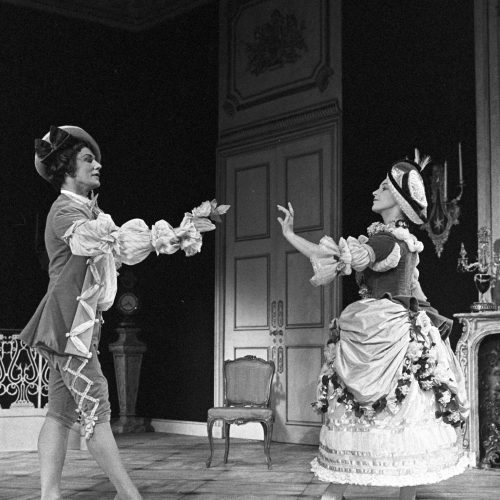
Brenda Last
Brenda Last achieved distinction as a ballerina with The Royal Ballet, but this was after a successful and multi-facetted career in many theatrical disciplines. Here, she tells Patricia Linton, founder and director of Voices of British Ballet, about her early training with teachers such as Tamara Karsavina, Vera Volkova and Lydia Kyasht, winning the Royal Academy of Dance’s Adeline Genée Gold Medal at the age of 16, and performing at the Edinburgh International Festival and in television before joining The Royal Ballet School. After that, she performed at Stratford-upon-Avon (as the leading dancer in Toad of Toad Hall) and then was asked by Elizabeth West to join Western Theatre Ballet as a founder member. Last talks about the early years of the company with Elizabeth West and Peter Darrell, and about Maurice Béjart, with whom she worked in Brussels.
The interview, which was recorded in 2010, is introduced by former Royal Ballet principal Stephen Jefferies.
First published: September 29, 2026
Biography
Brenda Last was born in South London in 1938. Recovering from a childhood illness, she started dance classes and became passionate about dance. She trained with Biddy Pinchard at Brixton Hill, and studied with such notable teachers as Tamara Karsavina, Vera Volkova and Lydia Kyasht before winning the Royal Academy of Dance’s Adeline Genée Gold Medal at the age of 16. She then went to The Royal Ballet School for a year, having already performed at the Edinburgh International Festival and worked in television. She was then the leading dancer in Toad of Toad Hall at Stratford-upon-Avon.
In 1957 Elizabeth West, with whom she had already worked in Edinburgh, asked Last to join her and Peter Darrell to become one of the founder members of Western Theatre Ballet. This was a pioneering company that specialised in dramatic works with contemporary themes, fusing classical and modern dance. She remained with the company until 1963, when Ninette de Valois saw her performing and asked her to join The Royal Ballet Touring Company. After two years in the corps de ballet, she was promoted to the rank of principal dancer. She stayed with the touring company because she relished the amount of performances it afforded – she once calculated that during her career, she danced the role of Lise in Frederick Ashton’s La Fille Mal Gardee 101 times. She eventually became ballet mistress for the company in 1974.
In 1977, Last unexpectedly became director of the Norwegian National Ballet in Oslo, following the sudden death of David Blair, a former Royal Ballet colleague who had just taken up the position there. In 1980, Last returned to London to teach at the London Contemporary Dance School, where she stayed for 14 years. During this period of time she also worked extensively with the Noriko Kobayashi Ballet in Tokyo, where she staged works by Ashton and de Valois, among others. She has also worked with the Royal New Zealand Ballet and The Australian Ballet, as well as English National Ballet and Scottish Ballet.
Brenda Last, who was married to the musician, conductor and accompanist Stephen Lade until his death in 2022, has served on the Arts Council Dance Panel and as a trustee of The Royal Ballet Benevolent Fund. She is vice president of the British Ballet Organisation, having previously been director of Training there. She was appointed an OBE for her services to dance in 2012.
Transcript
in conversation with Patricia Linton
BRENDA LAST: I can remember my mother took me to Sadler’s Wells, to see an opera and there was dancing in there, and then they said to me, “What would you like to do?” It might have been a birthday, might have been towards the end of the war, and I said, “I’d like to go and see those ladies with powdered legs,” because I thought the tights, they were obviously fishnets, of course, in those days, and I wanted to go and see the ladies dance with the powdered legs, because I thought that’s what they did. So, I started to go, and of course, this teacher, she didn’t only teach you tap and ballet, Greek, we did everything there. There was ballroom if you wanted to do it. She was just a fantastic teacher.
PATRICIA LINTON: Can you remember her name?
BRENDA LAST: Biddy Pinchard. She also was very generous, that she would suggest that you went to [study with] people. She suggested I went to Katie [Kathleen] Crofton’s. Now, Katie had the most appalling studio, really. It was called Max Rivers Studios at Leicester Square, and at Katie’s, also [Tamara] Karsavina came. So, sometimes Katie would whistle her way through… and give you barre, and then maybe Madame Karsavina would come in and give you an adage. And of course, this studio, Miss Pinchard’s, used to have… various people used to come and, you know, see you in class, and say, “Oh, why don’t you come up to Vera Volkova’s?” So, I went to Vera Volkova’s. And then, somebody else I went to, I went to Anna Northcote in West Street, and she had a downstairs studio. Vera was sometimes downstairs, and Anna Northcote was up, so it used to change around like that. Also, in West Street Studios was Madame Kyasht, who I went to.
PATRICIA LINTON: Lydia Kyasht?
BRENDA LAST: Lydia Kyasht. And then I went to South Kensington. Pinchard said I must go there when I was about 13, 14, to Andrew Hardie, and I learnt all about pas de deux. I was never frightened of pas de deux. And so, I was learning and meeting all these people. It was such a wonderful time to be a Londoner, and go and meet these people, and do all these things.
These women were very generous, I have to tell you that, too. You know? Vera only said, “Oh, well, just pay me two shillings.” I think those classes were three and sixpence, or something, “Just two shillings when you can, and then if you need some more shoes, then let me know and, I’ll buy the shoes for you.” And Anna Northcote, if you went along and she thought you were good, she would give you class, a free class. And it was just wonderful to do a different class, different steps, different enchaînements, and see all these people. All of that. I was feeding off all of that all the time. And when I look back now, what a fantastic background to see all these people. [Zizi] Jeanmaire and Colette Marchand, all these people in class. And they used to say, “Ah, this is good, you can do more, do it like this,” you know, and they used to talk to you at the side of the studio, and things. It was wonderful. I mean, I went to Biddy all my life. She taught me really everything. I went to these teachers as well; I never left her. I never left her until I was 16. I did the, the [Royal Academy of Dance’s Adeline] Genée medal, with her got the gold medal that year.
PATRICIA LINTON: So, you were about 16 at this point?
BRENDA LAST: I was, yes. [19]’55.
PATRICIA LINTON: And you hadn’t thought about The Royal Ballet School at this juncture?
BRENDA LAST: No, but from winning the Genée medal, and going to these outside classes, um, at Andrew Hardie, there was a woman called Frances Crossley, and she was going to the Edinburgh Festival with a small group called West Country Ballet, and would I like to go up? So, I said “yes”, and we rehearsed in town, somewhere like Fetter Lane, or whatever, a small little… or Toynbee Hall, somewhere like that. And then we went up to the Edinburgh Festival and appeared in a very small venue called the Princes Theatre, which is on Princes Street, which is upstairs in the building. And I met, for the first time, Peter Darrell who was a dancer, Peter Brownlee who was a dancer, Elizabeth West who was one of the choreographers with, um, Wendy Hilton was there, who was a choreographer and dancer. Michael Holmes, who did baroque dance and things. So, I went up there and did the three weeks, and then the school had already started, and when I came to go to the school, and it already started, I was put into a class in the Baylis Hall with Miss [Barbara] Fewster. With, it seemed like hundreds of girls. And Miss Moreton was in charge of the school.
I enjoyed Barbara’s classes very much, but Miss Moreton wasn’t particularly nice to me, actually, and I think it was because I had been a Genée medal winner and had come in late as well. And I think she didn’t, sort of, go terribly true with her. She didn’t like that very much.
PATRICIA LINTON: Were you offered the school on the strength of the Genée?
BRENDA LAST: No, no, no, just gave you a… I had to go and do an audition.
PATRICIA LINTON: What were your impressions, other than Miss Moreton’s, um, frostiness?
BRENDA LAST: Well, the person who I really thought was absolutely wonderful was Harold Pluçis, who inspired you, and because I had done pas de deux before, I was quite strong and wasn’t frightened. Anyway, he said, “Last, come here,” and then in the middle of the room, relevé, and he put his hand out, and it was like a plate. He was a big man, and he put one hand up, and it looked like a plate, and I had to go like this, relevé, and développé à la séconde, and he promenaded me around. Well, I couldn’t have fallen over, because his hand was so large, it just covered me. It was like a vice, you know, which was… And it was just fantastic, this man, what we did… But, you know, I really felt, “This is wonderful,” but I could only afford to be… my parents, my father paid [for me] to be there one year, and I wanted to get out. I’d been working already in the Edinburgh Festival, and doing things on television, and what have you. And I thought, “I’m not going to have a career here”. But at the end of the year, there was various things, auditions and things coming up, and there was a film that was going to be made called Let’s Be Happy with Vera-Ellen, and Pauline Grant was looking for dancers, and some of us went along to it from The Royal Ballet School. Lucette [Aldous] and I were in it, Hazel Merry who I knew from the School, she was in it. Well that finished, and then I was asked if I would like to go to Stratford-upon-Avon to do Toad of Toad Hall. So, I went as principal dancer.
PATRICIA LINTON: Was that a word-of-mouth thing?
BRENDA LAST: I think it could possibly have been Elizabeth West, actually, I think, because she was going to be the choreographer. So, that was a very good season. During that time, with Elizabeth being down there over winter, she spoke to me about this possibility of starting up this company called Western Theatre Ballet, and it had come from performances that the Bristol School of Dance had done. It was not going to be classical ballet, it was going to use the classical technique in doing, as she said, “kitchen sink dramas” she called it, I think it was. Because, you know, a lot of other people were doing… John Osborne, there were all these people who were doing different things now in the theatre, which I was interested in and I thought, “Ah, this sounds good”. And I said, “Yes, I would be interested, Liz, I would be”. She said, “We won’t have a lot of money, but I’ll let you know if we can get the money together, with Peter Darrell as a choreographer”.
PATRICIA LINTON: Peter Darrell who you’d met?
BRENDA LAST: Yes, I met Elizabeth, and… I’d met Elizabeth and Peter Darrell at the Edinburgh Festival, you see. So, that’s where it started.
PATRICIA LINTON: It was avant-garde, really.
BRENDA LAST: Oh, it was, yes.
PATRICIA LINTON: Social themes, dance drama.
BRENDA LAST: Mm, mm. It wasn’t going to be watered down classical ballets. It wasn’t going to be that – it was going to be our own works. She phoned me… “Could we meet?”, and so, well, the usual place we were meeting, the Marquis of Granby, the pub on the corner of West Street, because that’s where, you know, you would go and do class, then you’d go in there and meet. And she said, “Now, you know, we’re looking for people, Bird [Brenda Last’s nickname], you know. Do you know anybody who wants to come and be interested in this sort of thing?” So, I suggested Hazel Merry and Oliver Symons, because they were just getting married, and I knew Hazel from school. And de Vos, she had found a girl called Suzanne Musitz, who was a couple of years older, and had worked in the Marquis de Cuevas ballet company. And so, ten of us all got together.
We did some rehearsing here in Fetter Lane. There was a sort of a, like, a room that might have been a committee room, lots of chairs all the way around. It was just a lino floor, old-fashioned brown lino, and we got there, and there was this older dancer man from Europe, err, was Norwegian, was Erling Sunde. We were a various collection of people, shapes and sizes, and all of that. Feisty, like that, you know? Would argue and disagree, and you know, but we were all wanting this to be, well, to see how it would go, be a success.
PATRICIA LINTON: So, Peter and Elizabeth chose well?
BRENDA LAST: Yes, absolutely. Elizabeth, particularly, actually, was very good about choosing people. She was an extremely strange woman. I mean, she was like a bulldozer in a ballet world, really. But that’s why she got it. It’s terrible, a terrible shame, her death, actually, so early on. It was awful. Um, but she was a pioneer, actually. I mean, Madame de Valois and Mim [Marie] Rambert met her and liked her. I know that they, you know, she was another… Yes, they recognised this woman. She was, yes, she was absolutely incredible.
PATRICIA LINTON: How did it survive?
BRENDA LAST: Tt was really through the good auspices of the Bristol people. They thought the performances that had been done by the ballet school down there were rather good. And these people were really very generous to us and gave us money. They gave us money. And then we did a performance at The Arts Club, which is in Great Newport Street here in London, and The Arts Council came, and gave us some money. Then we toured in Europe, and sometimes we didn’t have any money. When we were in Spain, we ran out of money, and we had a nasty little man sitting in the bus taking every single penny that we had, so yet again, these good angels in Bristol sent some money out. But our stage manager had to barter and sell some of his tools, you know, one of those metal tool things, he had to sell that, and some lights and things like that. So, that we could have actually a meal that night, about two o’clock in the morning, in this sort of pension where we were staying, err, we had a drink and eat whatever we could downstairs in the bar, and all the prostitutes came in and joined us all, and, you know, and, err. I mean, it was… it was weird and wonderful, actually, but, um, you do somehow manage to get by.
PATRICIA LINTON: So, you really were living for and in the moment?
BRENDA LAST: Oh, yes. Absolutely. We didn’t know how long we were going to survive. We were very passionate about what we were doing, because it was new and interesting. I think going to Brussels, for me, was a huge experience, actually.
We went to the Monnaie. [Maurice] Béjart was coming from… I think he was in Germany with a very small group, maybe ten like us, and Western Theatre Ballet. Janine Charrat came from France with her group. [Milorad] Mišković came with about five dancers, or whatever. Jack Carter and Yvonne de Garze and Yvonne Meyer, I think her name was, came. So, there was quite a lot, there were about five different groups of us, and the Monnaie dancers were also a part of this group of people. So, we were all together, we were going to do a Rite of Spring which hadn’t been done since the [Vaslav] Nijinsky one, and it was a marvellous experience.
PATRICIA LINTON: Could you talk about Béjart in rehearsal at all?
BRENDA LAST: Well, he had electric blue eyes. He was short and stocky, and he made the boys at the beginning like, like frogs, like animals, and then, you know, developed up like that. It was just… you were just sat around [watching]. Rather like when Rudolf [Nureyev] came to The Royal Ballet, we all sat around. Whatever he was doing you just… a happening was happening at that moment in time. It was more contemporary movement, and things, and it was a different way of using the body, and you know. And it was theatrical. Acting and part of what you were, and this intensity of the music and the movement, what you were doing, just blew me away.
PATRICIA LINTON: Sounds like all your senses totally engaged.
BRENDA LAST: Absolutely, absolutely. It was just, again, just the most fantastic happening in one’s life. I feel so privileged to have been a part of it.
You may also like...
Celebrating Ninette de Valois: a conversation with Giannandrea Poesio
Anne Heaton