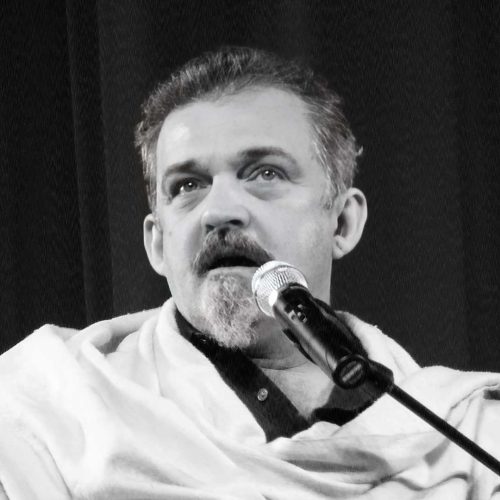
Kevin Richmond
This interview is a reminder of how lucky we in Britain have been with our great choreographers – in this case Christopher Bruce. Talking to Deborah Weiss, dance writer, editor and former first soloist with London Festival Ballet, Kevin Richmond also reminds us about taking chances, fun and friendship. The interview was recorded in 2018 and is introduced by Deborah Weiss.
First published: April 14, 2026
Biography
Born in Nottingham in 1958, Kevin Richmond was the eldest of three boys. His interest in theatre began at primary school where he was encouraged to participate in drama classes. At the age of ten he was recruited as a child actor to appear in a number of productions, including Waiting for Godot with Peter O’Toole and in the 1972 Harold Becker film The Ragman’s Daughter. Initially, Richmond wasn’t keen to learn to dance but was convinced by his teachers that it may help his acting career.
Richmond’s first professional dance job was with an education project called Dance for Everyone when Richmond was just 17. He joined London Festival Ballet in 1977 under the directorship of Beryl Grey and remained with the company, now English National Ballet, for 22 years. He worked with five directors during this time and among his most memorable experiences was working with the choreographer Christopher Bruce on Swansong. Bruce created the ballet on Richmond, Matz Skoog and Koen Onzia in 1987 and this work and its cast were celebrated worldwide. Other important roles included the title role in Christopher Hampson’s Scrooge, Tybalt in Romeo and Juliet and Dr Coppélius in Coppélia.
After retiring from the stage, Richmond completed the Professional Dancer’s Teaching Diploma at the Royal Academy of Dance and taught at London Studio Centre, Basler Ballett, Cathy Sharp Dance Ensemble and latterly, at the Zürcher Hochschule der Künst in Zürich where he taught the BA in Contemporary Dance course. He also taught as a guest teacher with many companies including Rambert. He became ill with cancer in 2018 and died the following year.
Transcript
in conversation with Deborah Weiss
DEBORAH WEISS: Let’s talk a little bit about Christopher Bruce because that was a momentous time for you because he created Swansong on you and Matz Skoog and Koen Onzia. So, tell me a little bit about that.
KEVIN RICHMOND: Well, now. Chris [Bruce] arrived and the first piece that he did for the company [London Festival Ballet], as a trial, was a piece called Land and it was based on some Polish folk songs – Arne Nordheim is the music. And he came… it’s quite simple for Christopher’s techniques and that’s why it was chosen. But he did it first in Genève, in Geneva, for the Young Ballet of Geneva, and so it was still quite fresh. He came; he did this piece. Groups of about eight dancers, and it’s a nice piece of dancing.
DEBORAH WEISS: Were you in that?
KEVIN RICHMOND: To begin with, no. He didn’t cast me, but then somebody went off and so I was in, from the beginning… well, halfway through the rehearsals I was in. And so, that was my first, the first piece of Christopher. Then he did something called The World Again. He did about five or six pieces, with Swansong being the last piece he did for the company. And Swansong was produced just before the summer holidays.
DEBORAH WEISS: I think it was 1987.
KEVIN RICHMOND: You’re good. You’re so good!
DEBORAH WEISS: I’ve just done my homework, that’s all!
KEVIN RICHMOND: And he did it and we rehearsed it before the holidays. And we went on holiday, came back and carried on rehearsing it. And there were three of us, as you’ve already said. There was Koen, Matz and myself. I don’t recall another cast at that time. I think he just wanted to work quite closely with the whole thing. And the music was done, written by a man called Philip Chambon and, I remember the first… We had a little tap routine to do. The tap goes all the way through – it was like a soft shoe shuffle. I would call it for Matz and myself and then Koen joins in later. He wasn’t quite sure. He kind of went “Tea for Two”. He kind of said, “Tea for Two,” and the pianist that was working in the studio was a lovely guy who is still working in the studio, called Kevin Darvas and Kev played “Tea for Two”, the tune goes [sings]. Anyway, we rehearsed to this tune, which then later Philip Chambon and his electronic wizardry put into like a sound, so it became [imitates music] and this number is known now as the “Tea for Two” section.
And then… things were added all the way through. For example, there’s a smoking moment when Chris said, “OK guys, you can go and have a cigarette. I want to work with Koen.” So, I went out and got a cigarette, and I came back and I blew it in Koen’s face to say, “Ha, ha, ha, ha, you’re gonna have to work with Chris now for the next two hours. We’re having a cigarette outside!” And, from that moment was born the cigarette moment in Swansong, when you think that the interrogators have left the stage, but one of them comes back and lights a cigarette and blows smoke into the victim’s face.
DEBORAH WEISS: So, he’s taunting him?
KEVIN RICHMOND: Yes.
DEBORAH WEISS: Right.
KEVIN RICHMOND: I used a cigarette, but sometimes I didn’t. Sometimes I used like a glass or a cup of water, which was just in the side of the stage and I would come on and I would pour the water into a cup, as if I was going to give it to him, but then I would drink it myself and squeeze the cup and walk off. It was an intimidating, moment for… for Koen. Koen was never quite sure what was going to happen, which kept it all on the edge.
We took this performance of Swansong – just jumping to a performance mode – to Argentina on tour, shortly after the Falklands crisis, and we were at the Teatro Colón. We’d gone there with Maximiliano Guerra, who was doing a kind of gala evening and part of the gala evening was Swansong. Maxi would be dancing Don Q, [Don Quixote] and then in the second part we would have the serious bit, which was Swansong. And we went on to the stage before, in the interval, and there were always two guards – security guards – downstage in the wings, either side of the stage. And we came onto the stage before to practise a few things, and suddenly these two guards with machine guns came onto the stage and they went to the chair in the middle, which was already set, and they started to tap [makes a tapping noise with his feet] and they both tapped their way off, flicked their shoes down to the corner, where they were supposed to be sitting in the corner. It was the most chilling moment any of us had ever felt, and we just smiled. I don’t even think the guns had bullets in them, you know, but they were just there as security men and that’s what they did.
DEBORAH WEISS: So, just to explain a little bit…
KEVIN RICHMOND: Yes, yes.
DEBORAH WEISS: Swansong is about officers interrogating somebody, or it’s…
KEVIN RICHMOND: Visually you look it, and many people have asked this question. Now, when we first started the rehearsals, Christopher said he was thinking of calling it Clowns because we were a couple of clowns, and this is where maybe the red nose comes into the piece. If you’ve seen the piece as a moment where Koen has to wear a red nose as part of a punishment, in a way. And we almost go to stretch it and take it off as if we’re going to flick it into his face, but then we take it off, and go off the stage.
And so, he was going to call it Clowns... because it’s a vaudeville number or tapdancing number, and we interrogate him with the same route of tapping. So, it’s repetitive, repetitive, repetitive, repetitive, and eventually he loses control and just bursts out this whole tapping routine, like “I’ve had it…” And we have to say, “Good; now we’re getting somewhere. Now sit down and stay calm. We’re going to leave you alone.” So, that would then go into a solo for Koen.
There were moments with Chris creating. He would say, “So, guys…” And Chris would move very fast with these tap things and contemporary moves that he did very well, of course. And he said, “Do this…” “Can’t… I can’t do this, but I could do this.” He would go, “OK, but don’t do it that way, do it this way.” And so, it really became a piece for all of us to be involved with it; it wasn’t just a choreographer coming and saying, “Do this step.” It was a… a beautiful, creative moment and a very influential moment in my career as a… as a movement maker, I would say, as a performer, not a ballet dancer; as a performer. One of the things Christopher always said was, “Don’t… don’t perform it; don’t act it. Everything you want to say is in the choreography. It’s already there; you don’t have to do anymore,” which was true. And when we all felt that, and it came together, we knew that there was a good performance between the three of us.
DEBORAH WEISS: It seems to have a reputation for being quite magical.
KEVIN RICHMOND: I think so. I think it has influenced a lot in the dance world. This one, certainly in the UK anyway. I danced it in Berlin. I was invited to Berlin to dance it with two other gentlemen, I can’t re… Janik Porcan was one of them and I can’t remember the other guy, sadly. It’s done in Houston, but it has to be places where Christopher can visit still. He doesn’t like to let it completely go; he has to have the reins on it to hold it back. And Rambert, of course. Ballet Rambert did it later as a piece. Interestingly enough, we actually toured and you said it was 1980…
DEBORAH WEISS: 1987…
KEVIN RICHMOND: ’87. We toured around the country. It had its premiere in Bilbao. This was an interesting moment because we had… When we arrived at the airport in Bilbao, we had a chair, we had two canes; that was the set. That was it, that’s all we had: a chair and two canes. And we arrived with the costumes, of course, carried our own costumes, and the security looked exactly like…
DEBORAH WEISS: …the characters…
KEVIN RICHMOND: The characters we were playing, so, we were kind of laughing around that. And then the next day there was a press conference and also, at that time, there was a conference at Bilbao for Amnesty International. And so, we were invited to the theatre to have a discussion and Chris was… We were all sat there and the press were like, “So, it’s political; it’s political.” And Chris ended up saying, “It’s not political. It’s about the end of a dancer’s life.” And he obviously had another idea about it, but I have to say it was based on a book called A Man by Oriana Fallaci, and it’s a man that’s in a Greek cell and what he sees from the cell, and what happens to him. It’s based loosely on this story – was the last one I heard, so there’s lots of theories. Does he die at the end, or does he just escape, the victim? And there’s always questions; it always stirs something. It’s relevant today because of Guantanamo [Bay prison camp] of course. If you look at the interrogation that way, and those dreadful things that happened in Guantanamo. So, yes, I hope it has a long, long life.
DEBORAH WEISS: Yes, I’m sure it will have.
KEVIN RICHMOND: I hope so; I hope so.
The transcript of this podcast may have been lightly edited for ease of reading.
You may also like...
John Craxton
Patricia Thorburn