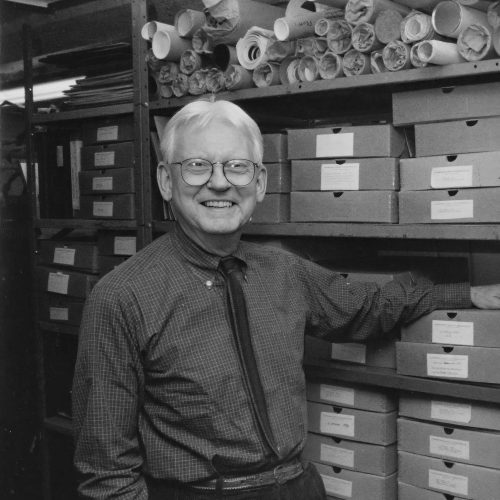
Roger Tully
There is so much in this short interview to love and revere. Roger Tully was a legendary teacher, who was an inspiration to many dancers over many years. He had strong and very definite ideas about dancing and technique, but he was always looking beyond – to maybe something spiritual. He was a teacher who in the great early Twentieth-Century tradition of teachers, taught outside institutions. For the art of dance to live on, long may this independent spirit last and flourish. In this interview, which was recorded in 2020, Roger Tully talks to the dancer, choreographer and writer Jennifer Jackson, who was also one of his pupils.
First published: April 21, 2026
Biography
Roger Tully was born in London in 1928. After National Service and training as an optician, his love of dance led him to study with Marie Rambert at her school. He went on to study with Cleo Nordi, Lydia Kyasht, Stanislas Idzikowski and, above all, with Kathleen Crofton, who had herself studied under the former Imperial Russian ballerina Olga Preobrajenska and danced with the Anna Pavlova company. His association with Crofton, which lasted for many years until she herself departed to the USA in 1966, asking him to take over her classes, was perhaps the central influence on his own approach to dance and to teaching.
From 1949 until 1951 Tully danced with Ballet Rambert, and then with International Ballet until it’s closure in 1953. He also worked on the musical stage and with Walter Gore’s London Ballet, where he partnered Paula Hinton. In the 1960s he danced in the USA and in Canada with Les Grands Ballets Canadiens.
In 1977, Tully bought a house in Bedford Gardens in Kensington and established a studio there, where he taught until he moved away from London in 2015. He remained independent of established schools and teaching systems and his classes, in which he taught all levels, from beginners to established professionals including principal dancers from major companies, gained an enviable reputation for their grounding in the classical tradition. His teaching was much valued by those looking for something different from the norm. He addressed the person who dances and stressed artistry rather than gymnastic virtuosity. His approach, however, was systematically thought out, looking to move with the body’s natural weight, rather than fighting against it, so as to achieve a true sense of vertical balance and stability. In this quest he was also influenced by his study of classical sculpture. In 2011 he published The Song Sings the Bird: A Manual on the Teaching of Classical Dance, in which he sums up his decades of experience in the teaching of ballet.
As well as working in Bedford Gardens, he also taught ballet at Pineapple Studio and Dance Works in London and to ballroom dancers in Helsinki, as well as master classes in Paris, Rome, and Tokyo. Even after he had moved away from London to Haywards Heath in Sussex, he continued to teach right up to his death in 2020, at the age of 91.
Transcript
in conversation with Jennifer Jackson
ROGER TULLY: Somebody took me to see Coppélia with the Sadler’s Wells [Ballet] during the war, that’s right. And I remember sitting there and I remember sitting there, now. I thought, “I can do this.” It was the first thing I really felt that I felt – that it switched me on, in some way, that I felt I could do. It’s a Cinderella story, really, a little bit. I wrote to the Sadler’s Wells and asked for an audition, and they sent me an audition, and I hadn’t got any shoes, and I hadn’t a dance belt and I didn’t know where to get them so I couldn’t go.
JENNIFER JACKSON: What age were you at this point?
ROGER TULLY: I should think I was about 17, 18. Then I went into the army, you see, because it was conscript at that time, so I had to go into the army. I don’t quite know why, but I decided I would audition for [Ballet] Rambert. So, I wrote to Rambert and I was given an audition, and I did the audition in my khakis – you know, my khaki uniform! Any rate, they offered me a scholarship when I came out of the army.
[Marie] Rambert, for whatever reason, became rather enamoured of me. I suppose she saw the potential there and therefore she pushed me, so within nine months she had me on stage because she could see I would develop as a performer and it was fortunate at that time because [Alicia] Markova and [Anton] Dolin had just come back from America because they went to America during the war and they had just come back to London. They gave some gala performances. For that, they needed [a] corps de ballet, they needed background, so they went to [the] Cone Ripman [School], and the Rambert [School], and we became the sort of, corps de ballet. That was my first opportunity.
JENNIFER JACKSON: Was that one of the – kind of – principles, do you think, of her schooling, if you like? To enable performance opportunities for all of her students?
ROGER TULLY: It is the fundamental switch that has taken place, actually, that all the teachers of that time taught us to dance. That was their prime concern, to teach us to dance. The tendency these days is for people to be taught a technique and then asked to make it dance which, is, of course, is complete reversal. So, we were encouraged to dance, and our natural potential was encouraged and then it was up to the individual to realise that you needed some sort of technique if you… I remember [laughs] lying in the bath one day with my feet on the taps and looking at them and thinking, “Well, you’re going to do something about those feet,” but it was up to oneself to do that, to some extent.
JENNIFER JACKSON: Can you talk about the – kind of – wider experience of life at the time that might have a way of dancing?
ROGER TULLY: Yes. Well, it’s interesting because it’s something you can’t do, now, because, in a way we were bullied through. The teachers were very hard and quite often unkind, in a sort of way. It’s only later that one realised they were trying to get one beyond where one was doing or involved in one’s ego, where it began to happen. Which, of course, is what happens in a good performance. The performance goes through into another dimension and then the limits somehow drop off. It’s the same watching a good athlete. So, Rambert could be quite merciless. She would look at you and say, “Your feet are like Kirby grips,” or “Your legs are like spaghetti.” Then she would pitch you against another dancer and say, “Well, you see… see what Terry is doing.” But you could do that then because we had just won the war, everything was going to be fine. So, you could pick yourself up very quickly.
But now, because the prevailing environment is very anxious, you cannot send dancers out into the… from the studio in that state because there is very little in the environment to pick them up. That’s what the businesses… as you said of the tea after the class is about, actually, is to bring one down because one has to be vulnerable in the studio but it’s not a good idea to walk up into Notting Hill Gate being too vulnerable, you know. So, the tea enables people to talk about… then when you go out of the door, you’re able to cope.
JENNIFER JACKSON: That’s a lovely aspect of studying with you, I think Roger, is that there is… it’s more than the ballet class, in many ways. The function of the tea afterwards, and the fact that you serve us tea, is rather an interesting reversal of roles because I think your class does demand from the dancer that you submit the material, we are obedient to you in a sense, but…
ROGER TULLY: Yes, and you’re also exposed to yourself. This is the thing, because no real work happens until a dancer… or anybody studying anything… until you are exposed to your own ignorance, really. That is the beginning of the work. So, to bring people to that state creatively you have to take care of them. I mean, that is one of the things that some of the older teachers like Rambert… they weren’t very conversive with… Actually, they did leave you pretty devastated.
JENNIFER JACKSON: Can we talk also about your other studies of ballet, Roger, with Lydia Kyasht and Cleo Nordi.
ROGER TULLY: Well, there came I time, I think, I had been with Rambert about two or two and a half years and I… something intuitive in me felt that something was wrong. Rambert had become enamoured of [the Enrico] Cecchetti [Method] but she really wasn’t entirely qualified to teach Cecchetti. She had studied with him, but she was essentially a Eurhythmics Dalcroze – that was her background. Something in me was dissatisfied, so I decided to leave. My body was changing because I had a very easy, natural body and it was getting, sort of, locked. So, I left.
Well, of course, we were very fortunate in those days because we had the tail-end of all the [Serge] Diaghilev, [Anna] Pavlova environment so there were people like Cleo Nordi, Mary Skeaping, Kathleen Crofton, [Stanislas] Idzikowski, all who had been in the Diaghilev for… and they were the teachers. They were all in the West End, teaching. And largely at a studio called West Street. So, I floated. I, sort of, floated around these teachers and in those days, of course, a professional class was a professional class, so where did I first learn to do à la seconde turns? Watching Erik Bruhn in class. Actually, in class, you know? They were professional classes in those days, so one had an opportunity of learning from these people, you see.
Then, I went to Crofton, and I couldn’t make head or tail of her in a sort of way because, she never analysed, she didn’t describe. She just was it, you know? And you didn’t quite know how to pick up… it’s like looking at a painting and thinking, “Well, how do I learn to paint?” So, I couldn’t really make her out, so I went to other teachers. I went to Cleo Nordi quite a lot, Idzikowski. I liked working with Idzikowski, not because he was a particularly good teacher but because he had been a great dancer and to be in the presence of a great dancer who only indicated what we did and you knew exactly what it was from that. I mean, one of the other things which was extraordinary was that the first class I went to, he gave a ten-minute barre.
JENNIFER JACKSON: My goodness.
ROGER TULLY: You know, but this gave some idea… and there is a lot of legendary and fantasy about Cecchetti, you see. Cecchetti never taught the beginning because he was always teaching people who had spent eight years… seven or eight years at the Mariinsky so, of course, you could do a ten-minute barre, which, by my standard, was barely enough. So, then I started looking around again and I came back to Crofton.
For me, the particular thing about Crofton was that she had never personalised what she had learned from Pavlova and from… and she was a pupil of Preobrajenska. My experience with all the others – who should be nameless – but they had in some way personalised it. They had a particular idiosyncratic way of teaching it. The reason Crofton was so difficult to actually pinpoint was because she hadn’t personalised it. It was it. I understood this later, actually. My wife and she got quite friendly. So, one day Margaret said to her, “Kathleen,” she said, “What was Pavlova like?” Kathleen said, “Pavlova was a great light and when she died, the light went out.” As she was saying this, you could see where the light was and that she had never interfered with it. That was why it was so difficult to pinpoint her because she was somehow had to enter into, where she was teaching from not what she was teaching. It took me 15 years… I studied with her for 15 years to really begin to understand where she was coming from, which was so pure.
JENNIFER JACKSON: That undoubtedly has guided you, I suppose, in your own development?
ROGER TULLY: Absolutely, yes. Yes, I mean the classical form was not something through which you floated your personality on, but you tried to get your personality as far as you could out… so that it was just it. Depending then on the dramatic situation, then you might colour it but, basically, as its form you have very little of your own ego in it.
The transcript of this podcast may have been lightly edited for ease of reading.
You may also like...
Darcey Bussell
Cassa Pancho