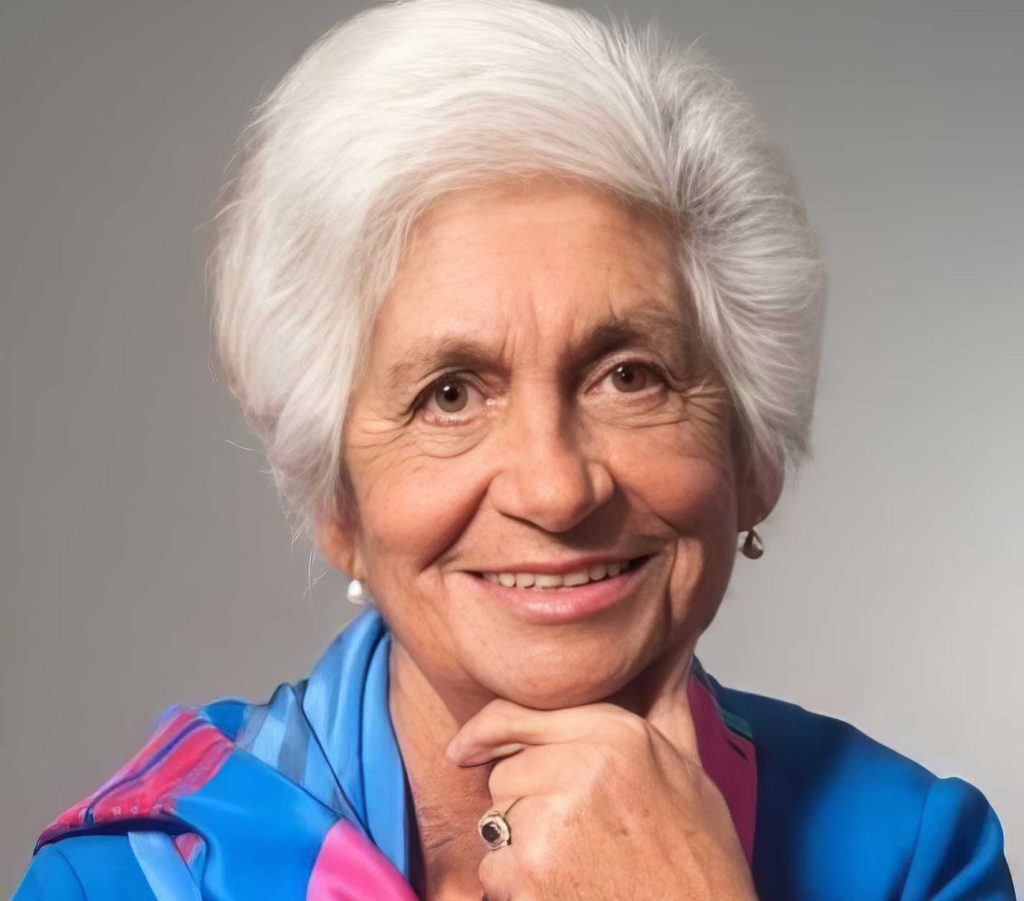
Jill Tookey
Jill Tookey, the founder of National Youth Ballet of Great Britain (NYB), in conversation here with Frank Freeman, explains how she set about it, and what her vision was. She gives a breathtaking insight into how all the different and necessary strands of activity plait together to create something worthwhile. She speaks engagingly about some of the ballets created for NYB, and about working on them with esteemed members of the ballet world, such as John Lanchbery and Wayne Sleep. The interview was recorded in 2010 and is introduced by Anna Meadmore.
First published: March 31, 2026
Biography
Born in Kent in 1937, Jill Tookey arrived at what was to be her dancing destiny by an unusual route. She had enjoyed ballet as a child but was swallowed up by the fashion industry of the 1960s, becoming fashion editor for both Woman and Beauty and Honey magazines. By the 1980s, and as mother of four children, she had begun writing childrens’ books. Pedro the Parrot, published by Thames and Hudson, was to be the springboard for an extraordinary adventure. To set Pedro dancing, music was found and also a choreographer. From there Tookey never looked back. She was alert to the huge interest in dancing and performance in the young and how, with the right build up, they could channel their excitement into something truly worthwhile.
By 1988 Tookey had founded the National Youth Ballet of Great Britain (NYB) and she remained its artistic director until she died in 2016. She was always able to see the bigger picture as well as the details, with many ballets specially created for NYB and many young choreographers and dancers encouraged. As a result of her inspired and energetic leadership, literally thousands of children have had opportunities to enjoy the magical world of the theatre, with a number going on to dance professionally. Jill Tookey was appointed a CBE in 2016, but died that same year, and, sadly, was unable to collect her award. She was represented at the investiture by her ten-year-old granddaughter, who had danced with NYB for four years.
Transcript
in conversation with Frank Freeman
FRANK FREEMAN: Jill, you’ve just celebrated the 21st anniversary of National Youth Ballet in 2008. When you started National Youth Ballet all those years ago, did you ever imagine it would become such a wonderful, ongoing success?
JILL TOOKEY: Well, I suppose I didn’t, although I was passionate about my idea, actually, I called it a ballet workshop because I thought I’d been out of ballet for a long time, and that was probably the most sensible thing to do. I knew people at Sadler’s Wells, and they very much encouraged me to go for it, and continue with workshops, and we were based at Sadler’s Wells at the time. This was extremely exciting, even in those far-gone days, and I never, ever imagined it would take off like this. I thought we might get some local children from London and the South-East, but it soon became apparent we were going national on this, and we were having bus loads of people coming down to auditions. And then a few years later, I decided that I really ought to call it the National Youth Ballet of Great Britain, because this was what it was becoming, and with the support of the Royal Academy of Dancing as it was then, and Sadler’s Wells, and Stephen Remington, I applied for national status, and, um, we got it. So, that was the beginning.
FRANK FREEMAN: And you had a huge demand at the start, although they were mainly girls at the start, but now there are many boys.
JILL TOOKEY: That’s right. I think it was five per cent boys in the beginning, and now it’s definitely 25 plus, which is very good news.
FRANK FREEMAN: And you’ve had many famous alumni with dancers all over the world in some of the great ballet companies…
JILL TOOKEY: Absolutely.
FRANK FREEMAN: Drew McOnie. There’s a programme on television now called So You Think You Can Dance? and just at the beginning of that, and he’s still in the… in the running, yes?
JILL TOOKEY: He’s still in. We’re down to ten now, top ten in the country.
FRANK FREEMAN: You have, as I say, a very impressive alumni, many in ballet companies all over the world, including The Royal Ballet, Birmingham Royal Ballet, English National Ballet…
JILL TOOKEY: I’ve got one in New York City Ballet, err, oh… They’re all over the place! All over Europe, and a lot in musical theatre as well.
FRANK FREEMAN: Yes, and the other very interesting thing, and so valuable for young dancers, is that you always wanted to have ballets created on them, and you’ve had many well-known choreographers, such as Christopher Hampson and Wayne Sleep, and others. And is that something that you always had in mind?
JILL TOOKEY: Yes, I wanted to give the children the fullest experience that we could have. I mean, things are changing a little bit now, because we’re creating our own choreographers, which is amazing, amazing.
FRANK FREEMAN: So, I mean, what, what did Chris, Chris Hampson…
JILL TOOKEY: Chris did, yes, he did Carnival of the Animals for us, yes. I can’t remember which year that was, but probably about six years ago, seven years ago, yes.
FRANK FREEMAN: And Wayne Sleep made two full-length ballets.
JILL TOOKEY: Three.
FRANK FREEMAN: Oh, three?
JILL TOOKEY: First of all, he did Cinderella, that was right, which was Paul Reade’s lovely score and then when I engineered Toad [of Toad Hall], which was very exciting. Actually, Toad came third, so I mustn’t jump the gun. It was Alice next. We called it Wonderland, Scenes from Alice, and the score for that… Yes, Joseph, Joseph Horovitz. And then, finally, we were actually very lucky in the year 2000. I’d managed to get some sponsorship from HSBC. They’d been quite interested in us and asked us if we’d do various outside events at the Guildhall and Lincoln’s Inn. So, I went to see Sir John Bond, to see if, if he would actually support us in any way with HSBC, and initially he did, with a small amount, and I remember him sitting there and saying, “Well, we’re going to offer you £10,000, Jill,” and I thought, “Wow,” and he said, “But it’s for educational purposes.” And he said, “You don’t look overjoyed.” And I said, “Oh, I’m, I’m absolutely thrilled to have £10,000 offered to us, but the only thing I would say is that if you mean just to put into outreach I think that’s quite a shame, because surely the reason you’ve asked me to come here today, or allowed me to come here today is because you’ve been impressed with our performance, and I’d be very happy to split the money into some scholarships for children that couldn’t afford to come to the National Youth Ballet, and, some outreach work in primary schools, but the other third, I’d really like to put into performance.” And he said, “You seem to know much more about this than me, that’s fine.”
So, that was the beginning of that, and that was, sort of, three years running I had small amounts, or that sort of chunk. And then he invited me back. He said that the company was going to sponsor all the national youth companies, the, National Youth Orchestra, the National Youth Theatre, the National Opera Studio, and would we like to come along and be a fourth member. And I said, “That is amazing,” and then we were offered umbrella sponsorship for something called Centre Stage, which ran for three years, and that was my big opportunity to try and do Toad, because I wanted to do something that was going to attract attention to us, and give us some publicity. So, I made up my mind straightaway I wanted Jack [John] Lanchbery to write my score, having been always very keen on La Fille mal gardée.
FRANK FREEMAN: So, Jack Lanchbery was the musical director of The Royal Ballet?
JILL TOOKEY: Yes.
FRANK FREEMAN: Well, certainly when I was in The Royal Ballet, and, err, that conducted for all that.
JILL TOOKEY: Yes, I couldn’t find him to begin with, and then I finally dug him out, and he was in Melbourne, living there, and spoke to Jack, and told him about my idea, and he said, “Oh, Toad. Do you want me to arrange a piece of music, or write a piece of music?” and I…
FRANK FREEMAN: So, this is based on…
JILL TOOKEY: Wind in the Willows.
FRANK FREEMAN: Wind in the Willows.
JILL TOOKEY: Yes, but I, I wanted to feature… to call it Toad.
FRANK FREEMAN: Yes.
JILL TOOKEY: Um, and to home in on that big character.
FRANK FREEMAN: And this was the third ballet that Wayne…
JILL TOOKEY: Well, he didn’t know. I hadn’t got a choreographer then. I wanted to get Jack hooked first, and Jack is such a lovely man, as you know, and he was very enthusiastic. And he said, “If you want me to compose it, that would be amazing,” and I said, “Well, I did.” So, I then called Wayne and said, um, told him about the idea, and he said, “Who’s going to write the music?” and I said, “Jack Lanchbery,” and he said, “Oh, my goodness!” He said, “I was Squirrel Nutkin in [Tales of] Beatrix Potter,” and I said, “I know, I know.”
It was just a delight from the beginning to the end. And I kept saying to Jack, “But you’ve got to tell me what I… what your fee is, you’ve got to.” And, err, he kept saying, “Oh, don’t worry about it, don’t worry about it,” and finally I said, ‘Come on, come on Jack, tell me.” And he said, “I’m getting an old man now, and this is so exciting, and it’s wonderful to work with the National Youth Ballet doing something new,” and he said, “I’m going to give it to the company.” So, I couldn’t believe it. So, it was all done legally, and, so, the score is ours, which, um, is amazing, yes.
So, yes, so three big ones with Wayne.
FRANK FREEMAN: Now, can we just talk about how the thing runs at the moment?
JILL TOOKEY: Yes, it’s all on a cycle. We usually have the auditions in the Spring, starting in February, and probably have our finals in early May, and cast it then. It’s quite a job to cast a company of 100, and then 20 little ones, and we’ll probably see over 500 dancers. It varies a bit from year to year, but that’s sort of an average, and then we recall, from the first rounds, to the finals in London. We now have a ten-day summer school rather than an eight-day summer school, because previously we’d had seven ongoing rehearsals in London, which was expensive for people coming from places like Manchester and Liverpool, and Chester, and Wales, and… to have to come to London for seven weeks running. So, we’ve extended our residential summer school to ten days, which gives us a better chance of cracking it. But then we go straight into performance…
FRANK FREEMAN: Now, going back to the summer schools, one of the most important things that happens in that summer school is the choreographic competition which you also instigated.
JILL TOOKEY: Yes, I think it’s probably been going about ten or 11 years now, and it started as a very small thing, and gradually developed over the years, and we had different people coming to adjudicate initially… but Frank, you’ve been involved for some years, and I think you can endorse that it really has grown in quality, and now it’s really quite thrilling to see the ingenuity and the pieces that come each year?
FRANK FREEMAN: So, what happens is that the company members choreograph the ballets.
JILL TOOKEY: Their own piece.
FRANK FREEMAN: Their own piece during the summer school, in their own time.
JILL TOOKEY: Yes, and they don’t have a lot of spare time, either. And they can either do a duet, or a group piece, or a solo piece, and the solo piece can be made on somebody else, not necessarily themselves. Recently, we’ve had such a high standard that I have invited one or two different people each year to put their piece on stage at Sadler’s Wells, which has been even a greater challenge, really, now they know that that is a possibility. So, I reserve a spot in the programme to do that, if there is something of that value, and that level.
So, it’s really become quite an event at summer school. Well, a real event, and the fact that we’re finding new aspiring choreographers is very good news.
FRANK FREEMAN: It’s so strange that the men don’t seem to involve themselves as much as the women, as much as the…
JILL TOOKEY: Um, we’ve had a few that have… that try very hard there. A lot of males have gone on to dance, but it’s the choreographic. They seem to be nervous of trying to tackle that, don’t they? I don’t know why.
FRANK FREEMAN: Yes, it’s strange. I mean, the men like Drew McOnie, who we’re going to talk about are really very talented. So, can we talk about Drew? Because he is very special, and he’s been with the company for a long…
JILL TOOKEY: Since he was 11 or 12. Yes. His first role with us was as Ratty in Toad, and the following year he danced Toad, because we did it two years running and he’s very focused, and very ambitious. And a few years ago, I had an inspiration to write to the… Prince Charles… and ask if there was any chance that he’d allow us to make a ballet inspired by his book, The Old Man of Lochnagar. And I just thought what fun it would be to perhaps have a young choreographer take this piece on, but I was very keen that there should be somebody there as his mentor.
So, I was thinking of Drew, and he’d just gone to Matthew Bourne’s company, to work professionally in New Adventures, so I asked Matthew if he would consider mentoring Drew, and he said he would love to do that, and Drew made a fantastic job of it. He was very creative with his ideas. Everybody seemed to think it was exciting that we were having a young… a young boy, really, he was then. He was 21, I think, Drew, and he’s gone on to great things. He’s had a long spell with Matthew Bourne – I think three years, probably – and now he’s out on his own this year. He’s done one or two things for himself, and he’s currently competing for [the] So You Think You Can Dance? programme on BBC1.
He’s a bit after my own heart, really. He sees that creating something on stage has got to really entertain. It’s also got to be true to the story, and you’ve got to be… embrace everything else that’s musically wanted and design-wise. So, I think he’s got the whole thing in his head, he just needs more experience now to get a break.
The transcript of this podcast may have been lightly edited for ease of reading.
You may also like...
Romayne Grigorova
Rick Guest
