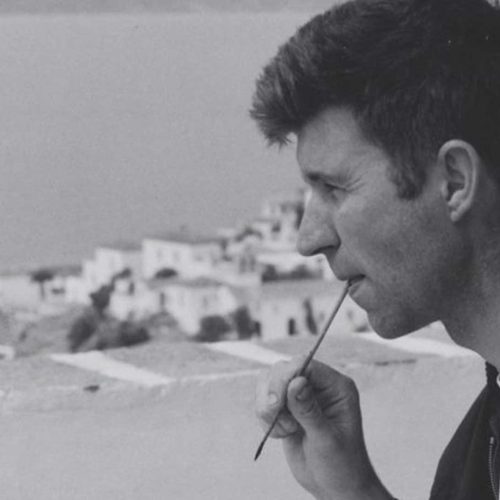
Robert Harrold
It really does seem true that dancers in the difficult years of World War Two were happy to exist on the bare minimum. The common bond was that they all loved dancing and that appeared to keep them going. In this interview with the dancer and teacher Robert Harrold, which was recorded in 2007, Patricia Linton, founder and director of Voices of British Ballet, talks with him about a career that commenced during a time of conflict. The interview is introduced by Jane Pritchard.
First published: April 28, 2026
Biography
Robert Harrold was born in Wolverhampton in 1923. His first dancing lessons were in Birmingham with Evelyn Goodwin, and his stage career began with the Anglo-Polish Ballet in 1940. For the next few years, he danced with Ballet Rambert, where he experienced a fine repertoire of ballets with an enviable range of choreographers, in which he often partnered Rambert’s charismatic ballerina of the time, Sally Gilmour. During the later years of World War Two, Harrold was a member of the Central Pool of Artists (CPA), and he was a part of groups that entertained the troops in Italy, via India, Ceylon and Australia. After the war he danced in musical theatre and television and began to develop his choreographic ability. Most important was the beginning of his lifelong love and involvement with National and Folk Dance. He was a tireless advocate of this form of dance and, along with his friend and mentor Helen Windgrave, wrote books and formed groups – notably the Modial Company – and educational enterprises to interest people in general and to win converts if possible!
Dancer, teacher, examiner, adjudicator and writer, Robert Harrold had a very full and busy life in dance and contributed unstintingly to the many ventures in which he was involved. In 1986 he received the Imperial Award for Outstanding Services to the Imperial Society of Teachers of Dancing (ISTD), an organisation he had been involved with for many years.
Transcript
in conversation with Patricia Linton
ROBERT HARROLD: Barbara Vernon and John Gregory were touring with Anglo-Polish Ballet.
PATRICIA LINTON: Now, you must’ve been about what by this time?
ROBERT HARROLD: About 17. Barbara Vernon and John set up an audition. I went up, I think, to Huddersfield in the Black Out and everything because I think the war had just started. They said “yes” because they were all so short of boys and so I joined the company and off I went. But it was really not doing classical work but doing character work – the Polish mazurkas and so on.
PATRICIA LINTON: And you had this mixture of classical ballets?
ROBERT HARROLD: Yes, they’d always do [Les] Sylphides and…
PATRICIA LINTON: [Le] Spectre de la rose.
ROBERT HARROLD: And at that time, it was a very strong company. Alexis Rassine was in it, and Gordon Hamilton and all sorts of people. And Bridget Kelly – she was then Maria Sanina, one of Rambert’s people – she was in it. The whole lot…
PATRICIA LINTON: I’m going to ask you if you remember any of these ballets? I think they were all done by [Czeslaw] Konarski or choreographed by Konarski. Something called Schubertiana?
ROBERT HARROLD: Schubertiana was a duet. Yes, that was a Konarski thing there. You did lovely adage things but not on pointe with shoes on. He was dressed in a tail suit, and she was in a lovely flowing gown.
PATRICIA LINTON: And [Alicja] Halama? She was the leading ballerina, was she?
ROBERT HARROLD: Yes, but she wasn’t classical. I think they’d both been trained in Warsaw, but she didn’t do any of the classical things. She didn’t do things like Spectre de le rose or Sylphides, she just did with Konarski those two things and then…
PATRICIA LINTON: Blind Man’s Buff and Matthew is Dead?
ROBERT HARROLD: They’re all character ballets.
PATRICIA LINTON: Krakow Wedding?
ROBERT HARROLD: Krakow Wedding, yes that’s right. They were all character ballets, and they were very good in it as well. The ballets were lively – Krakow Wedding was lively and jolly.
PATRICIA LINTON: So, it gave a very good balance?
ROBERT HARROLD: Yes, a very good balance to people who hadn’t seen much ballet or any ballet, really, come to that.
PATRICIA LINTON: And how was it funded?
ROBERT HARROLD: Purely by what they took at the Box Office, I think.
PATRICIA LINTON: How did you all get paid?
ROBERT HARROLD: Well, they were good on paying. I got paid four pounds a week, but you could live on that.
PATRICIA LINTON: Can you remember anything about the tour, about the theatres or…?
ROBERT HARROLD: They were pretty grotty, some of them, and they were glad of any date, so were rooted by Moss Empires who said, “You’ve got to do twice nightly”, so you did 6.30[pm] and 8.30[pm]. You went to places like Dewsbury, and a lot of them were Variety Theatres and you had a pick-up orchestra who was awful because they’d never played this sort of music before in their lives. But we carried always the same conductor, a very good pianist and, I think, a violinist who kept it together. So, what the others did was awful, but they kept them all together.
PATRICIA LINTON: Were you with the company when it got bombed out?
ROBERT HARROLD: Yes.
PATRICIA LINTON: Did you lose everything? Scores?
ROBERT HARROLD: We got bombed in Birmingham of all places. It was the first day I’d joined them, and I’d just done two performances with them in Krakow Wedding, and on the Wednesday, there was a bomb, and it went right through, I think it was, [the] Prince of Wales Theatre. Luckily, dressing rooms were on both sides away from it, so none of the costumes were destroyed. Some of the scenery got a bit battered about and torn and so for ages afterwards when we toured with that, they would make an announcement and say we do apologise for the backcloths, but they’ve just come from a city where it was bombed, and that brought in a lot of sympathy!
PATRICIA LINTON: So, you were with the Polish Ballet for what? A year and a bit?
ROBERT HARROLD: Not quite as long as that. I suddenly thought we did have classical classes, but they were never ideal as they were done in the theatre and you were on a rake or hanging onto a bit of rope or whatever. I think we had a break somewhere, or there was a holiday or something, and the [Ballet] Rambert were in Birmingham, so I contacted them and did an audition for Mim [Marie Rambert].
PATRICIA LINTON: Marie Rambert?
ROBERT HARROLD: Marie Rambert, who said, “Yes, yes, yes!” Well, everybody was short of male dancers weren’t they! And so being with her you couldn’t slip out of anything, you were at every class. And the first thing I did with her was in the Arts Theatre at lunchtime when they were doing lunchtime things.
PATRICIA LINTON: Lunch-hour performances?
ROBERT HARROLD: Yes. And they put us in Aurora’s Wedding, and Pauline Clayden was then with it.
PATRICIA LINTON: Because there was this amalgamation between the London Ballet of Antony Tudor, wasn’t there, and Rambert – got together to do these lunches. He’d gone to America by this time?
ROBERT HARROLD: And a lot of his dancers and his repertoire all came into the Rambert, so she inherited all those wonderful Tudor works, and so on. And she had [Elisabeth] Schooling and Sally Gilmour, and all sorts of people.
PATRICIA LINTON: And what was it like working with her [Rambert]?
ROBERT HARROLD: She was better with the boys than she was with the girls – [she] could be very difficult. But then, every person that runs a ballet company, or an opera company, they’re not all sweetness and light. How could you run it if you’re not strict? [Ninette] De Valois wasn’t easy to work with; none of them were easy to work with. I think Rambert’s saving grace was that she had a sense of humour, a tremendous sense of humour. She was a great character and a hard worker, and she made you work hard. Because, in those days, you didn’t have any Equity ruling that you could only do so many hours a day. I mean, she made you work from morning til night, and we carried a big repertoire of about 25 ballets that were always changing and putting new ones on. If you went somewhere for two weeks it all had to change. And when we went to Birmingham, we used to be there for three weeks and all the time you were rehearsing, rehearsing.
PATRICIA LINTON: Was it predominantly her that did the teaching and the rehearsing?
ROBERT HARROLD: She would’ve been lost, I think, without Sally Gilmour and Schooling because they had the most fantastic memories and they remembered all the ballets – the boys’ parts, the girls’ parts, the lot. Then unfortunately, with the Arts Theatre, she got into some sort of financial problem, and the company couldn’t work as such, so it lasted about a year where there was no company. People like Frank [Staff] and Walter [Gore] picked up on things like Tales of Hoffman because a lot of us went into that from the company. One or two films we did. We did all these things to keep being paid and to keep us all in work.
PATRICIA LINTON: So that was in the Strand Theatres that you did The Tales of Hoffmann?
ROBERT HARROLD: Yes, that’s right.
PATRICIA LINTON: And this was done by Frank Staff?
ROBERT HARROLD: Who choreographed it.
PATRICIA LINTON: Could you talk a bit about Frank Staff?
ROBERT HARROLD: He was very clever, very creative, a very good dancer but a bit lazy. It all came too easy for Frank, but he did some very clever ballets. Things like outside of ballet, but mainly his ballets were with Rambert. Peter and the Wolf was a very good one.
PATRICIA LINTON: You were a Huntsman in that.
ROBERT HARROLD: I was a Huntsman, and what else did he do? He had lovely ideas, but they weren’t always carried through because Rambert said it couldn’t afford it, and so on. I mean this was her problem: money.
PATRICIA LINTON: The other two women I want to ask you about at Andrée Howard and Susan Salaman…
ROBERT HARROLD: Susan Salaman, I didn’t know. We used to do a couple of her ballets.
PATRICIA LINTON: La Rugby I know you were in.
ROBERT HARROLD: And La Cricket.
PATRICIA LINTON: And La Boxing.
ROBERT HARROLD: And we actually did those on television at Alexandra Palace. That’s when we were all out – we did these things when we were not working. Yes, it was live and if a camera went wrong that was it, you still had to keep going, and you had black mouth and the make-up was all yellow! Extraordinary.
PATRICIA LINTON: Let’s talk a little bit about Andrée. I mean it’s quite extraordinary that a woman at that time, other than de Valois, was creating such diverse and interesting ballets. Did you know her?
ROBERT HARROLD: Oh, yes! Gosh, yes. She was a strange character, but very clever.
PATRICIA LINTON: What was her background? How did she arrive in ballet?
ROBERT HARROLD: Through Rambert because she was in the company as a dancer and, again, they did them all on a shoestring because they had no money for costumes. I remember in… we used to do Mermaid, which was another of Andrée’s… the Prince used to have a lovely pink satin sort of blouse thing with a bolero over the top, and I used to think this was really one of the nicest things one’s ever worn! And it was a night gown that belonged to Romola Nijinska. I wondered why it was nice as it was obviously bought in an expensive lingerie place.
PATRICIA LINTON: You actually did Mr Tebrick in Lady into Fox. Can you say a little bit about that?
ROBERT HARROLD: All those early ballets, nobody was a technical dancer, so what they created were ballets that suited the people they’d got to work with. And so, things like Mr Tebrick, they weren’t demanding technically. Or any of those ballets, they were not demanding technically, but they were emotionally, and they were from an acting point of view. And when you had somebody like Sally Gilmour, who was a very dramatic strong dancer, you were working with somebody… they sort of pulled it out of you and you had a good relationship going.
I was with the Rambert – don’t know how long it was – and then [I] got called up. We were, ‘cos when she [Rambert] got out of that muddle, that legal thing, it wasn’t [the] Arts Council then, it was [Council for the Encouragement of Music and the Arts] CEMA – Council for… we used to call it, Mediocre Arts! But it was the forerunner of the Arts Council, and then with that money we all set off on these marathon tours, and, of course, the War was on and we went to Army Camps and Air Force Camps and Munitions Factories as well as theatres. So, they were marathon tours and extraordinary places that one had to dance in. Munitions Factories all had a little theatre, but you sometimes had to do two performances – one for those who were going into the work and sometimes one of those that would be working they’d all come out of work…
PATRICIA LINTON: Before shift and after shift?
ROBERT HARROLD: That’s right. So, sometimes you did a performance at midnight because that was the ones that were either going on or coming off. And then, often in the middle of a performance, the Air Raid alarm would go off, and all the audience would disappear because they were all pilots, so they’d go rushing out to get into their planes whilst you were dancing away. Quite extraordinary. But somebody asked me the other day, who was doing a thesis, “Did you ever get sent up?”, and I said “No, never”. Nobody ever whistled because they’d never seen men in tights, doing [Les] Sylphides and that, with white tights on, you’d think they would all laugh but nobody did. I was always amazed at that.
The transcript of this podcast may have been lightly edited for ease of reading.
You may also like...
Edward Watson
Barbara Fewster