Dianne Richards
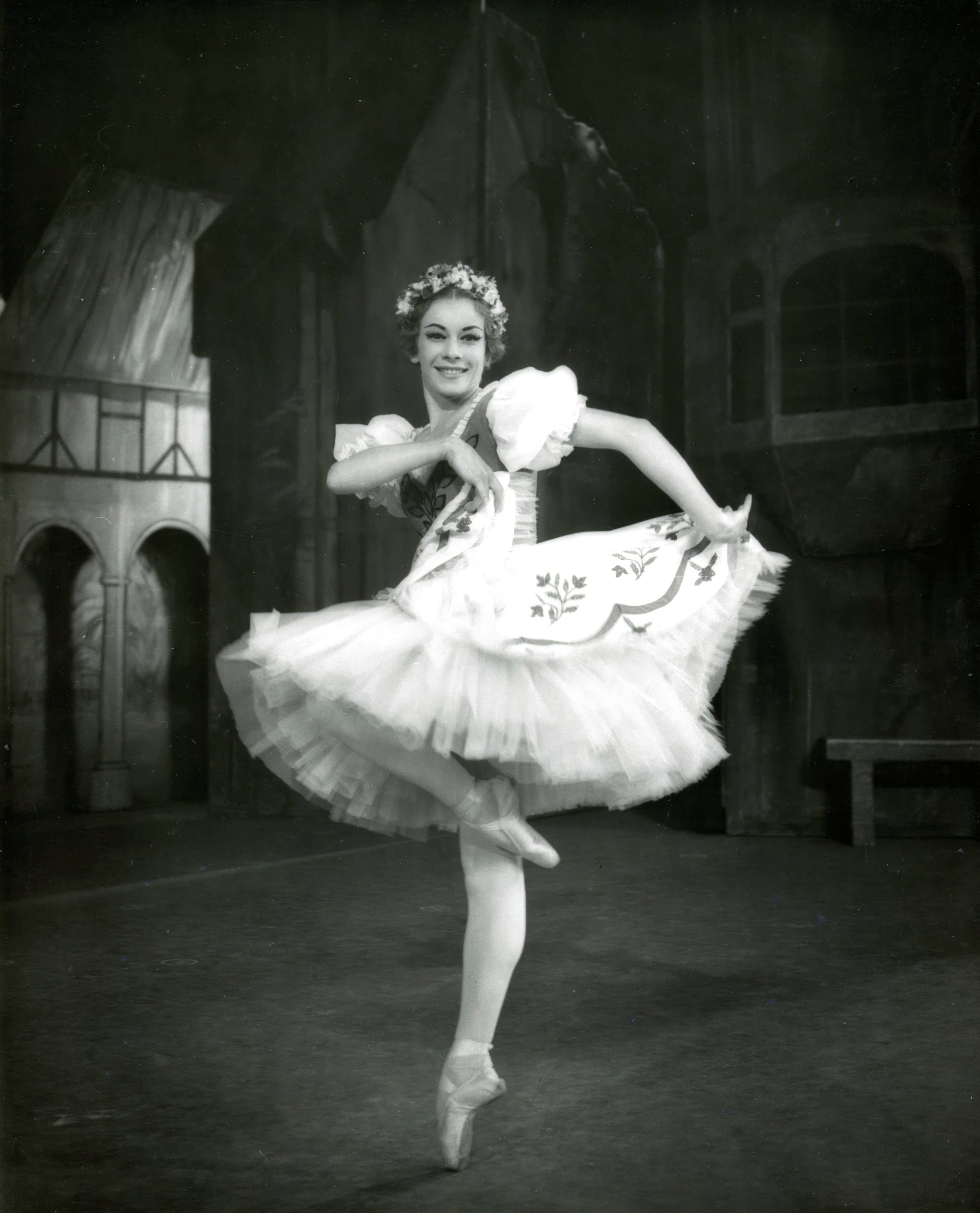
Here is Dianne Richards, skipping through parts of her dancing life – in this case at the start of London Festival (now English National) Ballet. Names from the world of Serge Diaghilev and his Ballets Russes, such as Alexandra Danilova, as well as Tamara Toumanova, Alicia Markova and Anton Dolin, weave through her very special company story and still cast a shimmering magic spell whenever mentioned.
In conversation with Patricia Linton, founder and director of Voices of British Ballet, Dianne explains how, at the age of 14, she danced in a performance in her native Rhodesia (now Zimbabwe), in which Markova and Dolin were appearing as guest artists. When she was 16, Dianne came to England with her mother. Dolin remembered her and asked her to join London Festival Ballet (LFB), with whom she worked for 18 years. Dianne was soon dancing solos and was coached in the role of The Nutcracker’s Sugar Plum Fairy by Markova herself. With LFB Dianne toured the world, including long tours of North America where the company had their own train. A highlight was performing in Monte Carlo in 1956 for the wedding of Grace Kelly and Prince Rainier; another was Igor Stravinsky conducting Petrushka in Chicago and disagreeing with Dolin over tempi. She also recalls Charlie Chaplin pursuing Nathalie Krassovska in Paris. The interview is introduced by Deborah Weiss.
First published: January 27, 2026
Biography
Born in Rhodesia (Zimbabwe) in 1934, Dianne Richards studied under Majorie Sterman. She joined London Festival Ballet in 1951, becoming a soloist in 1955 and a principal in 1959. In a very full career with the company, she toured the world and worked with many famous dancers, including Alicia Markova, John Gilpin, Anton Dolin, Erik Bruhn, Serge Lifar, Alexandra Danilova, Tamara Karsavina, Irina Baronova and Tamara Toumanova. She also appeared as a guest artist with American Ballet Theatre from 1963 to 1964. Richards danced with Galina Samsova and Andre Prokovsky’s New London Ballet in 1972 and then with Scottish Theatre Ballet until 1974, when, at the age of 40, she retired from the stage. She then went to live in South Africa, and in her retirement taught from time to time, including at a newly opened academy in Hong Kong and, at the invitation of Robert de Warren, for Northern Ballet Theatre in England.
Transcript
in conversation with Patricia Linton
Dianne Richards: In 1947 [Anton] Dolin and [Alicia] Markova came out [to Rhodesia – now Zimbabwe] to dance with the State Theatre Ballet. They came straight from American Ballet Theatre. I was 14, and he [Dolin] spoke to my mother, unbeknown to me, and said he was planning on starting a company in England and when I was old enough would she bring me over.
Patrician Linton: Had they seen you dance at this point?
Dianne Richards: I did Red Riding Hood in their [The] Sleeping Beauty. I did all the RAD [Royal Academy of Dance] exams, and I won the RAD scholarship, went over [to London] in 1951. I was 16, and I said to my mother, “I would really, really like to join a company now. I want to be on the stage. I don’t want to go back to school”. Well, Louis Godfrey was celebrating his 21st birthday in Sunderland; the Festival Ballet was there [on tour], so I went up to see him and Dolin said [to me], “Join the company”.
Patricia Linton: Did he remember you?
Dianne Richards: Yes. So, I did. I first performed with them in Monte Carlo, which was very swish.
Patricia Linton: Yes, so in 1951, Festival Ballet were the first company, weren’t they, that weren’t Russian to be invited to dance…
Dianne Richards: Yes.
Patricia Linton: …at Monte Carlo?
Dianne Richards: And we used to go every Christmas, [and] spend about six weeks there, in those famous studios. It was wonderful.
Patricia Linton: So, what was the allure of Festival Ballet? What made it so…
Dianne Richards: The people who ran it. Dolin and the people who got in as I, the names I mentioned to work with us, and [the] always interesting repertoire. It made our lives very interesting. There was always someone new to work with.
Patricia Linton: And was he [Dolin] very hands on? Was he always there?
Dianne Richards: Yes, although he did his odd plays and films, he was very much part of the company. Markova was rather distant from the dancers and then she left in 1952, I think.
Patricia Linton: To go back to New York?
Dianne Richards: When we were in Monte Carlo, yes, she left.
Patricia Linton: Why did Markova go?
Dianne Richards: Well, there were various rumours – appendicitis was one, but I think she died with her appendix, actually. Dolin and Markova were a partnership for 25 years and they fought like cat and dog. Loved each other but, fights…
Patricia Linton: So, periodically she had to disappear?
Dianne Richards: And this was for good. After she came back, later on, Ram Gopal did a solo for her which she performed as [a] guest artist with the company, and she came and did Giselle again. I can remember that last performance, standing in the wings, and she did her chaîné, chaîné, chaîné, chaîné, chaîné, chaîné, arabesque, and all. Her whole costume was pure silk net and she stood there and then she sailed around, very quietly after the music and the silk just swished around her and she went into the wings. She said, “I have been working my whole life just to end that solo like that”. Once! It was just glorious, like someone had gone [blows] with a dandelion.
We had huge audiences. We toured the world. I was with the company 18 years. We went everywhere, and then we would have five weeks out where no one got a penny; start off again. We had a big following because of Dolin and the guest artists that every season we had.
Patricia Linton: Sensational, actually.
Dianne Richards: We had [Tamara] Toumanova and [Alexandra] Danilova. Toumanova, with her mother, “Mama”, they were quite characters. Danilova was wonderful – she used to give fabulous classes. And they all came from Diaghilev [Serge Diaghilev’s Ballets Russes – although Toumanova never appeared with his company]. They were all very special. They used to coach us in whatever – Les Sylphides, Swan Lake, Sleeping Beauty – they used to coach us.
Patricia Linton: And [Nathalie] Krassovska? Do you remember her?
Dianne Richards: Oh, Krassovska! Wonderful, wonderful, beautiful. Tata.
Patricia Linton: Yes, that’s right. Tata.
Dianne Richards: Tata.
Patricia Linton: Yes.
Dianne Richards: Charlie Chaplin was absolutely, passionately in love with her and we were performing at the, I think it was the [Théâtre des] Champs Elysées in Paris, and he was always backstage wanting to marry her. “Ah, non, ne me touche pas, I cannot”, she would go. “Non, non”. And we would go to the embassy parties, for instance, and Tata always had a bag of oignons [onions] with her, a bag of oignons and a bag of pointe shoes, which she would darn at these dos in Balmain, and she liked to make her own salads. So, she always had a bag of oignons with her. [Laughter] And she would make her own salads. Krassovska took over from Markova when Markova left, walked out, in Monte Carlo. That’s how she got all her roles.
Patricia Linton: We’ve got to go back to how you began to move from the corps de ballet…
Dianne Richards: Oh, alright.
Patricia Linton: …into your solo roles.
Dianne Richards: Um, I was 18 years old. We were in Zaragoza and Mr D [Dolin] said, “You’re going to do Harlequinade for your 18th birthday”. And I did it with John.
Patricia Linton: With John Gilpin?
Dianne Richards: Yep. So that was my first principal role; lovely pas de deux. And then the next role I did was [the] Sugar Plum Fairy at [the Royal] Festival Hall. I did a matinée.
Patricia Linton: And this was in the [Alexandre] Benois [the stage designer’s] Nutcracker?
Dianne Richards: Yes
Patricia Linton: I read that Markova said the Sugar Plum Fairy must be danced like crystal.
Dianne Richards: That’s right, and I was extremely lucky to have her coaching me in it.
Patricia Linton: How was she as a coach?
Dianne Richards: Markova? Very quiet; distant but meticulous.
Patricia Linton: We should talk about your tours, actually.
Dianne Richards: What did we do? We danced at Grace Kelly’s wedding in the courtyard of the palace [in Monte Carlo].
Patricia Linton: When she married Prince Rainier?
Dianne Richards: Yes, because whenever we rehearsed in the Diaghilev rooms at the Opéra, Rainier and his brother used to always come and watch. They were mad about the girls. [Laughs] Homage to a Princess was one of the works, [to] Stan Kenton’s music.
Patricia Linton: This is quite sensational.
Dianne Richards: And we all were issued with envelopes with the stamps, with their faces on the stamps, the wedding stamps.
Patricia Linton: That’s a fantastic coup for Festival Ballet. Was this Dolin, Anton Dolin’s connections?
Dianne Richards: Yes, and Dr [Julian] Braunsweg. Yes. And we literally toured all over the world, non-stop. We went to South America. The first time was, I think it was 1960 or 1961. We were there three months, non-stop working.
Patricia Linton: And did you fly with all the sets and costumes, or did they go a longer route?
Dianne Richards: Yes, we [had] charter flights, and you couldn’t go to the loo because the toilets were full of luggage. When we went to America in 1954, we sailed there on the… it was the Empress of Scotland, and we had a ball. We did! We gave performances for the passengers. We did class every day on [the] first-class deck, and we finished [rehearsing] Alice in Wonderland.
Patricia Linton: On the boat?
Dianne Richards: On the boat. John Gilpin, coming back on the Ile de France, he did [the] Black Swan [pas de deux], but he did Odile, and he did 32 double fouettés – this is Gilpin as Odile, in the black tutu en pointe with his finger on the ceiling of the ship. [Laughter] [sings] Thirty-two double fouettés! Brilliant – brought the house down.
Patricia Linton: It sounds like tremendous fun.
Dianne Richards: We had wonderful fun.
Patricia Linton: Yes!
Dianne Richards: Our [Sol] Hurok tour [in America]. Six months [of] one-night stands except for Los Angeles – we were there for two weeks. We had our own train. So, it was just us, the crew, all our costumes and scenery and the orchestra. Whole train.
Patricia Linton: You lived on the train?
Dianne Richards: Yes, for six months. Spoilt rotten we were. We had two poker schools for dancers.
Patricia Linton: Two poker schools! [Laughs]
Dianne Richards: Mama Toumanova used to hold séances every night! [Laughter]
Patricia Linton: So, it really was a whole life involved with that?
Dianne Richards: Complete… it was a complete family. A real family.
Patricia Linton: What about the [Mikhail] Fokine repertoire?
Dianne Richards: I can remember a wonderful performance [of Petrushka] in Chicago. There was Dolin as Petrushka, Papa Beriozoff as the Moor, Tamara Toumanova as the doll, and Stravinsky conducting it.
Patricia Linton: What was he like?
Dianne Richards: He was rather old then, and he and Dolin had a great big do, fisticuffs nearly, after the performance because Dolin said to him, “So slow”. “It is my music. I will conduct as I like”. “You’re just an old man”, Dolin went [Laughs] because it was very slow. But, of course, half the public came to see Stravinsky, the other half came to see the Diaghilev dancers that were on.
Patricia Linton: Yes, yes.
Dianne Richards: That was a fabulous performance, really fabulous.
Patricia Linton: Even if it was slow?
Dianne Richards: Yes.
The transcript of this podcast may have been lightly edited for ease of reading.
You may also like...
Yvonne Minton
Roger Tully