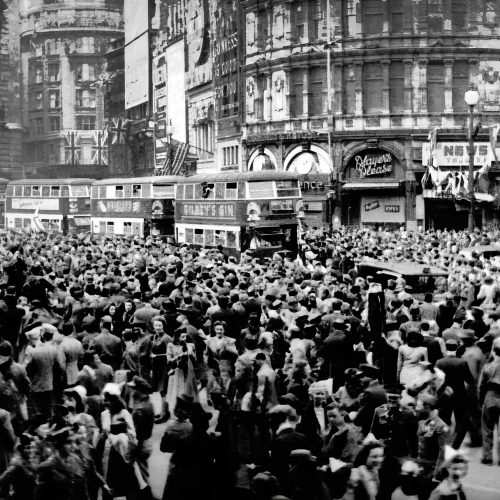
Thea Musgrave
In 1969, Peter Darrell choreographed Beauty and the Beast for Scottish Theatre Ballet. In this podcast Thea Musgrave discusses with Stephen Johnson the challenges and idiosyncrasies she found when creating the music. She was amused to discover that she wasn’t the first composer to have to succumb to balletic demands! Deep, observant and fiercely straightforward, it is fascinating to hear Musgrave describe so poetically another work she created for dance, Orfeo. The interview is introduced by Stephen Johnson.
First published: November 4, 2025
Biography
Thea Musgrave is one of the United Kingdom’s most important and prolific contemporary composers, pursuing her own idiom and musical sensibility throughout a long and distinguished career. She was born in Barnton, in Edinburgh, and went to school in Shropshire. After study at the University of Edinburgh, from 1950 until 1954 she studied in Paris, working under the direction of the redoubtable and influential Nadia Boulanger. She attended the Tanglewood Festival (in Massachusetts) in 1958, studying under Aaron Copeland.
In the late 1950s and 1960s she established herself in London as a notable figure in British musical life. In 1970 she was a guest professor at the University of California (Santa Barbara). In 1972 she married the American musician Peter Mark and has lived in the United States of America ever since, where she has held many notable positions, including a distinguished professorship at City University, New York, from 1987 until 2002.
Musgrave’s style has been described as a synthesis of expression and abstraction, noted for its drama and complexity, often with a strong romantic undercurrent. Her many works include several operas, including ones devoted to Mary Queen of Scots, the abolitionist and social activist Harriet Tubman and the statesman Simón Bolívar, as well as many concerti and orchestral works, often inspired by poetic and pictorial themes. As well as working in America, she has made frequent visits to the United Kingdom and Europe, including taking part in the BBC’s ‘total immersion’ weekend devoted to her works in London in 2014. She composed the scores for two ballets, Beauty and the Beast in 1969 and Orfeo in 1975. Thea Musgrave has received many honours, including two Guggenheim Fellowships and many honorary degrees. She was awarded a CBE for services to music in 2002.
Transcript
in conversation with Stephen Johnson
Stephen Johnson: When we’re talking about Beauty and the Beast, we are going back a few years.
Thea Musgrave: We’re going back many years!
Stephen Johnson: But do you remember getting in contact with Peter Darrell, the choreographer, about this?
Thea Musgrave: Sure. I remember being in contact with him. The details of that contact, I don’t remember.
Stephen Johnson: Can you remember your first impression of Peter?
Thea Musgrave: I just remember him. Very pleasant man and obviously a lot going on in his head, but he was always very nice to work with. It was a great pleasure. And, also, I had Colin Graham, who wrote the, what do you call it, a scenario?
Stephen Johnson: Yes, yes…
Thea Musgrave: As opposed to a libretto in opera.
Stephen Johnson: I think you call it a scenario.
Thea Musgrave: I had worked with, and I knew quite well. Well, first of all, Peter Darrell said, would you like to write a ballet? I said, ‘Yes, of course’, without really realising what I was getting into, because I was more familiar with opera than I was with ballet. But when Colin gave me this very detailed scenario, with timings, I thought, ‘Oh boy, this is this is a challenge’. And then I checked up on that. I went to look at what [Marius] Petipa gave Tchaikovsky, and I saw, you know, three bars of three, four here, 16 bars of whatever. And what is surprising is that Tchaikovsky did just that. So, it was very interesting. So I was actually very grateful, for Colin had obviously thought it through very carefully with Peter Darrell, you know, not in terms of the actual movements and dance, but in terms of dramatically what you need in ballet, because what I quickly realised that opera and ballet have similar things, though, in the theatre and they’re dramatic or, you know, whatever, but they’re not the same. There are some very big differences.
So that’s what I had to come to terms with. And then having this very detailed scenario from Colin really made me work very hard because I thought, ‘OK, I will do it’, he says. But to then make musical sense out of this and make it sound like music that was sort of natural and just happened to be that way with all these demands, was a challenge. The thing that really surprised me was this. And where it’s really different from opera is that, you know, you have an opera aria solo, big solo. It can be two, three minutes. A solo in a ballet is probably 1.5 minutes. Right. Very much, much shorter. So, you have to make what you want to say much more quickly and establish it right away. And then these sort of in-between bits, like the rest of time that you have in opera, in ballet, you know, the storytelling or whatever, I tried to make it as interesting as possible so the whole thing would really flow.
Stephen Johnson: Weren’t you using a taped element in this ballet?
Thea Musgrave: Well, what happened was that Colin had put in the scenario ‘peals of evil laughter’ or something like that. So, I thought how on earth am I going to make peels of wicked laughter? Because the other thing is, we chose to do it with a chamber orchestra, so it was tolerable and yet enough players that it could be done in Sadler’s Wells or a bigger theatre, not just a town hall. So, there are 20 instruments. And anyway, how was I going to do peals of wicked laughter with instruments? So, I thought, well, it’s easy enough to do with, with some tape. And then I thought, well, if I have tape, I might use it constructively and use it for a particular purpose. So, what I remember mainly doing is for the time travel that you go back into, into the other world. And so, it was nice because it gave another kind of sound as you were traveling backwards or forwards, whatever. So, then tape became an integral part [of the score]. I don’t remember how I made the tape, whether I did a lot of tape with Daphne Oram, who was sort of the expert at the time and who worked a lot with the BBC, you know. It was all very, very new and now it’s so familiar. It was also new back then. I mean, we’re talking 1969. Of course it was around, but people in general, composers in general, hadn’t really got started using it, just very few people.
Stephen Johnson: When you started to encounter the business of turning your music into a ballet, were there any surprises for you? Were there things that you found difficult to adjust to about the whole process of realising in dance?
Thea Musgrave: I don’’ know that they were surprises. There were just things that were there that I had to had to deal with. One very interesting thing for me was this. That when we finally… when once I’d finished the music and in piano rehearsals with the dancers, I went to as many rehearsals as I could just to see how it all worked. Now this is what I learned was that Peter, who I respected enormously, I think he’s a very, very gifted and wonderful and musical choreographer. But he would get entranced with certain things, and he’d want to add in a little something or a little extra turn, and then he’d say, slow the music a little bit. I need to do this here. So, after a bit I said, ‘Peter, you know, this is supposed to be a metronome 76 and you’re slowing it down to 63, or whatever, in order to do this? You know that won’t work because the tempi are important’. And so, I had to sort of keep an eye on him not to do too many beautiful things, to slow things down.
Then I learned that Kenneth Alwyne was a conductor when it first happened. But then we did a tour of Europe, and Kenneth wasn’t free, for some reason. They asked me to conduct, and this is what I learned, that you really had to know what a crotchet 76 is in terms of tempo, because singers can stretch a little bit. Dancers, if they take a leap, are going to come down no matter what when they come down. And it better be when it’s supposed to, so as to be with the music so that, as a conductor, as a performer, I had to learn exactly and remember the tempo. Particularly certain dances were more sensitive than others, other kinds of things. I think dancers could stretch tempo a little bit, but in certain things they really couldn’t because of the nature of the choreography. So that was a very important… Those two things were very important lessons for me.
Stephen Johnson: When you were composing, did you have any movements in your mind, any dance movements in your mind?
Thea Musgrave: No. I couldn’t do that. No, I mean, that’s Peter’s job. I think I asked him what sort of thing do you want here? Is it slow or fast? Whatever. You know, Colin has said this is a minute and a half. So, then I went to Peter and said, what do you want here? I mean, sometimes it was obvious that, with the pas de deux, love was going to be a certain kind of music, but [at] other times there were various possibilities. So, I think I must have said to Peter, ‘What [do] you have in mind?’ and then I would decide, you know, what it was going to be. And, also, all the way through musically, I wanted there to be contrast, so that one thing didn’t sound like the next thing, and yet there would be the same time continuity. So, you know, so the balances you make in, in any music, same kinds of decisions.
Stephen Johnson: I’m just thinking that. Stravinsky said there was a particular sound he used to make for on points. Well, there was a particular kind of articulation he used on points, and there were certain kinds of movements in his mind that went with certain sort of musical articulations.
Thea Musgrave: You know what I remember about Stravinsky? I remember seeing Agon with a wonderful slow duet. Yes, with ABT [American Ballet Theatre] or City Ballet of New York [New York City Ballet], I don’t know, one of the American companies. That was wonderful because it was seamless. He managed to make a… it must have been [George] Balanchine, I guess. Yes. Must have made it absolutely seamless choreography. It’s not like one step and dancers have these weird counts one step followed by another, followed by another, and the sort of gap in between it was absolutely continuous and seamless, and I’ve never seen anything quite like that. It was really beautiful.
Stephen Johnson: How did you feel as a composer turning to this wonderfully old-fashioned story with a happy ending? Did you at first think, ‘Oh, am I going to do this as you said?’ Or did you? Did you find before long the kind of musical language that was appropriate to this suggested itself?
Thea Musgrave: Well, you have to write. I don’t know how to say it like in your own language, because otherwise it’s a pastiche. You have to write your own music and make it as appropriate as you can. I had recently had to write something in honour of Bach. I mean, if that’s not scary, I don’t know what is. And I thought, you know, I’m not going to… I can’t write like Bach. I mean, there’s no way it would be pastiche, and it would be a kind of cheat, but I had to write something which was appropriate to the occasion. So, I found a way of doing it another way. So, I think the same in ballet, you or according to the story, you have to find a way of being magic, like Beauty and the Beast and time travelling. Uh, when he takes her back, that is appropriate to the story but is also writing your own music.
Stephen Johnson: Now, the other ballet you’ve written, Orfeo, is a rather different proposition, isn’t it?
Thea Musgrave: It’s, um. I just saw that the other night in New York. Well, that is interesting, because it was not written as a ballet, that was written as a concert piece, and it was written in various versions. It was the first version, [which] was written for a live flute and a recording on tape. Now it so happens that the tape was made by Jimmy Galway, wonderful, wonderful, famous flute player, and Jimmy Burnette, [who] was in the BBC transcription service. And in there we worked on the Jimmy Galway. Had recorded and added electronics and all this. So, what’s on the tape is the setting, and also Eurydice. Orfeo is the head of the story. So, it’s really what he’s imagining as he remembers and grieves for Eurydice. So, when it was done as a ballet, when Pat Spencer – who’s a wonderful New York flute player – did it, she said she’d like to try that. So, I thought, well, why not?
So, what happened in the production? Actually, the recent one was a little different. She started by kneeling on the floor, as you know, like a pants roll that some of the… in the ancient operas, the male roles are taken by trouser role [sung by a woman pretending to be a man]. Yes. And trouser roles. Right. And so, she was kneeling on the floor, sort of mourning. So, the flute was like this. And then gradually I put in ‘Che Faro’ from Gluck [the aria ‘Che farò senza Euridice’ from Gluck’s opera Orfeo ed Euridice]. Um, ‘Che Faro, Euridice’. Yes. So, it’s as if she’s remembering. So, she sort of looks up. And then she gets up. I don’t know how she gets up from kneeling on the floor. I can’t do that anymore. And playing the flute. It was absolutely extraordinary.
So, she hears this voice and wonders if she can go back and find he wants to go into the underworld to find – there’s this big river to cross. And in one production there was just a blue light that crossed the stage, and the Furies were there to stop her. So, the sort of… But all that’s on tape and [what] Orfeo thinks and feels is on the live flute. So anyway, she gets back, she manages to calm down the Furies, and she goes back, and she pleads to get together Eurydice. Then what happens? There was different in the two productions. This was very interesting. In the first production, she was upstage and there was a white light behind her, so she crossed diagonally from upstage. Downstage right. She came forward slowly playing, playing in this, the figure was always, ‘Look at me, look at me, look at me’, you know, like in the legend. And so finally when she reached downstage, she looks and of course, then the light disappears. She’s gone forever, and then she’s back, mourning by the river. In this production I just saw in New York, she was downstage right at the front, and she walked upstage with her back to the audience. And so, the light was behind the other way round. Yeah, if you see what I mean. So that, you know, then the light goes out and there’s no Eurydice anymore. So, there are different ways to do it. That was that was very interesting to me.
Stephen Johnson: Looking at your development as a composer, you’re not somebody who gives the impression of having changed with the times that some people did. It looks as if you’ve followed your own very distinctive course.
Thea Musgrave: But you develop because you learn things. You meet people and you learn things. You don’t stand still… but you… I always think you have to follow your own path. You mean you learn from people? I’m still learning from people. Even at my great age. You know, I don’t know everything about instruments. I learn from people, you know, ‘Can you do this? Can you do that? How about that? Would that work? Oh, no, it won’t work. OK, well, how about this?’ And you know, and I have friends who are wonderful performers. And so, they teach you. Yeah. Why not?
Stephen Johnson: So, if there’s anybody out there looking for a composer to write a new ballet, you definitely consider yourself up for it?
Thea Musgrave: Maybe. Maybe I’m too old. I don’t know.
Stephen Johnson: I don’t think so.
You may also like...
Celebrating Ninette de Valois: a conversation with Giannandrea Poesio
Antoinette Sibley