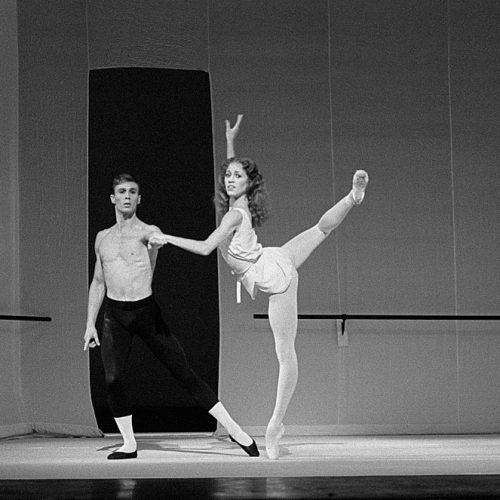
Felicity Sands-Widdrington
The fate of many a dancer is discussed at the end of this interview. Adventures are recounted with unaffected humour and a deliciously 1930s delivery. In this interview with Patricia Linton, founder and director of Voices of British Ballet, Felicity Sands-Widdrington talks about becoming a Bluebell Girl in Paris and being stuck in prison when World War Two broke out, before getting back to London via Switzerland and France. The interview was recorded in 2003.
First published: May 19, 2026
Biography
Felicity Sands (later Felicity Sands-Widdrington) was born in Kalgoorlie, Western Australia, in 1917. She took ballet classes in Perth with Linley Wilson, and came to London in 1936, partly to complete her Royal Academy of Dance exams and, when there, she trained under Olive Handley. She then got a job working on a film in Vienna, (Premiere 1937 directed by Géza von Bolváry) along with 100 other female dancers in a spectacular dance sequence.
After that, Felicity danced professionally in France, Italy, Austria and Switzerland, and eventually joined the Bluebell Girls at the Lido de Paris. During her dancing career she was always the only Australian in whatever company she was appearing. She was dancing in Milan in 1939 just before World War Two broke out. Two days before Italy joined the war, she and some of her colleagues were arrested and thrown into prison, wrongly suspected of being involved with gun runners. After a few days they were released and escorted by the Italian police to the Swiss border. She got into France and was able to get back to London on one of the last boats to leave for England.
Back in London in 1940, Felicity thought show dancing was “no way to conduct yourself in the war”, so she drove ambulances, before working in the Postal and Censorship Office in the famous Room 99. She had married in 1940, and after the war never returned to professional dancing.
Transcript
in conversation with Patricia Linton
FELICITY SANDS-WIDDRINGTON: I saw an advertisement in The Stage, and I went along with my little suitcase, and I did my time-step and my high kick, and I was in! I was told to stand on the side, and we rehearsed in Paris at the Folies Bergère in the day when no-one was there. Included always was a visit to the performance at the Folies Bergère. We were like school children: we were all lined up and we were shown to our seats, and [Miss] Bluebell [Margaret Kelly] would say, “Now, you will remember to tip the girl that shows you in, or the boy, whoever it was”. You see, so we were told what to do and we tipped. It was really like school! [LAUGHS]
PATRICIA LINTON: And she was still a very young woman at this time?
FELICITY SANDS-WIDDRINGTON: Actually, she was only about seven years older than I was, but she was much more commanding than I ever was. I was quite subservient where she was concerned. Once you had worked for Bluebell, she liked to keep her girls on. She was a very good woman to work for – very fair.
PATRICIA LINTON: Did she take care of you all?
FELICITY SANDS-WIDDRINGTON: Well… we knew we had to behave, otherwise we would be sent home. We would rehearse in Paris for five days. She would then come with us until we opened, wherever it was going to be. She would stay perhaps two days after we opened. Then we would be put in charge of the captain of the troupe, and she would go back to Paris again to look after the Folies. Her husband was the pianist at the Folies Bergère, and he always played for us when we rehearsed. He had a slightly roving eye. It never roved my way, but it did rove! But it was more than your life was worth because Bluebell would get her clutches on you! [LAUGHS]
PATRICIA LINTON: Did she choreograph all the shows?
FELICITY SANDS-WIDDRINGTON: No, we often had other people to teach us whatever numbers we were going to do. Usually there would be four in a show not lasting more than five or ten minutes for each number, I suppose. And then once we knew it, Bluebell would oversee the rest of the rehearsals. Then we would be measured for our costumes. All the costumes were of the most beautiful materials, really absolutely splendid and we had to look after them, too.
PATRICIA LINTON: And how many countries were the Bluebells dancing in at this time? Is this still 1937?
FELICITY SANDS-WIDDRINGTON: 1937, yes. We were her first touring troupe and after that, a year later, we went into Switzerland. She always had the girls at the Folies Bergère: this was her real main source of income, but gradually she sent girls all over the world. In fact, if there hadn’t been a war she was going to send some to South America: I opted out of that because I thought it was not the way to conduct yourself in the war – to go off dancing. So, I abandoned dancing in 1940 and…
PATRICIA LINTON: So, you were still in Italy then? [At the start of the war]
FELICITY SANDS-WIDDRINGTON: I got stuck in Italy in 1940. My contract had ended and Italy was about to join the war but hadn’t joined the war. But you had to get an exit permit to leave the country, and for some reason they wouldn’t give it to us. We went down to Milan to try and get it, and two policemen came to the hotel, and my sister-in-law was there [Zeta] and Catherine Dunn, who was our Captain, and I was there. They asked us to go, “Questora?” and questioned us, and at the end of the day they said, “I’m afraid you are going to be guests of ours, you’re not going back to the hotel”. So, they took us and put us in the [San] Vittorio Jail in Milan, because we’d known a very peculiar Italian-American who suggested that he’d brought some rifles over from America on a ship called the George Washington and landed them in Trieste, and they were going to go from Trieste through Yugoslavia into Greece where the fighting was. And we thought, “How ridiculous! What a story to tell!”
Anyway, he was staying in the same hotel we were in Milan, and he said, “I’ve got to go down to Rome now: would you look after my gramophone?” It was a portable gramophone. He was quite an amusing chap; he used to ring us up in the morning at breakfast time say[ing], “Good Morning” and then he’d put “Begin the Beguine” on his gramophone and play it over the wire. So, you see, he left us with this “Begin the Beguine” and the gramophone and went. And so, when the police said, “You’ve got this – you must have been hand-in-glove with this man doing this”. We said, “Oh no! We used to just have a rum and hot milk with him at night when we got back from the theatre.”
Anyway, apparently, he had been doing this, and they told us that they had shot him. But it took ten days. We had to get in touch with the [British] Consul and, of course, while we were still in prison Mussolini declared war and we were still there. The RAF came and bombed Milan, and two days later they came and said that, yes, they did believe that we hadn’t done this. We could now get our clothes from the hotel, and they would take us to the frontier, and that was that. We got to the hotel, and we had ten days hotel bill to pay from not being there. We had to pay for extra food in prison. We gave a donation to the nuns who looked after us in prison [LAUGHTER]… and we were covered in bug bites; I might tell you!
And so, they took us to the frontier. A little policeman sat with us on the train. He said goodbye to us, and we went over into Switzerland. And so, there was never any more dancing. It was a very, very short dancing career. What? Fifteen years training and four years on stage! [LAUGHS]
The transcript of this podcast may have been lightly edited for ease of reading.
You may also like...
Donald MacLeary
Federico Bonelli