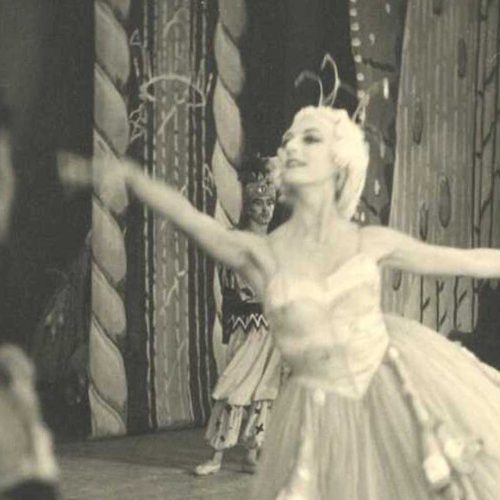
Deborah Macmillan
Deborah MacMillan, who talks to former Royal Ballet principal Bruce Sansom, is not afraid to speak her mind. Here she variously both endorses and explodes myths. Apart from anything else, these ten minutes should give hope to anyone who suffers from depression – nothing is impossible. Through the gloom of life, both within and without, her husband, the choreographer Kenneth MacMillan, went on creating ballets that have given thousands of dancers around the world endless challenges and insights, let alone audiences. For all his breaking of moulds and pushing at frontiers, MacMillan’s absolute belief in the traditions of classical ballet is never far away. As well as being a choreographer, MacMillan was also director of The Royal Ballet from 1970 until 1977. The interview is introduced by Jennifer Jackson.
First published: December 2, 2025
Biography
Deborah MacMillan is the custodian of the ballets choreographed by her late husband, Sir Kenneth MacMillan, supervising productions of his works all over the world. Deborah Williams, as she then was, was born in Queensland, Australia, in 1944, and educated in Sydney. She studied paining and sculpture at the National Art School before moving to London in 1970, marrying Kenneth in 1974. She has designed ballets for both stage and television, as well as making numerous contributions to Royal Ballet productions, including the production realisation for the major revival of Anastasia in 1996, production and setting for a condensed version of Isadora in 2009 and costume designer for a revival of Triad in 2001. In 1984, Deborah returned to painting full-time and her work is represented in private collections both in the UK and the USA.
From 1993 until 1996, Deborah was a member of the Royal Opera House Board, and in 1996 was chair of The Friends of Covent Garden. She has served as a member of the Arts Council of England from 1996 until 1998, when she chaired the dance panel. She has also been a trustee of American Ballet Theatre and a member of the National Committee of Houston Ballet. She became Lady MacMillan when her husband was knighted for his services to dance in 1983
Transcript
in conversation with Bruce Sansom
Deborah MacMillan: I had never seen the [Royal] Ballet company; it wouldn’t have occurred to me at that point to go to the [Royal] Opera House. I don’t know why, it just seemed very… So, I didn’t actually get to anything at the Opera House until I met Kenneth [MacMillan].
Bruce Sansom: So, you arrived in [the UK] 1970. When did you begin to understand what Kenneth’s position was in the British ballet world?
Deborah MacMillan: Well, not until he asked me out, actually. He said, “Would you like to see something that I’ve done?” and I said, “Well yes, I would”. So, he took me to see… I think it was… Triad the first thing I saw, and I was quite nervous because I thought, “What if I think it’s horrible?” [Laughs]
Bruce Sansom: How old was Kenneth, and how long had he been director [of The Royal Ballet] at this point?
Deborah MacMillan: He was 42 and he’d been director since 1970, but I didn’t meet him until the end of ’71, and he’d been having a really dreadful time. He’d done Anastasia a couple of months before, and there’d been the most horrendous reception [for the ballet]… He had a sort of breakdown. Just as I met him, or just before I met him, he’d been in a really bad way. I mean, he’d not been able to leave the house, and for a couple of weeks he was, sort of, in a really frightful state.
Clement Crisp and Zoë Dominic (the photographer) got him to a very good, proper psychiatrist who got him onto some anti-depressants and things, and he was able to function, but he was chronically depressed for a large part of the time that we were together. I mean, life wasn’t easy for him. He had a very difficult time with the press and because of that he had a very difficult time with the board [of the Royal Opera House]… I mean he was perceived to have taken Fred’s [Frederick Ashton’s] job, which was not true. Just as Fred left [The Royal Ballet] there was a major pulling together of the two companies and there were sackings and that was something he was blamed for, and yet it had all happened before he came in. He wasn’t one to, sort of, fight his corner. He used to get quite, sort of, ground down… he wasn’t able to fight.
Then, when we got together, he asked me to go to New York with him. He wasn’t flying at this point [MacMillan had a phobia for travelling by air], so we went by boat, and it was a time of year when the trans-Atlantic things [liners] were not starting ‘till just after the company was opening in New York.
So, he was arriving [for] the second week of their tour, which was then perceived in New York to be a terrible snub… He’d deliberately not come for the opening, and it was a vile trip. It was my first experience of, sort of, lunatic ballet fans. I mean, I’d never come across anything like it in my life… it was shocking how vicious they were, and how destructive and how destructive [the dance critic] Clive Barnes was… I mean, out to absolutely… I mean, I think Clive Barnes wanted [choreographer John] Cranko to take over the company and was furious that his good advice was not adhered to. And it just, you know, the whole thing was deeply shocking, actually, and I remember thinking then, I mean, no wonder he’s been in a bit of a state.
Bruce Sansom: And in terms of the way you said Kenneth was treated badly, [are there] any examples that you could give? Or was it just a general, sort of, attrition thing?
Deborah MacMillan: It’s a sort of divide and rule. You know, I have big problems with the structure of something like The Royal Ballet, which is a highly specialised, totally professional environment and yet the people who decide on appointments, on and off, you know… for instance, the appointment of the artistic director, as we know recently, was taken by one supposed ballet expert, but she’s right at the end of her life, and two people who, you know, are amateurs. The fact that [Lord] Eatwell and Colin Southgate were deciding who will run The Royal Ballet would be like asking CD collectors to decide who should run EMI, where Southgate came from, or saying to people who like to wander around Cambridge with a camera and photographing the “dreaming spires” who should be on the academic staff [of Cambridge University]. However much you like watching… and it’s very flattering to be invited on to a board – I know because I was – [but] you have to keep reminding yourself that your job is only to support the professionals.
Bruce Sansom: What were some of the things that he either wanted to do and managed to do later on, or was never allowed to do because of [the] board, or whatever?
Deborah MacMillan: Well, there were [the] two great examples of what he was stopped from doing [by the board of the Royal Opera House] that he went and did somewhere else. And I suppose you could argue, well then, because he was very angry, he did something somewhere else with Song of The Earth and Requiem that perhaps he may not have achieved at the Opera House. But, you see, I think what he was starting to do with Anastasia was a huge, ground-breaking thing. He was actually blasting through the model of the three-act ballet, which, when it [Anastasia] was so dumped on by everybody, he withdrew from and then went back to [an] absolute model of the three-act ballet with Manon. Now, if that experiment had been seen as an experiment, and there’d been more encouragement, I think he could have done all sorts of things…
You know, he once said to me, “If you analyse Manon, it’s actually no different from [The] Sleeping Beauty”. You know, the diverts… move the action on a little bit more than in a straight classical ballet, but the structure of it is based on a traditional three-act ballet; the way it evolves, the repetition of musical themes and things.
You could argue, “Well that’s the recipe and that’s what works”, but if the art form is going to develop it’s got to be… in a way… got to be grabbed hold of and tackled and changed. He broke away a little bit again from it with Mayerling, and he certainly broke away with Isadora, but it wasn’t that he was stopped – he was stopped with Song of the Earth and Requiem – but always coming from the powers that be – and it wasn’t just paranoia (even though he suffered from that big time) – there was always a “wait and see, let’s wait and see what he comes up with”.
There was always a, sort of, withholding of appreciation of what he might be doing. Then there was the big Fred claque; you know there was the big Fred camp, which was very strong, and it was strong out there amongst people who were powerful and, you know, Kenneth was desperate to be part of a world that he’d not grown up with because he came from a completely working class background and felt it very keenly, and yet he was, sort of, disapproved of.
It was a funny environment to watch him work in, and I would watch people not have an opinion or… they didn’t even have the guts to say, “Listen, I think what you’re doing is a load of shit”, which, actually, is a much cleaner and healthier way – you know, saying, “I don’t like it, I don’t think it works” – than just [staying] schtum, not mentioning anything.
I have to say, during [the Jeremy] Isaacs reign [as head of the Royal Opera House], Isaacs didn’t actually work like that, and although I don’t think Isaacs really knew anything about dance, the night of the first night of [The] Judas Tree, the doorbell rang about an hour before we were due to leave to go the theatre and it was a hand delivery from the Royal College of Art – because Isaacs sat on one of their boards, or something – telling Kenneth that they had awarded him a doctorate and Isaacs had arranged for it to be delivered to the house just before we left, which I thought was a very, very, very sensitive and generously sensitive thing to do. Because it, sort of, gave him a real puff, just before… that was a nice thing to do. And yet there was an occasion under [Sir John] Tooley when there was, I think it was the first [night] of [La] Fin du jour, where the phone rang just as we were leaving the house, and John said, “Oh, I’m just ringing to wish Kenneth ‘Good Luck’ and to say to you, Deborah, I hope this one’s a success. If he gets bad reviews with this one, it’s very hard for me to support him.” [Laughs]. So, I said, “Erm, would you do that to an opera singer?” I was livid.
Bruce Sansom: And how was he when he’d been in the studio rehearsing or creating all day and he’d come back [home]? Would he talk about what he’d been doing?
Deborah MacMillan: Very little because it was… I always felt, in a funny sort of way, it was, sort of, happening in spite of himself, and that he was driven, in spite of himself. He sometimes… he’d be knitting, and he’d be getting more and more tight with the knitting, and the tension would get tighter – he was always knitting these frightful garments that he’d think I’d want to get into, or Charlotte [their daughter] would want to get into, and we wouldn’t, and he’d go on knitting them, or bits of them, and then he’d finish the ballet and put it down. After he died, I found all these half-finished bits of horrible knitting. [Laughter] Sometimes they were nice, sometimes – very rarely – they were nice…
It was funny because he used to talk about it being a sort of giant puzzle that he’d be trying to find the pieces for. Once he got an idea, he was ruthless with himself about that idea and instead of, you know… I mean, I watched him make steps in a room, but I used to watch him reject and reject and reject until, finally, they [the dancers] would do something that… it was almost as if he had this blueprint in his head, and until he got the things that actually fitted into the little holes in that blueprint he was going to chuck it all out.
Bruce Sansom: Can you remember the sort of build-up to Kenneth no longer maintaining his position as director? What was the lead up to that?
Deborah MacMillan: Well, I’ll tell you exactly what happened. The official story was that he got fed up of having to watch Romeo and Juliet every night, but the actual thing that happened was that, behind his back, he discovered that the board had gone to Madam [Ninette de Valois] and asked Madam to come back and do [a new production of The Sleeping] Beauty [replacing the production of the ballet he had staged just four years earlier], and he was just told that that was what was going to happen. And he came home and said, “I’m no longer directing the company; I’m resigning.”
Bruce Sansom: I just wonder what her [de Valois] instinct was about it; how much they told her as to…
Deborah MacMillan: Whether she knew or not?
Bruce Sansom: Whether she knew or not, exactly.
Deborah MacMillan: I mean, who knows? Because she was not… she was kept around a lot because I discovered, after Kenneth died – it came out in Tooley’s book – that he [Tooley] used to go and have tea with her regularly to find out about what she thought about how Kenneth was doing. Well, that’s not fair either because however much having been the founder choreographer, the founder director [of The Royal Ballet] you are prepared to let go and move on. Inevitably, you’re going to have opinions about what’s happening and you know you mustn’t have an input unless it’s an agreed…
Bruce Sansom: Did Kenneth get on with Madam?
Deborah MacMillan: He did. I mean, it was a parental relationship and those are always uneasy ones because, at some point, you have to grow beyond the parent. And, you know, she was always, I mean, hugely supportive of him but also very critical – the way mothers are, and probably with reason. I mean, she couldn’t stop meddling.
The thing she did that was very naughty was that when Kenneth, I think, had, I think after [he had choreographed] Valley of Shadows but certainly after My Brother, My Sisters, she said she wanted to talk to the [London] Ballet Circle, and she’d like the press to be invited. And she got up and delivered a broadside against “these” choreographers who are putting two [musical] scores together [in a ballet] – it just isn’t good enough, you know, and there’s too much floor work… It was meant to be all off the record, and Ann Nugent wrote in The Stage that Madam had attacked Kenneth.
Kenneth was away in New York and Iris Law [artistic administrator of The Royal Ballet] rang him to tell him, and he rang me up and said, “Can you check it out and find out what’s going on?” So, I got hold of The Stage, and it was, I mean it was quoted as a real broadside. So, I rang Madam up and said, “Look, he’s terribly upset; did you intend for that to be quoted as an attack?” And she said, “Certainly not, dear, certainly not. I was just making generalised opinions.” I said, “Well, you’ve been quoted as having been attacking Kenneth, will you retract it?” And she said, “No, it’s always a terrible mistake to speak to the press, terrible mistake to speak to the press”.
So, I mean, that obviously irked her terribly that he was experimenting in that way. But, you know, ultimately, she wasn’t vicious, and she wasn’t… she was not jealous as such, the way I think Fred [Ashton] was.
Fred was very jealous, actually, and naughty with it. Fred did an amazing thing. [David] Bintley did a ballet and Fred, when we came through the Pass Door [at the Royal Opera House], Fred saw Kenneth coming and sank to his knees in front of Bintley and said, “You are the one”. There were lots and lots of people on the stage, and it was all things like that, that were, you know, unnecessary.
Life changed enormously after Fred died, I have to say. Because then Kenneth became the grand old man of British ballet and a whole series of social things changed where he was not a part of before. But within weeks of Fred dying it was a very different scene for Kenneth, which I have to say he enjoyed.
The transcript of this podcast may have been lightly edited for ease of reading.
You may also like...

James MacMillan

Lilian Hochhauser