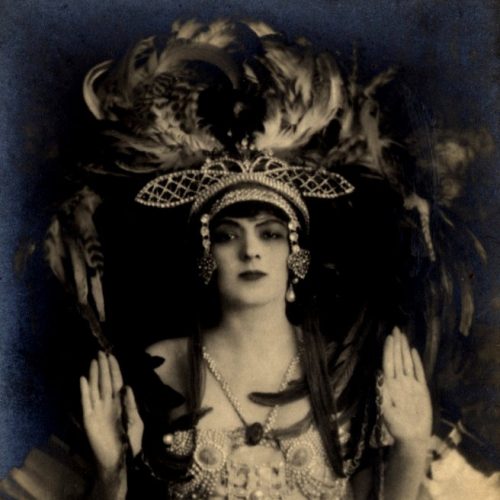
Celebrating Ninette de Valois: a conversation with Giannandrea Poesio
In 2026 Voices of British Ballet is celebrating the life of Ninette de Valois, to mark the centenary of the Royal Ballet School, with a series of interviews and special episodes that illuminate her life and artistic practice.
In this episode, Dr Anna Meadmore, Manager of Special Collections at the Royal Ballet School, introduces an interview with the writer and ballet historian Giannandrea Poesio. The interview was recorded in 2011 at a conference dedicated to Ninette de Valois where Giannandrea Poesio was one of the delegates. He talks with Patricia Linton about two meetings he had with de Valois and how she gave him the nickname “Cecchetti Boy”. He discusses Ninette de Valois’ reservations about the Cecchetti method and explores the use of historical mime in present day performance.
Anna Meadmore was one of the organisers of that conference in 2011 and reflects on the importance of dance history to the education and training of new dancers and choreographers. She also talks about Giannandrea’s talk at the conference about mime in ballet and the influence of Giuseppina Cecchetti and Francesca Zanfretta.
Giannadrea Poesio died in 2017.
First published: May 5, 2026
Transcript
in conversation with Patricia Linton
Patricia Linton: I am sitting with Giannanddrea Poesio and we are in the middle of the conference. He has just given a brilliant paper on mime.
Giannandrea Poesio: Thank you.
Patricia Linton: There were two things, two meetings you had with de Valois.
Giannandrea Poesio: Yes.
Patricia Linton: You said you would just like to talk about them.
Giannandrea Poesio: Both in 1992, I was a student at University of Surrey at that time, and Dame Ninette came with Pamela May to visit the university, and to check the ballet faculty. I was kindly introduced to her, as the guy who was working on this endless research on Cecchetti, and she immediately nicknamed me ‘The Cecchetti Boy’. During lunch, for a number of reasons, something went terribly wrong, so both Miss May and Dame Ninette were left alone, so I was sent as the ‘ballet representative’ of the students there. We started chatting, and I will never forget that, because first of all, she asked me where I was from, and when I told her I was from Florence, she reminisced about being Florence, and being told how the Renaissance was important. It confirms exactly what has been said today, that she has this extensive knowledge of everything. I mean she remembered paintings in the Uffizi Gallery that-, I mean I haven’t been long in Florence, I have to admit, I am ashamed to admit, at that time, I was still very young, and I didn’t know all of them. I have gone back after having this conversation.
More importantly, in May 1992, I was at that time Correspondent from London for the magazine Dancer Dancer, which to date is sponsored to date by Porselli. There was this prestigious award, national award, ‘A Life in Dance’, and Porselli asked me if it was possible to organise something for Dame Ninette. I had the full support of the Royal Opera House, we organised a very intimate ceremony with Margaret Barbieri and Peter Wright, Leslie Edwards, and Clement Crisp. I think it was Mary Clarke, and Miss Quinnell, and Dame Ninette. Dame Ninette gave an impromptu acceptance speech that lasted twenty minutes, standing with this absolutely dead heavy statuette that Porselli had given her. After that, she said-,
Patricia Linton: Not one note?
Giannandrea Poesio: Not one note. After that, she actually said, ‘Come and visit me, because I want to tell you a few stories about Cecchetti.’ So I thought this was a big chance, I made an appointment with Madame Quinnell, and I went to see Madam at her place. She was very, very nice, it confirmed everything that has been said. She kept calling me ‘The Cecchetti Boy’, because she couldn’t pronounce my name, and she told me all the stories that I have somehow re-used in my paper. It was evident that there was this great, great friendship between the two.
Patricia Linton: That’s what was interesting for me, listening to you.
Giannandrea Poesio: It was fantastic, the way she spoke of Maestro, as a person who cared. She told me that for her, the biggest lesson she learned was not so much the method, on which she had very serious reservations, but then she was the first one to point out, and at that time I was very green in my research, that Maestro was not happy with the codification of the method either. Let’s not forget that Dame Ninette was one of the founder members of the Cecchetti Society, something that was literally shredded to pieces in a letter to Beaumont, sent from Milan, where Cecchetti says, ‘This association is absolutely silly, it doesn’t do anything, it should not exist. I should be flattered, but I am not, because it’s not perpetuating my work.’ Whether Madam was aware of that, or not, I am not sure. Whether she was aware of this letter, which is in the Victoria and Albert Museum collection, where Cecchetti complains about the method not being complete, and being just a set of exercises, not a method per se, I really don’t know. It’s fascinating though, that in 1992, long before I could come across this letter, Dame Ninette told me, ‘Well I have certain reservations about the method being a method, and what I am interested in is that there are some good combinations, there are some very good enchaînements, which were not recorded as part of the book, which we used to do in class. I have just seen one now in Valerie Adams’-,
Patricia Linton: I was going to say, how much did you see in there?
Giannandrea Poesio: Well in the enchaînement with the-,
Patricia Linton: The brisé?
Giannandrea Poesio: No, not the brisé, the one with the-,
Patricia Linton: With the pas de chat?
Giannandrea Poesio: With the pas de chat, exactly, and finishing with the châiné. That is actually what I have reconstructed in Washington from Catarina ou la Fille du Bandit, which is an 1860 ballet, which Cecchetti revived several times. I couldn’t believe in front of my eyes I had something that, you know, it took me three months, because that is the end of the pas de deux. That is the coda for the girl. I thought, ‘Look where it has ended up now.’ So obviously she must have seen it, I mean Cecchetti loved these things with the hands, and everything, so she obviously grabbed it, and you know, one thing led to the other. What was important is that she stressed the fact that she was not against the method, but she had reservations.
Patricia Linton: Do you know what the reservation was?
Giannandrea Poesio: The reservation was that it was not complete, and she pointed out that a real method should be something that accompanies a dancer from the very early stages, and develops gradually, and fluidly. She thought, and actually I have it on record, she thought that is what Espinosa had given her, a more sort of gradually fluid development, building up. Whereas, she says, and there again we go back to Madam’s knowledge, because she said, ‘Well Cecchetti was never a teacher for children, Cecchetti was a teacher for professionals.’ So it is obvious that, you know, the exercises were recorded out of a professional class, but not as a method that you start ABC, and you arrive at the sort of big kind of-,
Those were her main reservations, she also found that although there are some movements which were theatrical, I am quoting again, I mean it was something I mentioned to say earlier in the paper, some of the exercises were too sort of rigid, and too strong.
Patricia Linton: Would it be fair to say that you have said about this emphasis on the hands, and on the line, that doesn’t really come through, does it, when you just read it, read the exercises?
Giannandrea Poesio: Exactly. No.
Patricia Linton: So that’s only something that can come either through word of mouth, or teachers who pass it on.
Giannandrea Poesio: Yes, absolutely. That was confirmed by Laura Wilson, who had studied with Cecchetti in the same class, in roughly the same year. Now the interesting thing, I have to say, that the one point that unfortunately we finished the interview, I mean Madam was really tired, and I realised that, and after that I never had the chance. It was interesting, she said, ‘And then there were the mime classes.’ She said, ‘They were very, very difficult to follow.’ That’s all. That’s what actually gave me the inspiration for the paper, I am thinking there were Guiseppina’s and all this flowery kind of ..which was so different from Zanfretta’s, which I understand why, particularly in the light of what has just been said about the knitting and all that. I understand why this neatness of Zanfretta’s sort of, you know, code, would actually be much, much better for Madam to have taught, and to have it taught in her school, and to have it passed on. Whereas she took exception to all this flowery thing, and she laughed a bit. She said, ‘Cecchetti was great, but sometimes he was a bit sort of too mad,’ and I don’t know what she meant by that.
Patricia Linton: The interesting thing is, she had such a knowledge, as you said, such a knowledge of pictures and so many things, and yet she narrowed her training down to what everybody is describing as ‘knitting of the feet’, just fast footwork. I wonder why she excluded. Was it because she thought this is what English dancers were good at, and they could be made to shine in this area?
Giannandrea Poesio: Well probably because I think she felt that-, I think, that’s personal opinion, she felt that all this sort of grand acting and everything, was something that belonged to the Imperial Russian era, and to the grand era of the Ballo Grande Italiano.
Patricia Linton: We shouldn’t ape it.
Giannandrea Poesio: We shouldn’t ape it, absolutely. It absolutely should not be aped, but she was quite, you know-, then she concluded with a nice joke. I agree, the sense of humour was tremendous, because I asked her if I could see her another time, and she said, ‘Yes, and next time bring some Martini.’ I will never forget that, and unfortunately there was never a next time, and my being stupid, I should have organised that. It’s one of the things that you regret, and keep postponing, and everything, and I never took the Martini.
She gave me this definition of an Italian dancer, and said, ‘An Italian dancer is someone who is always very, very theatrical, very beautiful, but is never there on time.’ In a sense, this speaks volumes about the musicality, or non musicality, whichever way you want to see it, of what Madam thought a dancer should be, because Italians follow the melody. The Italian language is a melody, is melodic, so they follow the melody and not the rhythm, and all this knitting, all this fast footwork, which was indeed part of the Cecchetti training, but also the Espinosa, and also the other, and particularly the Massine. Let’s not forget that Massine was obsessed by the fast footwork. So obviously having worked with him, I am sure that she got it from Massine, and Massine got it from Cecchetti, but filtered through his own experience as a dancer.
The famous step is called The Chain, which is deeply a Russian step, which is a very fast and intricate thing of the feet. When people were talking about ‘knitting’, I say, ‘Well hang on a second, where is the Massine influence?’ So she told me that, and I thought is this an attack on Cecchetti, that he was never there on time? I don’t know. Or is it just to say that all the Italian dancers she has seen that she has worked with were not particularly good, according to her standard. That was the final thing, and she joked and laughed, and she said, ‘Of course I don’t want to offend anyone.’ I said, ‘You are not offending, absolutely I agree.’
That is my brief experience with Madam.
Patricia Linton: That’s absolutely wonderful, Giannandrea. I just want to ask you just more generally about mime.
Giannandrea Poesio: Yes.
Patricia Linton: Certainly when I was in the School, in the 60s, or the early 60s, mime was taken seriously, and had a period in the week where you actually learnt mime seriously. Do you think, a, these days, people feel it’s not necessary, and do you feel looking at performances, actually it would be very helpful?
Giannandrea Poesio: Two things. I think that there is a problem there. The problem is, and please, this is not an attack on anyone, the problem is how we re-stage the classics, in a very fast, quick way, and very often, we tend to restage them on notation. That is part of the problem. The other part is that we try to be philological, which in those days, they weren’t. I mean think of how many dancers were interpolated by MacMillan and Ashton in Swan Lake and Sleeping Beauty, and they stayed there and became part of the tradition, whereas today, we try to go back to the origins, and we are obsessed by this history. The problem is that the origins are read in a rather schematic, in terms of notation, and reconstructed in a way, okay you go from A-,
Patricia Linton: Like Geraldine was saying, with the syllabus work.
Giannandrea Poesio: Absolutely, and you only go from A to B. Now mime, whichever school, the Zanfretta schematic as it was, but still obviously entailed some theatricality, and a very fluid kind of, I would say, lusciously fluid, of the Cecchetti. It’s not something that can be taught from A to B, it’s something that a dancer is happy to think about, and both-, I mean I remember Pamela May telling me, ‘Think about what you are doing. You’re telling that someone is dying, and your face is smiling.’ I had this class, and it was a revelation, and the same advice, I had it from Niels Bjørn Larsen, the great Danish mime, with whom I was lucky enough to study. Who told me, ‘No, hang on a second, if you actually use the music, you also have to use your soul through the music.’ So it’s like interpreting the gesture. So I think we have lost that.
Added to that, we don’t teach mime anymore, properly. I mean today, I think it was Miss Adams who actually said, ‘Your fingers are not relaxed, they should sing.’ Yes, I mean I am more and more worried, both as a critic, and as a historian, of the use of the hands today is very rigid, and very contracted. How can those hands be expressive? So first of all there is that problem, and then the way we reconstruct it. The re-constructer should actually be theatrically involved, know what the movement means and how it should be proposed. I think that is the problem, the dancers are completely out of it, it’s not their fault, the dancers are on the receiving end of all that. I think also as historians, we have now a bigger role in reconstructing ballet with the historical context. I mean some of us do not have time, I mean last time I reconstructed something I was given one week and 79 dancers. You know, that is the problem. So I think if-,
Patricia Linton: There’s always going to be the pressures of time, unless we sit down and decide this is what need, and we will try to find a place, find a time, find a way.
Giannandrea Poesio: Absolutely, but interestingly, this is one the few countries where ballet mime has survived. If you think all over the world, I mean France, in France they actually had to go back secretly to Pamela May, to have it back, and they-,
Patricia Linton: So we are half way there you mean?
Giannandrea Poesio: Absolutely. The other country was Denmark, where they are killing it. They used to have proper sort of refinement mime classes for the professionals. They have completely disappeared, particularly with the loss of Niels Bjørn Larsen, who was the greatest teacher. There are still fantastic teachers, and my other great point of reference is Kirsten Simone, but we are talking of people who should record these sorts of things, before everything is lost. The problem is, recording means mechanisation, that does not-,
Patricia Linton: Takes the life out of it.
Giannandrea Poesio: Absolutely, yes, and I think because its interpretation is acting. Now interestingly, I have discovered that the so-called ‘ballet mime’ which is the same as operatic mime and nineteenth century drama mime, long before Stanislavski said, ‘Enough with these conventions.’ I discovered that in opera, it is a completely different kettle of fish. Nowadays we train singers, along the principle of Siddons, Angeles, Marchesi, and all that, because we like this sort of idea of philology, but also in a post-modern setting. Recently I saw a production of Tannhäuser, not in Covent Garden, in Paris, where they actually went to the operatic movement – ballet mime, because the gestures are exactly the same, and I thought, ‘That’s interesting, in a post-modern context.’ I thought, ‘That’s a good experiment.’
Apparently, when I had a brief chance to work with professional actors at the National Theatre, they told me, ‘But these gesture help us use the diaphragm.’ So all the kind of ‘pulling it up’, that we heard so many times today in Valerie Adams’ class, I mean obviously it’s there, because without it, you know, if you don’t-, The other thing is that every mime teacher from the nineteenth century, not particularly the Italians, would actually instruct their students to sing it mentally to the music. Because composers like Adam, Tchaikovsky, and so forth, composed what was called ‘Music Parlant’, and it was meant to be mimed. So they actually had words that they could sing, and they remembered what was to be gestured.
Patricia Linton: Do you think mime, obviously it can help and is important for what we call our ‘classical ballets’, what about more modern choreography?
Giannandrea Poesio: It’s very important.
Patricia Linton: We have ‘body language’ now.
Giannandrea Poesio: We have body language, but I think we go back to Madam’s fantastic line. ‘Study classical ballet, the classical technique, and then you will have that kind of fantastic background to be flexible enough and to expand anywhere.’ Just one example, one person who has taken the old ballet mime, operatic mime, dramatic mime, to the extreme, and created his own gesture, is Mats Ek. He wants his particular dancers to be trained in the old fashioned Danish ballet mime, actually the pantomime, which is even better, of the Tivoli, before they can understand those funny gestures that they have to do in Giselle, Carmen, House of Bernarda Alba. So that probably answers your question, I think it’s all there, but for me it’s that element, like opera has recitativo, it’s just a tiny reminder that ballet, and I am talking ballet here, not just modern dance, ballet is a theatre art. So it’s supposed to express something, and that’s why you rejoice when you have-, we discussed Lauren Cuthbertson in Giselle, and when someone like her makes you cry in the mad scene, and you actually see that her gestures are not dictated by a ballet director or choreographer, saying, ‘You must do this and that.’ Yes she does it, but in her own way. Well that is core interpretation, and that for me is artistry, and that’s why I raved about her Giselle,
Patricia Linton: This is a very positive note to finish on, thank you so much.
Giannandrea Poesio: Fantastic. Pleasure.
The transcript of this podcast may have been lightly edited for ease of reading.
You may also like...
Jill Tookey
Barbara Vernon