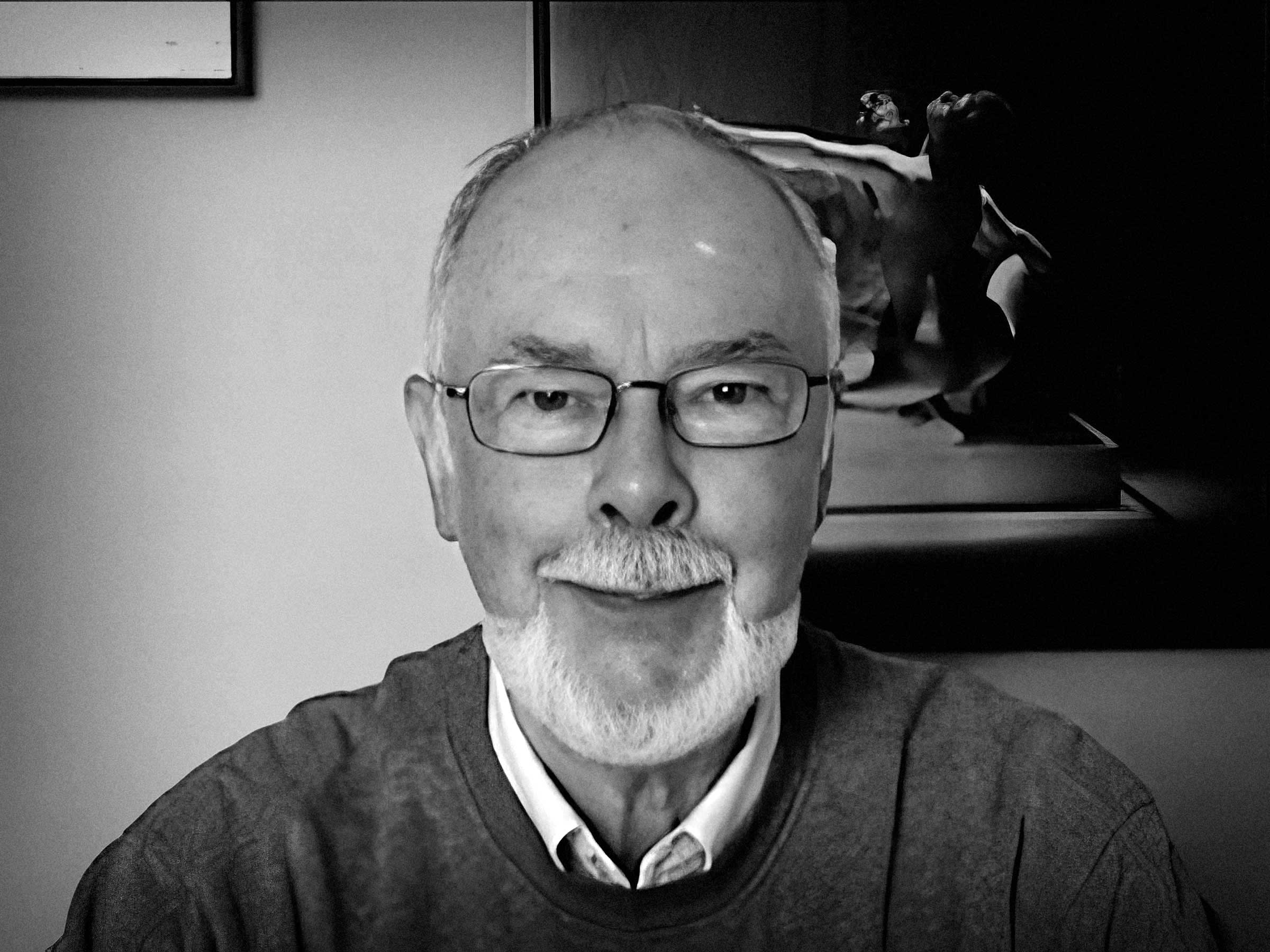
Alan Cunliffe
Here is Alan Cunliffe talking to Patricia Linton, founder and director of Voices of British Ballet. Inspired by watching pantomimes with his mother at the Harrow Coliseum in the 1950s, Cunliffe broke with the family military tradition and decided to pursue life as a dancer. He is another terrific example of the grit and sticking power needed to come close to one’s dreams. In this episode, which was recorded in 2013, Cunliffe takes us through some early points in his dancing career. His story is also a good reminder that there are many things in the theatre that one can be part of when it is time to hang up the dancing shoes. In Cunliffe’s case it was dance photography. The interview is introduced by Jane Pritchard.
First published: May 26, 2026
Biography
Alan Cunliffe was born into a military family in Portsmouth in 1937. When he was a child, he often went to see the pantomime at the Harrow Coliseum, and it was there that he first saw Ballet Rambert and became fascinated by dance. Alan left school at the age of 15 and became a window dresser but regularly took Saturday morning ballet classes with Barbara Vernon and John Gregory. His first dancing job was with Welsh National Opera. He then joined The Royal Ballet Upper School and, two years later in 1960, joined Ballet Rambert.
His four years with Ballet Rambert was followed by a short time with Sadler’s Wells Opera Ballet. During his dancing years, Cunliffe had developed a love of photography. He became apprenticed to the great dance photographer, Anthony Crickmay, and after some time as Crickmay’s assistant, he opened his own photographic studio. He remained passionate about dance photography for the rest of his life.
Transcript
in conversation with Patricia Linton
ALAN CUNLIFFE: Well, I was born in Portsmouth in 1937. Basically, I come from a military family. My brother was a boy soldier. He followed my father’s footsteps and he was a boy soldier as well. So, there was no kind of link to theatre apart from my grandmother, who was a Gaiety girl [a performer at London’s Gaiety Theatre], and she was rarely there, apparently. So my father was brought up by some neighbours who they called Aunt and Uncle.
PATRICIA LINTON: She was travelling?
ALAN CUNLIFFE: She was travelling all the time and [was] probably thought a bit risque.
PATRICIA LINTON: Right. So if it rubbed off, it must have been in the genes?
ALAN CUNLIFFE: That’s right. I’m convinced of that, actually. It must be in the genes. Yes. I mean, otherwise, there was no connection to theatre at all. The interest in theatre came purely from being taken to pantomimes. For me, that was magic. We’d sit right at the top of the back of the gallery, but I’d be absolutely transfixed and my mother would keep nudging me saying they were enjoying it. I was sure, but I was absolutely transfixed by it and, of course, loved anything to do with the fairies flying and all that sort of thing, you know, and all those special effects which were kind of limited in those days. But nevertheless, to me it was just magic. There was a local theatre – the Harrow, Harrow Coliseum it was called. I think it’s a supermarket now. And that was really, in a way, my lifeline to the theatre, because when I became a teenager, I would take myself to the Harrow Coliseum every week to see whatever was on. And, dare I say, I actually saw Ballet Rambert there for the first time with a piano accompaniment. And dear Gillian Martlew and John Chesworth were doing the Second Act pas de deux from Swan Lake to [a] piano. And Gillian always joked, she said, because she couldn’t do in the pirouettes, she could only do two turns. And she was meant to, I think, go up to three or four turns. But it didn’t happen.
PATRICIA LINTON: So this must have been the early [19]50s?
ALAN CUNLIFFE: It must have been. Yes. Yes, the early 50s.
PATRICIA LINTON: Had you had any dance lessons by this time?
ALAN CUNLIFFE: No.
PATRICIA LINTON: Had you thought about it?
ALAN CUNLIFFE: Nothing. Nothing at all? No.
PATRICIA LINTON: You were just [at] an ordinary academic school?
ALAN CUNLIFFE: Yes. I went to a secondary modern school. And in those days when you left school, you would talk to the careers, kind of superviser. And when I said I want to go into theatre of course, she thought, probably thought I was mad, you know? So, she said, “Well, let’s see. Let’s think about this”. And eventually she realised I was artistic, so she said, “I think you could be a window dresser”, so that’s what… that was my first job. I left school at 15 and became a window dresser. I didn’t much like it because I still yearned for theatre, really. I was a window dresser at C&A’s, and it wasn’t until probably after three years that as, as a sort of, it was an apprenticeship, really, as a window dresser, that a friend there took me to the ballet for the first time and it was really just like A Chorus Line. I saw the ballet and I can remember that. I can remember it was Les Patineurs and with Harold Turner doing his à la seconde pirouettes here as the curtain came down and that was it. I looked at that and I thought I could do that! But that was the turning point, and suddenly I thought, “OK, I’ll find a little ballet school somewhere”. And hence Barbara Vernon and John Gregory.
PATRICIA LINTON: She was your first teacher then?
ALAN CUNLIFFE: That’s right.
PATRICIA LINTON: Oh, tell me where she was? Where was her studio?
ALAN CUNLIFFE: This was in a church hall in Chelsea. It was near South Kensington. I’d started doing Saturday morning classes with the children.
PATRICIA LINTON: Did you know… do have shoes and tights, and all those sorts of things?
ALAN CUNLIFFE: Oh, yes! I had to buy those things. And I’ve got a feeling which was rather odd, actually. My mother knitted my first pair of tights and we used to laugh about doing the gusset. So, yes, that was really homemade tights with shoes I had to buy. It was rather odd because I was the only 16-year-old in the class with these children.
PATRICIA LINTON: So, Barbara Vernon, she was taking the class?
ALAN CUNLIFFE: Yes.
PATRICIA LINTON: And had you met John – her husband – John Gregory at this point?
ALAN CUNLIFFE: Yes, I had met him. I had met him. And I think he used to teach, because on Saturdays they would do classical [ballet] in the morning and in the afternoons it would be character work. So, they did kind of Spanish and Russian mazurkas, and things like that. I was there for a year, and eventually Barbara said, “I think you should start working full-time”. And that was the turning point, when I had to decide whether to give up work at C&A’s. So, I went out and worked in the evenings to support myself and pay the fees, and to still give my mother and father some money for food. I sold programmes in Stoll Moss Theatres. Yeah. I mean, it was a late start. I mean, I was already then by the time I went full-time – I was 17.
PATRICIA LINTON: And could we talk about the sort of styles that Barbara… did you know what you were learning?
ALAN CUNLIFFE: Did you not really know part of them? But the fact that it was the School of Russian Ballet and it was affiliated to the Federation of Russian Classical Ballet. So, all those schools had [Nicholas] Legat training, basically. So, I wasn’t totally aware of what that meant at that point, but it was important, I think, and I knew it was different from the Royal Academy [of Dance], you know. It’s a different way of working. It was different in ways of épaulement, for instance, you know. So, the way they would move their shoulders and the back bends, and all that. I knew that it was different from the kind of Royal Academy style. And they sort of told me that, you know?
PATRICIA LINTON: Yes, they were tremendous believers, weren’t they, in the Russian way of teaching up until [Agrippina] Vaganova.
ALAN CUNLIFFE: Yes, that’s right.
PATRICIA LINTON: They thought this was the real Russian [style of ballet], didn’t they?
ALAN CUNLIFFE: That’s right. Yes.
PATRICIA LINTON: Your parents were still quite accepting of what was going on?
ALAN CUNLIFFE: Sort of. I think sort of. I doubt whether they were very keen, certainly.
PATRICIA LINTON: You weren’t aware of them, sort of in corners and discussing it?
ALAN CUNLIFFE: No, I don’t think so. But it wasn’t until… Well, of course, the first job I got managed to get was the Welsh National Opera, and it was, I think for two weeks at Llandudno or somewhere like that. That was kind of quite exciting, you know.
PATRICIA LINTON: What did you actually do with them? Can you remember?
ALAN CUNLIFFE: Oh, Die Fledermaus, Faust. We rehearsed in quite a big studio in London, and by the time we got to the the theatres, they were tiny. Yes, the stage was quite small. And therefore all those sort of dances we’d rehearsed, we couldn’t do because we were elbow to elbow. And, of course, we’d all be finished up giggling, you know, and all that, fortunately.
PATRICIA LINTON: So, you’re on your way back to London…
ALAN CUNLIFFE: Yes. And I had no idea. But one of the dancers with the Welsh Opera suggested that I should audition for The Royal Ballet School. I didn’t much go with the idea, but afterwards I thought, “Well, maybe that’s not a bad idea”. So, I wrote to the school and they replied and said, “Come and audition”. And to my delight, I got in.
PATRICIA LINTON: Now, I’m just working this out. You were 22 at this point?
ALAN CUNLIFFE: I must have been, yes.
PATRICIA LINTON: And this was fine by the school, was it?
ALAN CUNLIFFE: Yes.
PATRICIA LINTON: They wanted men?
ALAN CUNLIFFE: Yes, that’s it. That’s it, really.
PATRICIA LINTON: So you join presumably in September and the New Year?
ALAN CUNLIFFE: I think it was, yes.
PATRICIA LINTON: And now your memories of it. We’re in… the building is at 45 Colet Gardens in Barons Court. That’s it. And can you remember your first class, your first teacher, there?
ALAN CUNLIFFE: Well, my first teacher was Harold Turner.
PATRICIA LINTON: The man who’d given you inspiration...
ALAN CUNLIFFE: That’s right. That’s right. Yes, that was very special.
PATRICIA LINTON: Did you notice now a difference in the training from your classes with Barbara?
ALAN CUNLIFFE: Not really, no. No, I didn’t really see the difference in that respect. It seemed to me there was more discipline at The Royal Ballet School and suddenly it felt very professional. A notice would go up on the board, the students board. And, you know, to tell you where you might be – a rehearsal for being in an opera, or something, and when you had to be there. So, this was kind of very professional compared to Barbara and John, of course, you know.
PATRICIA LINTON: So, now you’ve got the full gamut of training: pas de deux…
ALAN CUNLIFFE: Yes. And, of course, we had to learn, you know, solos from the classics and all that sort of thing.
PATRICIA LINTON: General repertoire.
ALAN CUNLIFFE: Yes.
PATRICIA LINTON: And character work, did you do?
ALAN CUNLIFFE: Character work. Yes, and I seem to remember we did folk dancing. Which was often things like, uh… Well, that dance where they hit the poles and I didn’t like that much because of… Morris dancing, that’s it!
PATRICIA LINTON: Which, of course, is something that [Ninette] de Valois would have liked to, the folk dancing. But why are you aware of de Valois? Did you ever see her at a school?
ALAN CUNLIFFE: Oh, yes. Yes.
PATRICIA LINTON: And your impressions were?
ALAN CUNLIFFE: Well, it was kind of frightening, you know…
PATRICIA LINTON: Because?
ALAN CUNLIFFE: Well, she had kind of total power, I think. Well, she did have total power in those days.
PATRICIA LINTON: Did you feel that, how? Just in the way she walked down the corridor even?
ALAN CUNLIFFE: I think so, yes. I think it was yes. It was really the way everyone else reacted, you know? So, she came into class, she would come into class and just sit and watch. And you could tell that everyone, you know, were making an extra effort. And I think she actually… One or two things that I was doing, rond de jambe or something, and she approved of that. And I thought, “Ooh good”, you know, in there. Because everyone was out to be approved by her, you know, so that would be a good mark down.
PATRICIA LINTON: I wonder if she knew that you’d been trained by Barbara because, of course, de Valois also studied with Legat.
ALAN CUNLIFFE: Oh, yes. No, I’m not sure about that, actually. I wonder.
PATRICIA LINTON: Yeah, she’s the sort of person who would have done their homework on that.
ALAN CUNLIFFE: Yes, that’s right. No, it was a very happy period. And I was very serious about being, you know, doing my very best and that everything was going to work.
PATRICIA LINTON: And you mentioned that you sometimes appeared as extras in the opera?
ALAN CUNLIFFE: Oh, yes. That was wonderful. I know. It was suddenly I was here. I was on Covent Garden stage, you know, and it was amazing.
PATRICIA LINTON: It does seem extraordinary leaving school at 15 and three years as a window dresser, never having danced a step in your life by your early 20s, you’re on Covent Garden stage.
ALAN CUNLIFFE: It is. Yes, it is. It is, really.
The transcript of this podcast may have been lightly edited for ease of reading.
You may also like...
Ernest Tomlinson
Jill Tookey